Art Blocks
A platform where generative art scripts live on-chain and each mint deterministically renders a unique output from the transaction's token hash.
▶ Run interactive simulation animated mechanism with editable parameters
How it works onchain
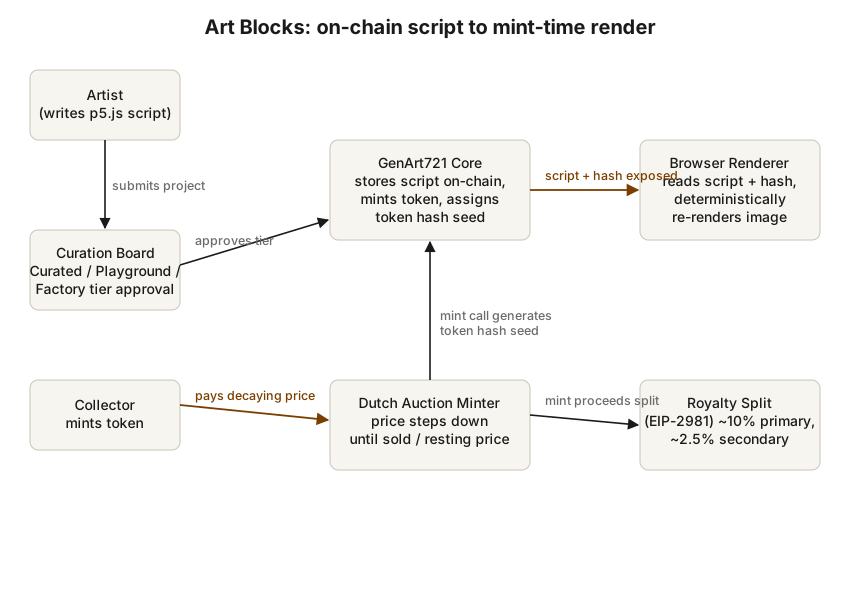 Open full-size diagram
Summary
Art Blocks is a Houston-founded platform, created by Erick Calderon ("Snowfro"), that turns generative art into a fully on-chain, mint-time experience. Rather than selling pre-rendered images, artists deploy an algorithmic script; when a collector mints, the transaction produces a unique token hash that seeds the script and deterministically renders a one-of-a-kind output. The platform is credited with defining the "on-chain generative art" category and drove one of the most intense speculative episodes of the 2021 NFT boom. Calderon launched the flagship Chromie Squiggle project in November 2020, with the broader curated platform reaching wide adoption through early-to-mid 2021. Landmark collections such as Tyler Hobbs' Fidenza and Dmitri Cherniak's Ringers became blue-chip generative art, some pieces reaching multi-million-dollar secondary prices.
Design (Mechanism)
The core innovation is the separation of the deterministic art script from the randomness source. An artist writes code (typically JavaScript, often with p5.js) that defines the rules and parameter space of a collection. The script is stored on-chain (Art Blocks states ~90% of collections are fully on-chain including dependencies). At mint, the smart contract generates a token hash — a pseudo-random value derived from the mint transaction — which is passed into the script as the seed for all randomness. The same hash always regenerates the same image, so the artwork can be reconstructed "with just a web browser and blockchain access," while remaining unique and unrepeatable across the collection.
Distribution used several sale formats. The signature mechanism was the Dutch auction: price starts high and steps down at fixed intervals until reaching a resting price or selling out. This was introduced partly to suppress gas wars and divert value from block producers back to artists (per ARTnews reporting on Calderon's efforts to cool the market). Reported economics included ~10% primary and ~2.5% secondary royalties, with a portion of primary proceeds directed to charity in some drops.
Art Blocks organized supply through curation tiers. "Curated" was the flagship, board-vetted collection; "Playground" (2021-2022) let previously curated artists release non-curated work; and "Factory" (2021-2022) was open to a broader set of artists. These later evolved into "Presents" (2022-2024), and today into "Studio" (artist self-publishing) and "Engine" (white-label/brand partnerships). The contract stack evolved from GenArt721 (Solidity 0.5.x) to GenArt721CoreV3 (0.8.x), reflecting maturation of the minting and royalty architecture.
Outcome
Outcome status: major_success. Art Blocks became the canonical home of on-chain generative art and a category-defining primary marketplace. During the August 2021 peak it posted enormous volume (a single day reportedly near $69M), and individual works reached headline prices: Fidenza #313 sold for 1,000 ETH (~$3.3M), Ringers pieces traded in the multi-million range, and platform records included a ~$5.8M sale reported by The Block. The platform legitimized generative artists as fine-art figures, culminating in institutional validation such as Sotheby's launching a Gen Art program with Art Blocks and hosting Dutch auctions.
Like the rest of the NFT market, Art Blocks volumes fell sharply after 2022 as speculative demand collapsed, but the platform continued operating and shipping (Studio, Engine, ongoing curated drops), retaining strong cultural standing among generative-art collectors.
Why it worked
- True on-chain provenance of the process, not just the image. Storing the script on-chain and reconstructing outputs from the token hash made the art verifiably deterministic and permanent, which resonated with collectors valuing longevity.
- Mint-as-performance. Generating the artwork at purchase time turned minting into a live, unpredictable event, creating scarcity narratives and social excitement.
- Curation as quality signal. The curated tier concentrated attention on strong artists (Hobbs, Cherniak, others), producing recognizable blue-chip collections that anchored the whole platform's reputation.
- Artist-favorable economics and legitimacy. Meaningful royalties, charitable framing, and institutional partnerships (Sotheby's) elevated generative coders into recognized fine artists.
Limitations and criticisms
Several dynamics tempered Art Blocks' trajectory:
- Speculative overheating. The 2021 frenzy produced gas wars, bots, and flipping that the founder himself publicly tried to cool via Dutch auctions and curation changes — a sign the mechanism struggled to handle demand cleanly.
- Cyclicality. Volumes and floor prices fell dramatically in the 2022+ downturn, exposing dependence on macro NFT sentiment.
- Royalty enforceability. As with the broader ecosystem, on-chain secondary royalties became difficult to enforce once marketplaces made them optional, weakening a key artist-revenue assumption.
- Curation bottleneck and centralization. A board-gated curated tier concentrated value and created access/gatekeeping tension as the platform scaled.
Lessons
- Deterministic, on-chain generation (script + token-hash seed) is a durable primitive: it delivers provenance, permanence, and uniqueness simultaneously, and has been widely imitated.
- Distribution mechanism design matters as much as the art — Dutch auctions were adopted specifically to manage gas wars and speculative access, showing that mint UX is a first-class design lever.
- Curation creates concentrated value but also concentrated risk and gatekeeping; a platform's reputation can become tightly coupled to a handful of flagship collections.
- Royalty-based creator economics are fragile when enforcement lives off-protocol; mechanisms that assume perpetual secondary royalties should plan for erosion.
Redesign (EDITORIAL — hypothesis, not fact)
This section is speculative analysis, not established fact. If rebuilding Art Blocks today, a stronger design might: (1) make royalty capture more robust by settling primary and secondary economics inside the mint/transfer path or via allow-listed marketplaces, rather than relying on voluntary marketplace honoring; (2) decentralize curation with a reputation- or stake-weighted committee plus transparent on-chain rationale, reducing gatekeeping tension while preserving quality signal; (3) generalize distribution beyond Dutch auctions with sybil-resistant, gas-insensitive mint queues (e.g., commit-reveal allocations or off-peak settlement) to blunt bot/gas-war dynamics; and (4) strengthen permanence guarantees by mandating fully on-chain dependencies for all tiers (not ~90%) and versioning script runtimes on-chain so renders remain reproducible for decades. A further hypothesis: pairing collections with optional creator-controlled secondary-royalty escrow could restore artist revenue resilience without depending on external marketplace policy. These are conjectures for discussion, not claims about Art Blocks' actual roadmap.
Sources
- About Art Blocks (official) — primary (docs)
- Erick Calderon (Snowfro) artist page (official) — primary (docs)
- Art Blocks GenArt721 core contract (Etherscan, verified) — primary (contract)
- GenArt721CoreV3 (Etherscan, verified) — primary (contract)
- As Sales Exploded on Art Blocks, Its Founder Looked for Ways to Cool the Fervor (ARTnews) (news)
- NFT platform Art Blocks breaks record with $5.8 million sale (The Block) (news)
- Art Buyer Turned $1,400 Into $3.3 Million (Decrypt, Fidenza) (news)
- Sotheby's Launches Gen Art Program With Art Blocks (nftnow) (news)
- Snowfro's Journey Into a Digital Art Revolution (nft now retrospective) (retrospective)
Related experiments
Last verified: 2026-07-26 · Spot an error? Suggest a correction