Words3
Fully onchain Scrabble-style word game by Small Brain Games where letter prices float via VRGDAs and the ETH spent on letters is redistributed to players pro-rata by score.
▶ Run interactive simulation animated mechanism with editable parameters
How it works onchain
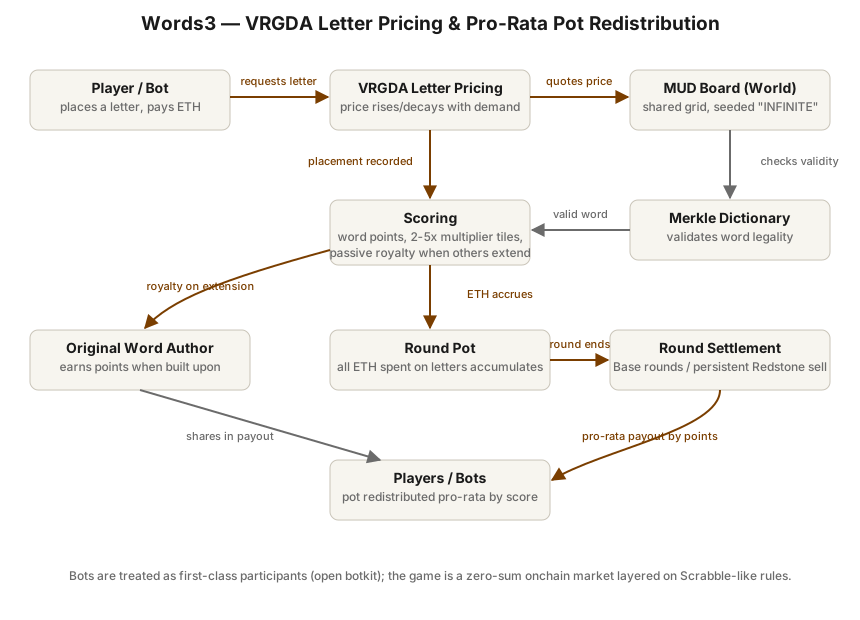 Open full-size diagram
Summary
Words3 is "onchain Scrabble with crypto-native twists": a fully onchain, PvP word game built by the pseudonymous indie studio Small Brain Games using Lattice's MUD framework. Players compete on a shared grid seeded with the word "INFINITE," paying ETH for every letter they place. Letter prices are not fixed — each letter is priced by its own VRGDA (variable-rate gradual Dutch auction), so heavily demanded letters get more expensive and neglected ones decay in price. Points come from playing valid words (with 2–5x multiplier tiles), plus passive points when other players build on your words. In the round-based versions, all ETH spent during a round was pooled and redistributed pro-rata to players by score/profitability at the end — making the game a zero-sum (minus nothing, since the pot returns to players) skill-and-mechanism contest over a common pot. Announced in late 2022, playtested on Lattice's testnet through 2023 (upgrading from MUD v1 to MUD v2), Words3 ran mainnet rounds on Base starting August 9, 2023, and relaunched in May 2024 as a persistent "infinite board" world on the MUD-optimized Redstone L2, where points could be sold for ETH continuously rather than only at round end. Its contracts are fully open source, and the developer explicitly embraced bots by publishing botkit resources.
Design (Mechanism)
- Board and placement. A shared Scrabble-like grid begins with a seed word ("INFINITE"). Any player may extend the board by paying ETH per letter placed; words must be dictionary-valid (word validity checked onchain, with the dictionary committed via Merkle proofs — the contracts vendor the
murkyMerkle library). - VRGDA letter pricing. Each letter's price follows a variable-rate gradual Dutch auction: prices rise when letters are bought faster than the target issuance schedule and decay when demand lags. This turns letter supply into a self-balancing market — a crypto-native replacement for Scrabble's fixed tile bag.
- Scoring. Valid words earn points based on letters used; certain grid squares carry 2–5x multipliers. Crucially, players also earn points when others later build off their words — a royalty-like "passive point income" that rewards building juicy, extendable positions rather than closed-off ones.
- Settlement. In round-based play (timed rounds, e.g. the 4-day Base round of August 2023), the ETH spent on letters accumulates in a pot that is redistributed pro-rata by points at round end; the objective is profitability (earn back more of the pot than you spent). The 2024 Redstone version made the world persistent, with players able to sell accumulated points for ETH on an ongoing basis.
- Infrastructure. Fully onchain logic on MUD (v1, then MUD v2); open-source contracts (
smallbraingames/words3-contracts); deployments recorded in the repo'sworlds.jsoninclude Base (0x227a...49bf) and Redstone chain id 690 (0x1754...24bb). Bots were treated as first-class participants, with the developer publishing a botkit.
Outcome
Words3 shipped, worked, and iterated across three phases: MUD v1/v2 playtests on Lattice's testnet (2022–mid-2023, with community playtest winners like pet3rpan), mainnet rounds on Base beginning August 9, 2023, community-run rounds on Base with WASD and AW Explorers (a @words3xyz community account appeared December 2023), and a persistent relaunch on Redstone's mainnet in May 2024 as one of the chain's launch titles. Scale stayed small: a May 2024 report counted 100+ accounts on the leaderboard, with the top player having spent roughly $900 on tiles and authored words like "OVERZEALOUSLY." No token was launched, no exploit or dispute is on record, and the game earned outsized mindshare in the fully-onchain-games niche relative to its player count. Public activity appears to have wound down after 2024; the studio moved on to other experiments. Precise revenue/volume figures: Unknown / not found.
Why it worked
- Mechanism-first design. VRGDA letter pricing, royalty-style passive points, and pro-rata pot redistribution are all mechanisms that only make sense onchain — Words3 was a genuine crypto-native game rather than a ported one, and it became a canonical showcase for VRGDAs in games.
- Familiar skeleton, novel economy. Everyone understands Scrabble; the learning curve was the economy, not the rules — a good recipe for a financialized game.
- Right infrastructure bets. Building on MUD (and migrating v1→v2, then to Redstone) kept a solo/small team shipping a fully onchain game cheaply, and open-sourcing contracts plus welcoming bots made the game legible and extensible.
Where the design broke
- Tiny audience. Fully onchain games in 2023–24 had a hardcore but very small player base; ~100 leaderboard accounts even after a smooth relaunch shows the ceiling.
- Pay-per-move friction. Paying ETH per letter (plus bridging to Redstone) is a steep ask against free Words-with-Friends alternatives; because the pot is redistributed pro-rata by score, lower-scoring players and slower reaction times transfer ETH each round to higher-scoring players and bots.
- Financialization vs. fun tension. Because pot share tracks scoring efficiency, skilled and automated (bot) players capture a disproportionate share of each round's pot relative to casual players; retention depended on a continuous inflow of new participants funding the pot, which never materialized at scale.
Lessons
- VRGDAs are an elegant onchain substitute for fixed resource supplies (tile bags, item drops): they meter issuance to demand automatically and generate price discovery as gameplay.
- Royalties on composable moves ("earn when others build on your word") are a powerful onchain-native incentive that rewards opening up the game state rather than closing it — a pattern portable to many builder/creator games.
- Zero-sum pot games with open bot access are honest about being PvP markets, but that honesty caps the audience: without a "fun subsidy" or asymmetric roles for casuals, players who consistently score higher capture returns from lower-scoring entrants, which discourages repeat play by newcomers.
- Infrastructure migrations (MUD v1→v2, Base→Redstone) are survivable for a small onchain game if contracts are open source and rounds are short — statefulness across versions matters less when the economy resets each round.
Redesign (EDITORIAL — hypothesis, not fact)
This section is editorial speculation, not a record of the project's plans. A redesign could keep VRGDA letter pricing but split the pot into two streams: a skill pot (pro-rata by points, as before) and a "vocabulary commons" stream paying long-tail royalties to any player whose words remain load-bearing on the board, vesting over weeks to reward board architecture over sniping. Casual retention could come from a free daily letter allowance (sybil-limited via proof-of-personhood or Farcaster identity) so newcomers can play without losing ETH, while whales and bots compete in the priced tier that funds the pot. Bot pressure could be turned into content by requiring bots to register onchain and rendering a public "human vs. machine" leaderboard split. Finally, embedding the game where distribution already exists (e.g., as a Farcaster frame/mini-app with session keys) would attack the real bottleneck — audience, not mechanism.
Sources
- words3-contracts (open-source MUD contracts, incl. worlds.json deployment addresses) — primary (contract)
- words3-contracts-v0 (earlier MUD v1-era contracts) — primary (contract)
- Small Brain launch tweet: 'Introducing Words3, a cryptoeconomic crossword game on @BuildOnBase' (Aug 9, 2023) — primary (archive)
- Words3 official site — primary (docs)
- Everything You Need to Know About Words3 — WASD (analysis)
- The Ultimate Guide to the Small Brain Games Ecosystem — WASD (analysis)
- The Botkits Are Coming — The New World (mirror.xyz) (analysis)
- Onchain Games I Played This Month: July — Four Pillars (playtest report, July 2023) (analysis)
- Glitch Weekly: The new crypto game even your normie friends will want to play (May 2024, Redstone relaunch) (news)
- Redstone Chain officially launches mainnet, announces upcoming games (May 2024) (news)
- words3 community account (@words3xyz) — community rounds with WASD/AW Explorers on Base (archive)
Related experiments
Last verified: 2026-07-27 · Spot an error? Suggest a correction