Loot Survivor
A fully onchain 'Play2Die' arcade dungeon crawler on Starknet where every run, death, and high score lives permanently onchain, funded by pay-per-session token fees.
▶ Run interactive simulation animated mechanism with editable parameters
How it works onchain
 Open full-size diagram
Summary
Loot Survivor is a turn-based dungeon-crawler "onchain arcade machine" and one of the first complex, fully onchain games on any L2. Built in Cairo on Starknet by longtime BibliothecaDAO contributor Loothero (later co-founder/CEO of Provable Games, with Starknetdev), it was the inaugural game of the Realms autonomous-worlds ecosystem and drew its item vocabulary from the 2021 Loot project. The design premise is "Play2Die": each session grants a single life; the player explores procedurally generated encounters, fights beasts, dodges obstacles, and upgrades stats and Loot-style gear until the inevitable death, which is recorded onchain forever. There is no off-chain game state — combat math, loot generation, markets, and the leaderboard all execute in smart contracts. The game shipped as a public alpha in 2023 (Goerli testnet, then Starknet mainnet in late 2023), iterated through a "1.5" version in 2024, and relaunched as Loot Survivor 2 in August 2025 on the Dojo engine with the Death Mountain public dungeon system and a SURVIVOR governance token.
Design (Mechanism)
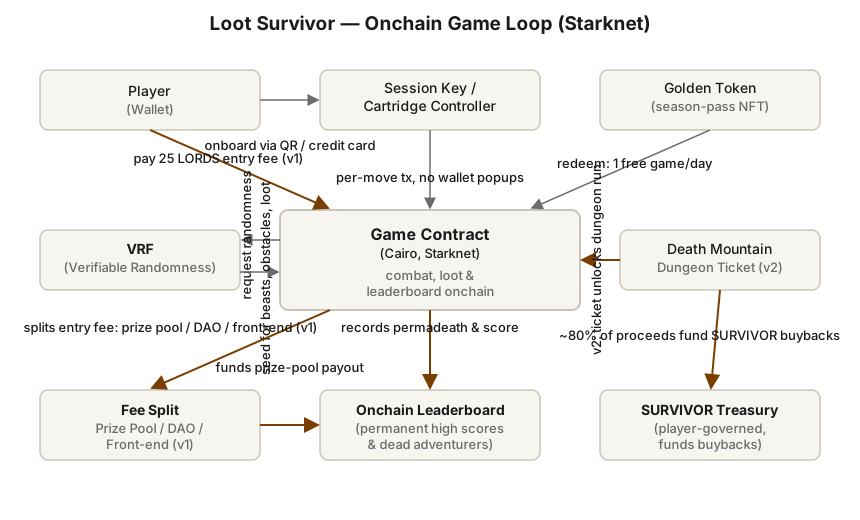
- Arcade pay-per-session economics. Instead of NFT asset sales, monetization mimics a coin-op cabinet: players pay a per-game entry fee (25 LORDS, roughly $2–3, in v1). Fees were split between a leaderboard prize pool for top scorers, the game's DAO, and the front-end client provider — an early example of protocol-level client incentives in gaming.
- Golden Token. An NFT functioning as a season pass: holders get one free game per day instead of paying per session, creating a capitalized claim on future play.
- Permadeath and a permanent leaderboard. One life per session, ~10-minute average runs, difficulty scaling without a win condition. High scores are immutable onchain records, solving the arcade problem of localized, losable leaderboards, and dead adventurers persist as onchain artifacts.
- Fully onchain simulation. Six/seven core stats (Strength, Vitality, Dexterity, Wisdom, Intelligence, Luck, plus Charisma in later versions), rock-paper-scissors combat between weapon types (Blade/Bludgeon/Magic) and armor materials (Cloth/Hide/Metal), 75 beasts, 75 obstacles, and 101 tiered Loot items — all resolved deterministically in Cairo contracts, with VRF supplying randomness so runs can't be precomputed.
- UX abstraction. Arcade Accounts / session keys (later Cartridge Controller with embedded wallets) let players start via QR code or credit card without per-action wallet pop-ups — critical for a game requiring a transaction per move.
- v2 additions (Aug 2025). Death Mountain: a token-agnostic, no-code public onchain dungeon system any project can reskin via contract calls; dynamically priced dungeon tickets with ~80% of proceeds funding SURVIVOR buybacks into a player-governed treasury; SURVIVOR token emissions to players; STRK "Wanted Beast" bounties and Budokan onchain tournaments.
Outcome
Loot Survivor became the flagship demonstration that non-trivial games can run entirely on an L2, and was heavily used by StarkWare as a benchmark and showcase — its transaction load was a meaningful stress test of Starknet fees, and it directly motivated gas-efficiency work (state packing of an entire adventurer into minimal storage). It seeded a broader "onchain arcade" genre and the Provable Games studio spin-out from BibliothecaDAO. Loot Survivor 2 launched in August 2025 as a full release; reporting around launch cited roughly $250,000 in in-game sales in its first five months, seasonal SURVIVOR reward pools (~2.26M tokens), and STRK tournament/bounty prize pools. Audience remains niche-crypto-native rather than mainstream, and the game is still operating as of mid-2026. Outcome: ongoing.
Why it worked
- Genre fit for chain constraints. A turn-based roguelike with ~10-minute sessions matched what an L2 could actually execute, instead of fighting blockchain latency with a real-time design.
- Death as content. Permadeath converted the blockchain's core property — irreversibility — into the emotional core of the game rather than a liability.
- Arcade economics over asset speculation. Cheap, repeatable pay-per-session fees with a skill-based prize pool created honest revenue without requiring an NFT bull market.
- Ecosystem leverage. Loot's CC0 item lore, BibliothecaDAO/Realms distribution, LORDS token utility, and StarkWare's promotion gave a tiny team outsized reach; the open MIT codebase made it a reference implementation for Cairo/Dojo game developers.
Limitations and criticisms
- Gas and UX friction in v1. At launch, gas could run $5–10 per game versus a ~$2.50 entry fee — the infrastructure cost dwarfed the intended economics until Starknet fees fell.
- Niche ceiling. Roguelike-with-real-money appeals to a small crypto-native audience; ~$250k of sales over five months for v2 is strong for fully onchain gaming but tiny by game-industry standards.
- Skill-extraction pressure. Prize-pool leaderboards attract optimizers and bots; deterministic onchain logic makes solver-assisted play hard to prevent, compressing returns for casual players.
- Platform dependence. The game's economy leans on Starknet incentives (STRK bounties) and ecosystem tokens (LORDS, SURVIVOR), tying its health to one L2's fortunes.
Lessons
- Design games around blockchain properties (finality, permanence, transparency) instead of hiding them: permadeath and immutable leaderboards are mechanics only a chain can credibly offer.
- Pay-per-session arcade economics is a viable alternative to NFT-asset speculation for onchain games, but only once execution costs fall well below the ticket price.
- Session keys / account abstraction are prerequisites, not nice-to-haves, for any game requiring a transaction per action.
- Shipping a fully open, fully onchain game turns it into public infrastructure: Death Mountain's "anyone can fork the dungeon" model shows game logic itself becoming a composable protocol.
- Iterating in public (testnet alpha → 1.5 → 2.0 over two years) works in crypto gaming, where the community treats alphas as seasons rather than broken products.
Redesign (EDITORIAL — hypothesis, not fact)
This section is editorial speculation. A redesign could attack the solver problem head-on: commit-reveal action submission plus periodically rotated, VRF-seeded rule variants would keep deterministic onchain logic while making offline solvers stale each season. Prize pools could be split into skill brackets (ELO-gated leaderboards) so casual players are not farming for pros, with a rake redirected to the treasury only above a revenue floor. The Golden Token concept could generalize into transferable "cabinet shares" — NFTs entitling holders to a slice of session fees from a specific front-end or dungeon, formalizing the client-incentive split. Finally, publishing Death Mountain as a cross-chain standard (mirrored state proofs to Ethereum L1) would hedge the single-L2 dependence and let dead adventurers become portable artifacts across the Lootverse.
Sources
- Loot Survivor — Provable Games docs — primary (docs)
- Loot Survivor contracts — Provable Games docs — primary (contract)
- BibliothecaDAO/loot-survivor GitHub repository — primary (contract)
- SURVIVOR Token — Provable Games docs — primary (docs)
- Loot Survivor and the Emergence of Onchain Arcades — The Loot Herald (analysis)
- Loot Survivor and Influence — two fully onchain games on Starknet (analysis)
- Let's Play: Loot Survivor 2 — Bankless (news)
- Loot Survivor — Indie Game Press Kit (IMPRESS) (archive)
- Loot Survivor: Starknet Game Insights — Braavos (analysis)
Related experiments
Last verified: 2026-07-27 · Spot an error? Suggest a correction