Gitcoin Quadratic Funding
Gitcoin's Grants Program pioneered real-world quadratic (matching) funding, distributing a shared matching pool to open-source and public-goods projects in proportion to the breadth of their small-donor support.
▶ Run interactive simulation animated mechanism with editable parameters
How it works onchain
 Open full-size diagram
Summary
Gitcoin Quadratic Funding is the largest and longest-running real-world deployment of quadratic funding (QF), the public-goods financing mechanism formalized in the 2018 "Liberal Radicalism" paper by Vitalik Buterin, Zoë Hitzig, and E. Glen Weyl. Through its recurring Gitcoin Grants Program — launched in early 2019 by Gitcoin, the company founded by Kevin Owocki in 2017 — Gitcoin distributes a philanthropist-provided matching pool to open-source software, DeFi infrastructure, community, and climate/"regen" projects. The core idea: allocate matching funds in proportion to the number of unique contributors a project attracts, not the raw dollar total, so that a project funded by many small donors is amplified more than one funded by a few whales. Per Gitcoin's own reporting, the program has distributed over $60 million to more than 3,700 projects, and helped early-stage projects such as Uniswap, Optimism, Prysm, and WalletConnect reach sustainability. It is widely treated as the canonical proof that mechanism-design theory can operate at scale onchain.
Design (Mechanism)
Standard crowdfunding rewards large gifts; QF instead computes a project's matching allocation as the square of the sum of the square roots of individual contributions:
match ∝ (Σ √c_i)² − Σ c_i
Because contributions are square-rooted before summing and then squared, breadth of support dominates depth. A grant with 100 donors of $1 receives far more matching than one with a single $100 donor. Gitcoin's first rounds used a capital-constrained variant ("CLR" — Capital-constrained Liberal Radicalism), because the theoretically ideal match is unbounded, so allocations are normalized to fit a fixed matching pool supplied by sponsors (the Ethereum Foundation and others).
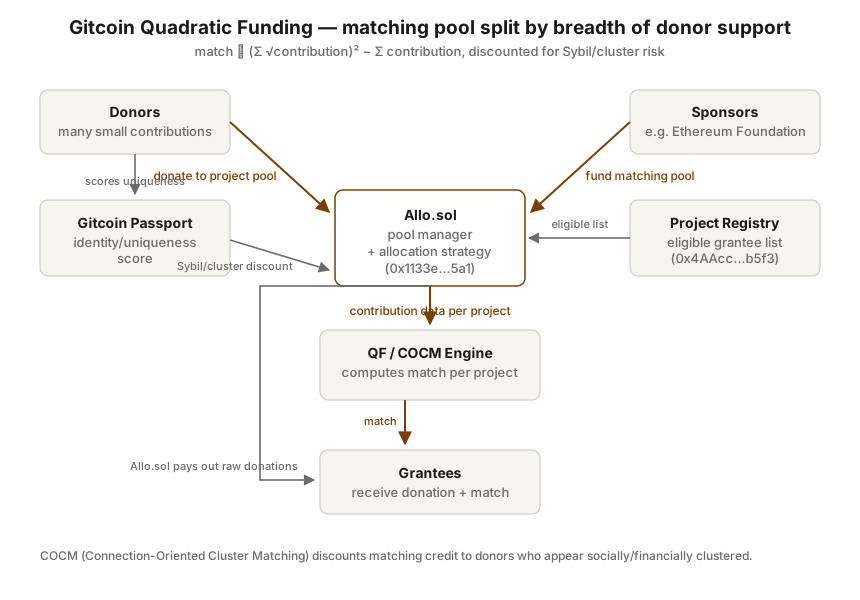
Early rounds ran off-chain matching computation with on-chain contributions; the open-source calculation logic lives in gitcoinco/quadratic-funding. Over time the stack migrated on-chain to Allo Protocol (Allo v2), a modular smart-contract framework separating pool management (Allo.sol, deployed at 0x1133eA7Af70876e64665ecD07C0A0476d09465a1), a project registry (0x4AAcca72145e1dF2aeC137E1f3C5E3D75DB8b5f3), and pluggable allocation strategies, deployed across Ethereum, Optimism, Arbitrum, Base, Polygon, Celo, Avalanche, Fantom, and Scroll.
Because QF's matching multiplier is enormous for broad support, it is acutely vulnerable to Sybil attacks (one actor splitting into many fake donors) and collusion. Gitcoin's defenses evolved into a layered system: an ML-based Sybil-detection pipeline (run with BlockScience) with human review, Gitcoin Passport identity scoring, pairwise coordination discounting, and Connection-Oriented Cluster Matching (COCM), which reduces the matching credited to donors who appear socially clustered, blunting coordinated manipulation.
Outcome
Status: major_success — with important caveats. Gitcoin Grants ran continuously from 2019 across dozens of rounds, growing matching pools from ~$25k in Round 1 to roughly $965k by Round 11 and cumulatively distributing $60M+ to 3,700+ projects. It made "quadratic funding" a household term in crypto governance and seeded a broad ecosystem of forks and derivative funding rounds. In May 2025, however, Gitcoin sunset the Grants Stack software product and its Grants Labs business unit (end of life May 27, 2025), citing operating costs outpacing revenue. Crucially, this was a wind-down of the product/company arm, not the mechanism: the Grants Program continues, Allo contracts remain deployed, open-source and forkable, and historical data is preserved via Open Source Observer. The mechanism itself is a success; the commercialization of the tooling business underperformed.
Why it worked
- Right mechanism at the right time. QF gave a rigorous, credibly-neutral answer to "how should a community fund shared infrastructure?" — a genuine pain point in Ethereum's public-goods-heavy ecosystem.
- Real matching capital. Deep-pocketed sponsors (notably the Ethereum Foundation) supplied matching pools, turning theory into meaningful payouts and giving donors a strong reason to participate.
- Ritualized, recurring rounds built habit, community identity ("GG" rounds), and a flywheel where past grantees became future funders.
- Iterative, transparent anti-fraud research (published Sybil analyses, COCM, Passport) kept the mechanism credible despite constant attack pressure.
Limitations and criticisms
- Sybil/collusion is a permanent tax. QF's amplification of breadth is exactly what makes fake-account and cluster attacks profitable; defenses reduce but never eliminate it, and each round requires costly human-in-the-loop review.
- Identity friction vs. resistance trade-off. Passport-style gating deters real small donors and never fully stops determined attackers — an unresolved tension.
- The tooling business never covered its costs. The Grants Stack software product had strong ecosystem validation but "operating costs significantly outpaced revenue," leading to its 2025 sunset — a reminder that a mechanism working well does not guarantee a viable product business built around it.
- Matching-pool dependency. Payouts hinge on external sponsors; the mechanism does not generate its own sustaining revenue.
Lessons
- A sound mechanism and a sustainable business are different problems. Gitcoin proved QF works at scale yet still had to wind down the company arm building the software — mechanism-design success does not imply a viable product P&L.
- Any mechanism that rewards breadth of participation invites identity attacks. Sybil resistance is not a feature you ship once; it is a permanent, evolving cost center, and honest QF deployments must budget for continuous adversarial defense (Passport, COCM, ML + human review).
- Credible neutrality plus recurring ritual builds ecosystems. Predictable, transparent, repeated rounds created durable community coordination that outlasted the tooling company itself.
- Keep the mechanism decoupled from the operator. Because Allo contracts are on-chain, open-source, and forkable and data was preserved externally, the mechanism survived the company's retrenchment.
Redesign (EDITORIAL — hypothesis, not fact)
The following is the researcher's editorial hypothesis, not established fact.
A next-generation Gitcoin-style QF might attack the two structural weaknesses — Sybil economics and funding sustainability — at the protocol layer rather than bolting on defenses. First, move identity from a scored allowlist to proof-of-personhood with privacy (e.g., zero-knowledge attestations of uniqueness) so that one-human-one-voice is enforced cryptographically at contribution time, shrinking the Sybil surface without doxxing donors or forcing centralized ML adjudication after the fact. Second, make cluster/collusion resistance native: COCM-style discounting could run as an on-chain allocation strategy with published, deterministic parameters, so results are verifiable rather than trust-me outputs of an off-chain pipeline. Third, address the matching-pool dependency by pairing rounds with endowment-style or protocol-fee-funded matching (e.g., a share of sequencer/app revenue routed automatically), reducing reliance on episodic philanthropy. Finally, separate "the mechanism" from "the operator" by treating QF rounds as a fully credibly-neutral public utility — permissionless round creation, standardized on-chain settlement, and a thin, endowment-funded steward — so the mechanism's survival never again depends on a single company's operating budget. The core bet: QF's fairness properties are worth preserving, but its long-term legitimacy depends on making both sybil-resistance and funding self-sustaining and verifiable on-chain, not operationally supervised.
Sources
- Quadratic Funding | Gitcoin (official mechanism page) — primary (docs)
- Allo v2 deployed contract addresses (allo-protocol/allo-v2 README) — primary (contract)
- gitcoinco/quadratic-funding — open-source CLR implementation — primary (contract)
- Liberal Radicalism: A Flexible Design for Philanthropic Matching Funds (Buterin, Hitzig, Weyl, 2018) — primary (analysis)
- Kevin Owocki founder self-identification (Hacker News) — primary (retrospective)
- Gitcoin Grants Round 11 Anti-Fraud Evaluation & Results (BlockScience) (analysis)
- How to Attack and Defend Quadratic Funding (BlockScience / Gitcoin) (analysis)
- Focusing Gitcoin's Future: Sunsetting Grants Stack [EoL May 2025] (governance) — primary (governance)
- Grants Stack Winds Down — What's Changing (Gitcoin blog) — primary (retrospective)
Related experiments
Last verified: 2026-07-26 · Spot an error? Suggest a correction