x402 Protocol
Coinbase-incubated open standard that revives the dormant HTTP 402 'Payment Required' status code so APIs, apps, and AI agents can pay for web resources with stablecoins directly inside the HTTP request/response cycle.
▶ Run interactive simulation animated mechanism with editable parameters
How it works onchain
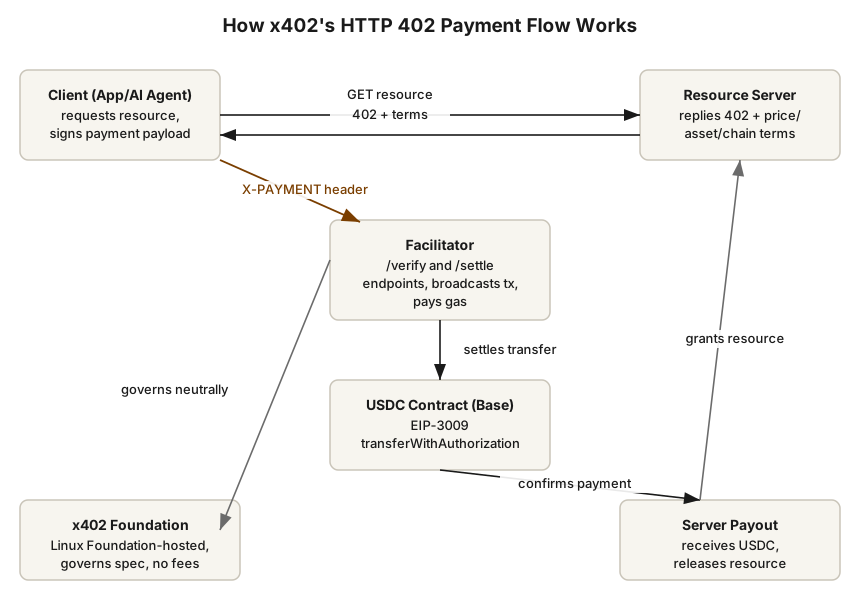 Open full-size diagram
Summary
x402 is an open payment standard, incubated at Coinbase Developer Platform and released on May 6, 2025, that activates HTTP status code 402 ("Payment Required") — reserved in the HTTP spec since the 1990s but never standardized — as a native payment layer for the web. When a client (a human app, an API consumer, or increasingly an AI agent) requests a paid resource, the server replies 402 with machine-readable payment terms: price, accepted token, chain, and destination. The client signs a payment payload, retries the request with the payment attached in an HTTP header, and receives the resource once a "facilitator" verifies and settles the transfer onchain. No accounts, API keys, or card-network intermediaries are required, and the protocol itself charges zero fees. Created by a team led by Erik Reppel (Head of Engineering, Coinbase Developer Platform), x402 was spun toward neutral governance via a Cloudflare–Coinbase foundation announcement in September 2025 and a Linux Foundation-hosted x402 Foundation launched in 2026. By mid-2026 it had processed on the order of 160M+ payments across 14 chains, with the deepest traction on Base.
Design (Mechanism)
The mechanism is deliberately minimal and lives entirely in the HTTP layer:
- 402 challenge–response. A resource server annotates paid routes (often one line of middleware). Unpaid requests get
402 Payment Requiredplus aPaymentRequirementsobject (price, asset, network, pay-to address, scheme). - Signed payment payload. The client constructs and signs a payment — in V1 carried in an
X-PAYMENTheader; V2 (December 11, 2025) modernized this toPAYMENT-SIGNATURE/PAYMENT-REQUIRED/PAYMENT-RESPONSEheaders, freeing the response body for concurrent use. - Gasless settlement via EIP-3009. The canonical "exact" scheme on EVM chains uses USDC's
transferWithAuthorization: the payer signs an authorization offchain; the facilitator broadcasts it and pays gas, so buyers need only stablecoins, not native gas tokens. The protocol deploys no bespoke contracts — it rides existing token contracts. - Facilitator role. A facilitator (Coinbase's CDP facilitator being the largest, but anyone can run one) exposes
/verifyand/settleendpoints, checking the signature and executing settlement. Servers can also verify locally, keeping the design trust-minimized rather than trustless-by-default. - Schemes and extensibility. "exact" (fixed price) shipped first; "upto" (metered usage) was specified as a future scheme. V2 introduced a plugin SDK so new chains (Solana/SVM, Stellar, XRPL) and even legacy rails (cards, ACH) can be added without protocol changes, plus wallet-based identity and reusable sessions.
- Governance. Stewardship moved from Coinbase to an independent x402 Foundation (announced with Cloudflare September 23, 2025; operational under the Linux Foundation in 2026), mirroring how core internet protocols are governed.
Outcome
Ongoing and, so far, the most-adopted attempt ever at HTTP-native micropayments. Chainalysis measured ~100M cumulative x402 transactions on Base alone from near-zero in mid-2025 through Q1 2026; aggregate figures across 14 chains exceeded 160M by May 2026, with Coinbase citing ~169M payments across roughly 590,000 buyers and 100,000 sellers in the first year. x402.org's live tracker showed ~75M transactions and ~$24M volume in a single trailing 30-day window in mid-2026. Adoption spread beyond Base: Cloudflare and AWS embedded x402 at the edge, and the XRP Ledger recorded 1.4M+ agent transactions within weeks of integration. Caveats: a large share of the Q4 2025 spike was speculative "pay-to-mint" memecoin farming (the PING token drove a >10,000% weekly transaction jump), and average dollar volumes remain small relative to card networks — sub-$1 micropayments collapsed from 46% to 4% of value share as $1+ transactions came to dominate (95% by early 2026). Chainalysis found improving quality signals: 4x better tester-to-payer conversion and rising weekly retention.
Why it worked
- It standardized something latent. HTTP 402 already existed in every web stack; x402 gave it a concrete wire format rather than inventing a new rail.
- Perfect timing with agentic AI. Autonomous agents cannot pass KYC or hold credit cards; signed stablecoin payloads over HTTP are exactly agent-shaped. The 2025–26 agent boom supplied instant demand.
- Near-zero integration cost. One line of server middleware, no accounts or API keys, no protocol fees, and gasless UX via EIP-3009 removed nearly every adoption excuse.
- Credible neutrality plays. Handing governance to a Cloudflare/Coinbase-backed, Linux Foundation-hosted body reassured competitors (AWS, Solana, XRPL, Google-adjacent agent stacks) that this was a standard, not a Coinbase product moat.
Limitations and criticisms
Real weaknesses remain: headline transaction counts were inflated by memecoin mint-farming rather than genuine commerce; the collapse of sub-$1 payments suggests true micropayment demand is still unproven; facilitators introduce a centralization/censorship point (most flow through Coinbase's facilitator); and organic revenue per seller remains modest compared to the "payment layer of the internet" framing. Fee-free protocol economics also mean sustainability depends on sponsors, not the standard itself.
Lessons
- Reviving a dormant standard (HTTP 402) is a stronger adoption wedge than inventing a new protocol — distribution beats novelty.
- Machine buyers, not humans, may finally be the customer micropayments always lacked; design for signatures and headers, not checkout pages.
- Gasless meta-transaction patterns (EIP-3009) are essential UX for non-crypto-native payers.
- Speculative token farming can stress-test and market a protocol, but it pollutes metrics — separate speculative from organic volume before declaring product-market fit.
- Early transfer to neutral foundation governance is a deliberate, effective strategy for standards that need adoption by competitors.
Redesign (EDITORIAL — hypothesis, not fact)
This section is editorial speculation. A stronger v3 would (1) ship the "upto"/metered scheme with onchain streaming settlement so agents pay per token/inference rather than per request, unlocking the sub-cent tier that collapsed; (2) decentralize facilitators via a permissionless registry with staked, slashable operators to remove the de facto Coinbase settlement chokepoint; (3) add native privacy (e.g., stealth addresses or note-based payments) since HTTP-header payments currently leak buyer graphs to every server; and (4) bind payments to verifiable delivery — escrowed settlement released on content-hash receipt — so agents are not trivially exit-scammed by paid endpoints that return garbage.
Sources
- x402 GitHub repository (coinbase/x402) — primary (docs)
- x402.org official site (spec, stats, V2 announcement) — primary (docs)
- x402 whitepaper — primary (docs)
- Introducing x402 V2: Evolving the Standard for Internet-native Payments — primary (docs)
- Cloudflare and Coinbase Will Launch x402 Foundation (press release, 2025-09-23) — primary (news)
- Coinbase Developer Docs: x402 Overview — primary (docs)
- Chainalysis: Inside x402 — 100M Agentic Payments on Base (analysis)
- The Block: Coinbase-incubated x402 payments protocol rolls out V2 (news)
- Coinbase & Linux Foundation debut x402 Foundation (April 2026) (news)
Related experiments
Last verified: 2026-07-27 · Spot an error? Suggest a correction