Superfluid
A money-streaming protocol whose Super Tokens extend ERC-20 so value flows continuously, per-second, on-chain without locking capital or spending gas per transfer.
▶ Run interactive simulation animated mechanism with editable parameters
How it works onchain
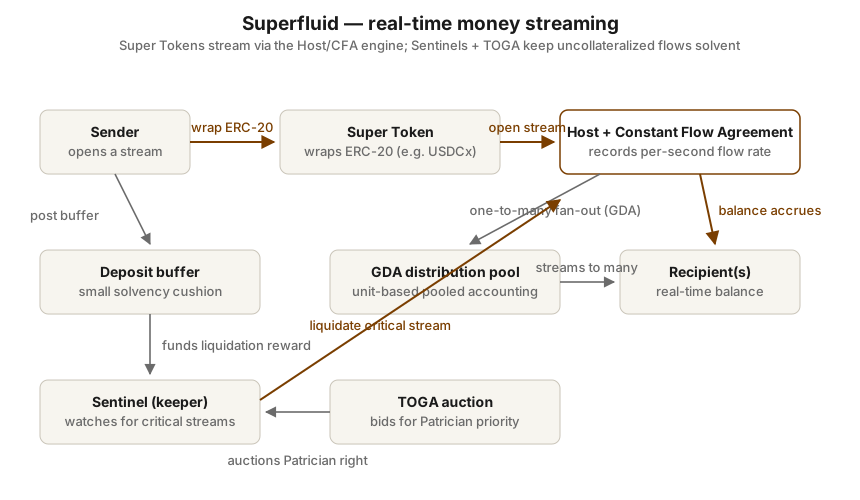 Open full-size diagram
Summary
Superfluid is an on-chain "money streaming" protocol: instead of sending a token in a single discrete transfer, a payer opens a stream that moves value to a recipient continuously at a fixed per-second rate until it is stopped. Its central innovation is the Super Token, an extension of the ERC-20 standard whose balance is computed dynamically — balance = static_balance + net_flow_rate × elapsed_time — so a wallet's number ticks up (or down) every block without any transaction firing per unit of time. This lets subscriptions, salaries, vesting, grants, and reward flows be expressed as always-on cash flows rather than batched payments, "netted in real-time at every block without consuming any gas."
The project was founded in 2020 (London, later distributed) by Francesco George Renzi (CEO), Michele D'Aliessi (COO), and ZhiCheng "Miao" Miao. It first shipped to production on cheaper EVM chains — notably Polygon and Gnosis Chain — in 2021, then reached Ethereum mainnet in early access (Feb 2022) once gas realities on L1 were better understood. It is now deployed across a broad EVM footprint including Ethereum, Polygon, Optimism, Arbitrum, Base, Gnosis, Avalanche, and BNB Chain. In February 2025 the Superfluid Foundation launched the SUP governance token (1B genesis supply) alongside a "Streaming Programmatic Rewards" campaign.
Design (Mechanism)
Superfluid is built as a modular framework around a central Host contract that mediates a set of pluggable Agreements:
- Super Tokens wrap an underlying ERC-20 (e.g. USDC → USDCx) or are natively minted. They carry a "real-time balance" and support agreement hooks. Balances change without per-block transactions; the state that changes is the account's net flow rate.
- Constant Flow Agreement (CFA) — the streaming primitive. It records a per-second flow rate between sender and receiver. Opening, updating, or closing a stream is a single transaction; the value then accrues autonomously. Many streams net together into a single account flow rate.
- Instant Distribution Agreement (IDA) — one-to-many instant proportional distributions using "units" in a pool (e.g. a 1000-unit reward pool where 100 units = 10% of a distribution), enabling airdrop/reward payouts to many recipients at O(1) cost regardless of recipient count.
- General Distribution Agreement (GDA) / Distribution Pools — the later "one-to-many streaming" upgrade that combines pooled unit accounting with continuous flows, so a single stream can fan out to up to millions of recipients scaling in real time. This was the headline feature of the 2024 raise.
- Super Apps — contracts that register callbacks triggered when a stream to/from them is created, updated, or deleted, enabling composable reactions (mint an NFT, open a downstream stream, etc.).
- Sentinels, Liquidations & TOGA — because a streaming account can run its buffer to zero while still owing outflow, external watcher nodes (Sentinels) close critical/insolvent streams and are compensated from a deposit buffer the sender posts. TOGA (Transparent Ongoing Auction) auctions the right to be the priority liquidator (the Patrician) for a token, aligning incentives to keep the network solvent. This solvency-buffer + keeper design is the load-bearing safety mechanism that lets streams be non-custodial and uncollateralized beyond a small deposit.
Verified Ethereum-mainnet contracts include the Host 0x4E583d9390082B65Bef884b629DFA426114CED6d, CFAv1 0x2844c1BBdA121E9E43105630b9C8310e5c72744b, GDAv1 0xAAdBB3Eee3Bd080f5353d86DdF1916aCA3fAC842, and SuperTokenFactory 0x0422689cc4087b6B7280e0a7e7F655200ec86Ae1; the Polygon Host is 0x3E14dC1b13c488a8d5D310918780c983bD5982E7.
Outcome
Status: partial_success. Superfluid is a genuine, still-operating DeFi primitive with real production usage — ENS DAO, Optimism, and Gitcoin's Allo ecosystem have used it for streaming-based funding, and it is one of the canonical "programmable cash flow" designs referenced across the space. It raised roughly $9M (seed, 2021) and a further $5.1M strategic round (Feb 2024, reported total ~$14.1M). Technically it delivered a novel, composable standard that others have imitated.
Commercially, the story is more mixed. "Money streaming" has remained a useful niche (payroll, vesting, grants, subscriptions) rather than the ubiquitous payment rail early narratives implied, and adoption has been steady but not explosive. The 2025 SUP token launch was an attempt to bootstrap a broader user base via programmatic rewards; SUP reached an all-time high around $0.099 in Nov 2025 and had fallen ~90% from that level by mid-2026, indicating the token has not sustained speculative or governance-driven demand. The protocol persists and ships; the token and mass-market breakout are the underperforming parts — hence partial rather than full success.
Why it worked
- A clean, composable standard. Encoding cash flow as a per-second rate on an ERC-20-compatible token gave developers a primitive that composes with existing DeFi and wallets, rather than a bespoke app.
- Gasless accrual. Real-time balances that update without per-block transactions solved the obvious "you can't send a transaction every second" objection and made continuous payments economically viable.
- Solvency design that avoids full collateralization. The deposit buffer + Sentinel/TOGA keeper market let streams stay non-custodial and capital-light while still protecting recipients, which was essential for adoption.
- Right-chain sequencing. Launching on low-fee chains (Polygon, Gnosis) first, before L1, matched the economics of a per-interaction-cheap-but-frequent use case.
Where the design broke
- Streaming is a feature, not a mass market. Continuous payment is compelling for payroll/vesting/grants but few end users demanded "money by the second," limiting TAM versus the ambitious framing.
- Mental-model and UX friction. Wrapping tokens into Super Tokens, maintaining a buffer, and reasoning about liquidation add cognitive overhead absent from a simple transfer.
- Token monetization arrived late and weakly. SUP launched in 2025, years after the protocol; its steep post-ATH decline suggests the token has not yet created durable demand or a strong flywheel.
- Competitive and substitute pressure. Vesting/streaming can also be done with simpler bespoke contracts (e.g. Sablier-style locked streams), and much value transfer stays batched, capping how much flows through Superfluid specifically.
Lessons
- A great primitive does not guarantee a great market. Superfluid nailed the composable "cash-flow-as-a-token" abstraction, but a novel primitive still needs a use case with broad, urgent demand — technical elegance and product-market fit are separate wins.
- Design the solvency/keeper layer as a first-class product. The buffer + Sentinel + TOGA machinery is what makes uncollateralized streaming safe; protocols that stream value must budget as much design effort for insolvency handling as for the happy path.
- Sequence deployment to the economics of the mechanism. Frequent, cheap interactions belong on cheap chains first; shipping to L1 only after the model was proven avoided burning credibility on unusable gas costs.
- Launching a token years after the protocol is a double-edged move. It can fund and govern a mature system, but a late token with unclear ongoing sink risks becoming a speculative afterthought rather than a demand engine.
Redesign (EDITORIAL — hypothesis, not fact)
The following is the researcher's editorial hypothesis, not established fact. If rebuilt today, Superfluid's biggest lever is probably demand capture over primitive-building. The core CFA/GDA machinery is strong; the gap is that the protocol sits one layer below the products people actually want. A redesign might (1) verticalize aggressively — ship first-party, opinionated apps for the two use cases with real pull (on-chain payroll/contributor comp and vesting/token unlocks), and treat the raw agreements as internal plumbing rather than the headline; (2) make Super Tokens invisible by using account-abstraction / intents so users never manually wrap, top up buffers, or think about liquidation — a stream should feel like "set salary, done," with buffers auto-managed and denominated in stablecoins users already hold; and (3) tie SUP demand to actual protocol usage via streamed fee rebates or a "pay fees in SUP for premium distribution pools" sink, so the token's value tracks real cash-flow volume rather than reward emissions. Finally, given that GDA one-to-many streaming is the strongest fit for DAO/ecosystem grants, a redesign would lean into being the default rails for retroactive and continuous public-goods funding, where the recipient count and real-time transparency of streaming are genuine differentiators rather than nice-to-haves. The hypothesis: Superfluid's ceiling is limited less by its cryptography than by living too far from end-user demand — closing that distance is the highest-value change.
Sources
- What is Superfluid? (official docs) — primary (docs)
- Superfluid official website — primary (docs)
- Superfluid protocol-monorepo metadata (network / contract addresses) — primary (contract)
- Superfluid is Now Available on Ethereum Mainnet in Early Access — primary (docs)
- Introducing SUP: The Superfluid Token — primary (governance)
- Superfluid Secures $5.1M to Boost Growth (official blog) — primary (news)
- Liquidations & TOGA (docs) — primary (docs)
- Superfluid raises $5.1M strategic funding (The Block) (news)
- Superfluid leadership team (The Org) (analysis)
Related experiments
Last verified: 2026-07-26 · Spot an error? Suggest a correction