Flashbots
R&D organization that turned Ethereum's uncoordinated MEV frontrunning wars into structured off-chain auctions (MEV-Geth, then MEV-Boost), becoming the de facto block-building supply chain for post-Merge Ethereum.
▶ Run interactive simulation animated mechanism with editable parameters
How it works onchain
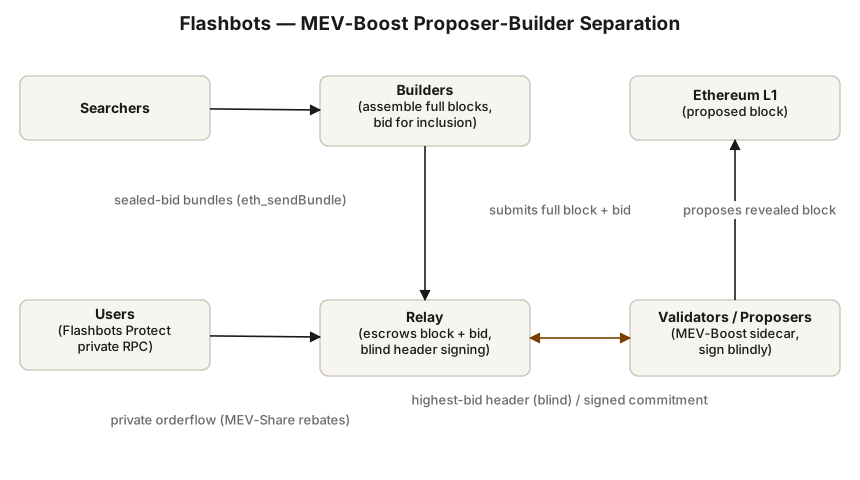 Open full-size diagram
Summary
Flashbots is an R&D organization founded in late 2020 by Phil Daian, Stephane Gosselin, Alex Obadia, and collaborators (Scott Bigelow and Tina Zhen are also credited as co-founders in company profiles) to confront the "MEV crisis" on Ethereum — the frontrunning, sandwiching, and priority-gas-auction (PGA) wars that were congesting the chain and threatening consensus stability, as diagnosed in Daian et al.'s "Flash Boys 2.0" paper. Its founding manifesto, "Flashbots: Frontrunning the MEV Crisis" (Nov 22, 2020), proposed a three-part program: Illuminate (measure MEV via MEV-Inspect/MEV-Explore), Democratize (open access to extraction via MEV-Geth), and Distribute (redirect MEV benefits). Rather than deploying an onchain protocol, Flashbots built off-chain market infrastructure: a sealed-bid bundle auction connecting "searchers" to miners (MEV-Geth, alpha launched January 2021), and after the Merge, MEV-Boost (activated September 2022), which implemented out-of-protocol proposer-builder separation and came to intermediate the vast majority of Ethereum block production. It is arguably the most consequential mechanism-design intervention in Ethereum's history — and also the source of its centralization and censorship debates.
Design (Mechanism)
- MEV-Geth / Flashbots Auction (2020–2022): A fork of go-ethereum let miners accept "bundles" — ordered sets of transactions submitted by searchers through the Flashbots Relay via
eth_sendBundle. The auction was sealed-bid and all-pay-nothing-on-loss: losing bundles were never included, so failed bids cost nothing, and bids were paid via gas price or direct coinbase transfers. This moved the PGA off-chain, eliminating failed-transaction spam. The relay was a trusted intermediary: it kept bundles private (no frontrunning by observers), simulated them, and forwarded only profitable ones to participating miners. - MEV-Boost (2022–present): After Ethereum's Merge, Flashbots shipped a validator sidecar implementing out-of-protocol proposer-builder separation. Specialized builders assemble full blocks and bid for inclusion; relays escrow blocks and bids so builders and proposers need not trust each other; proposers (validators) blindly sign the highest-bidding header, receiving the bid without seeing block contents until after commitment. This is a commitment-device design: blind signing prevents proposers from stealing MEV, and relay escrow prevents builders from stiffing proposers.
- Later iterations: Flashbots Protect (2021) gave ordinary users a private RPC to avoid frontrunning; MEV-Share (2023) introduced an order-flow auction that rebates backrun value to users; SUAVE (announced 2022) aimed at a decentralized cross-chain sequencing layer; BuilderNet (Nov 2024) moved block building into TEEs — as of December 5, 2024, Flashbots no longer operates centralized block builders on Ethereum.
- There is no token, no governance coin, and no canonical smart contract — the "mechanism" is an off-chain auction plus open-source clients (mev-geth, mev-boost, rbuilder on GitHub).
Outcome
Adoption was extraordinary. By March 2021 a majority of Ethereum hashrate ran MEV-Geth; post-Merge, MEV-Boost was adopted by roughly 85–90%+ of validators, and the Flashbots relay was at times the conduit for the large majority of MEV-Boost blocks. Gas spikes from PGA wars and reverted-frontrun spam measurably declined. But success created new problems: after OFAC sanctioned Tornado Cash (August 2022), the Flashbots relay filtered sanctioned transactions by default, and by late 2022 ~70%+ of MEV-Boost blocks were "OFAC-compliant," igniting the censorship crisis tracked by mevwatch.info (censoring share later declined as neutral relays gained share). Co-founder Stephane Gosselin resigned in September/October 2022 over these censorship disagreements. Block building concentrated into a handful of builders producing >90% of blocks. Flashbots responded by open-sourcing its builder, launching MEV-Share and BuilderNet, and exiting centralized building in Dec 2024. Outcome status: major_success as a mechanism (it defined the MEV supply chain and Ethereum's PBS roadmap), with serious, openly acknowledged externalities; the organization is still active, so the experiment is also ongoing.
Why it worked
- It priced an existing black market instead of moralizing about it. MEV extraction was already happening through uncoordinated priority-gas auctions; Flashbots offered every participant a strictly dominant option (miners earned more, searchers stopped losing gas on failed bids, users suffered less spam), so adoption was incentive-compatible and near-total without any fork or token.
- Sealed bids + privacy fixed the auction format. Moving from open-outcry PGAs (which leak strategy and spam the chain) to private sealed-bid bundles eliminated the negative externalities of bidding itself.
- Trust-minimizing commitment devices: blind header signing and relay escrow let mutually distrusting builders and 900k+ validators trade blocks safely.
- Research legitimacy: publishing data (MEV-Explore, transparency reports) and operating in public forums (ethresear.ch, the Flashbots Collective) made it a quasi-public-goods institution rather than just another extraction firm.
Limitations and criticisms
- Centralization of the supply chain: the relay and later a small oligopoly of builders became chokepoints; a mechanism designed to democratize extraction re-concentrated power one layer up.
- Censorship crisis: defaulting the dominant relay to OFAC filtering made most of Ethereum's blocks compliant-by-default in late 2022, a direct hit to credible neutrality and the cause of a co-founder's exit.
- Trusted-relay assumption: relays are unaccountable trusted parties; the 2023 "relay exploit" era (e.g., the low-carb-crusader incident against MEV-Boost relays, April 2023) showed the escrow could be gamed.
- Distribution goal lagged: "Distribute Benefits" arrived late (MEV-Share, 2023); for years MEV flowed to searchers, builders, and validators, not to the users whose orders created it.
Lessons
- Structuring an existing adversarial equilibrium beats banning it: giving all parties a strictly better structured venue can drain a black market almost overnight — but the designer then owns the new market's failure modes.
- Off-chain mechanisms can govern onchain systems: Ethereum's de facto block production rules were set by a voluntary sidecar and a Discord, not by protocol governance — enormously effective and enormously fragile.
- Neutrality must be designed in, not promised: a single dominant relay with a compliance default became a censorship vector; credible neutrality requires structural decentralization (many relays/builders, TEEs, or enshrined PBS), not operator goodwill.
- Auction format matters as much as auction existence: sealed-bid, no-cost-on-loss bidding removed the spam externality that open PGAs created; the bidding mechanism itself was the pollution.
- Measure first: MEV-Inspect/Explore's "illuminate" phase built the shared empirical reality that made the intervention legitimate.
Redesign (EDITORIAL — hypothesis, not fact)
The following is editorial hypothesis, not established fact. A redesigned Flashbots would treat the relay as a protocol, not a company, from day one: (1) enshrine or trust-minimize the escrow role early — e.g., commit-reveal block auctions secured by TEEs or threshold encryption (the BuilderNet direction, started four years sooner) — so no single operator can set censorship defaults for the network; (2) ship the user-rebate order-flow auction (MEV-Share-style) simultaneously with the extraction auction, so the "Distribute" leg is structural rather than aspirational, blunting the political economy of pure extraction; (3) impose protocol-level anti-concentration pressure on builders — inclusion lists or partial-block auctions so proposers retain a censorship-resistant lane; and (4) make neutrality a binding default: relays that filter transactions should have to opt out of a neutral spec, not opt in to one. The deeper hypothesis: intermediary layers accrue power faster than their governance matures, so decentralize the intermediary before it wins the market, not after.
Sources
- Flashbots: Frontrunning the MEV crisis (founding post, Nov 22 2020) — primary (retrospective)
- Flashbots: Frontrunning the MEV crisis (ethresear.ch thread) — primary (governance)
- Flashbots Transparency Report — January 2021 — primary (retrospective)
- Flashbots official website (product timeline) — primary (docs)
- Flashbots Docs — Auction Overview — primary (docs)
- Flashbots GitHub (mev-geth, mev-boost, rbuilder) — primary (contract)
- Flashbots co-founder steps down after disagreements with team over censorship (The Block) (news)
- Ethereum's 'Censorship' Problem Is Getting Worse (CoinDesk) (news)
- MEV Watch — censoring relay share on Ethereum MEV-Boost (analysis)
Related experiments
Last verified: 2026-07-26 · Spot an error? Suggest a correction