Kleros Curate
A generalized token-curated-registry platform where deposit-backed submissions to any list can be challenged and adjudicated by Kleros's crowdsourced jury court.
▶ Run interactive simulation animated mechanism with editable parameters
How it works onchain
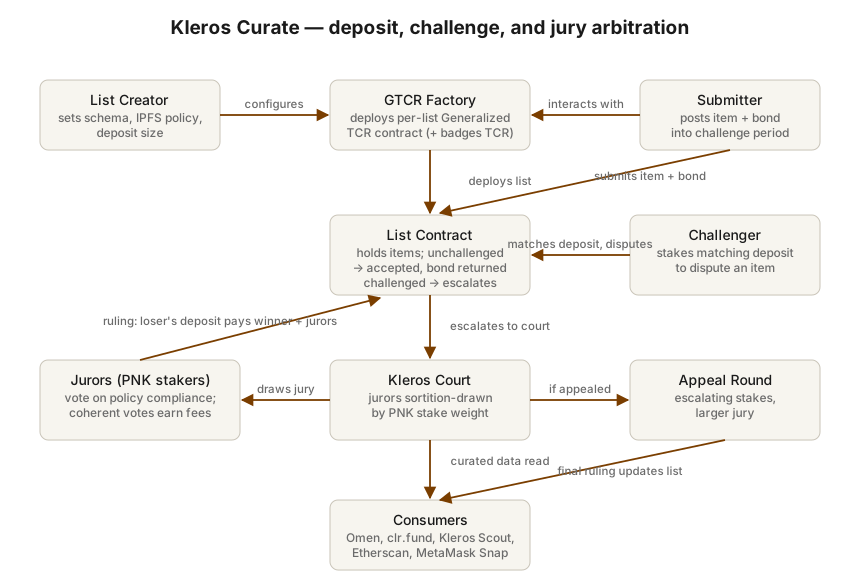 Open full-size diagram
Summary
Kleros Curate is a "list of anything" platform: a generalized token-curated registry (TCR) system where anyone can deploy an on-chain list, define acceptance criteria in a policy document, and let open, permissionless curation run on economic incentives. Submissions require a deposit; anyone may challenge a submission by matching the deposit; challenged items go to the Kleros arbitration court, where crypto-economically incentivized jurors rule on whether the entry complies with the list's policy. The public launch of the Curate dApp was announced on June 12, 2020, building on Kleros's earlier Token² Curated Registry (T2CR, a curated ERC-20 token list launched in March 2019, which reached 400+ vetted tokens). Curate became the substrate for registries such as Omen's "Verified Markets," clr.fund's eligible public-goods projects, and — most durably — Kleros Scout, a set of address-tag and contract-metadata registries that feed security data to consumers including block explorers and a MetaMask Snap. It remains live and actively developed as of 2026.
Design (Mechanism)
- List creation. A factory contract (GTCR Factory on mainnet,
0xe9dd5236...9cd5) deploys a new Generalized TCR per list (plus a companion badges TCR). Creators set the item schema (arbitrary fields: text, numbers, addresses, booleans), a written listing policy (stored on IPFS), deposit sizes, and challenge-period length. A "TCR of TCRs" registry indexes lists themselves. - Submission. A submitter posts an item plus a bond. The item sits in a challenge period; if unchallenged, it is accepted and the bond is returned.
- Challenge. Any observer may stake a matching deposit to challenge an entry (or challenge a removal request). This converts curation into an open bounty: incorrect entries are profit opportunities for vigilant challengers.
- Arbitration. Challenged items escalate to the Kleros court, where jurors — drawn by stake-weighted sortition of PNK token stakers — vote on policy compliance under a Schelling-point game: jurors who vote coherently with the final majority earn fees; incoherent jurors lose part of their staked PNK. Rulings can be appealed with escalating stakes and larger juries; the loser's deposit compensates the winner and jurors.
- Key difference from "TCR 1.0" (Goldin/adChain). Classic TCRs resolved challenges by token-holder plebiscite, which suffered from voter apathy and made every list need its own token. Kleros's generalized design replaces the vote with third-party arbitration by a shared court, so lists need no native token, disputes get an actively incentivized jury, and criteria are enforced against an explicit written policy rather than vague holder sentiment.
- Light Curate. A later iteration moved item data off-chain (IPFS + subgraph) and used EIP-1167 minimal proxies, dropping list deployment costs from roughly 7M gas to ~700k; deployed on Gnosis Chain (
0x08e58Bc2...805a), where cheap challenges make micro-curation viable.
Outcome
Partial success, still ongoing. The mechanism has worked as designed for six-plus years: registries stay materially clean because bad entries are profitable to challenge, and the T2CR/Curate pipeline demonstrated that arbitration-backed TCRs avoid the death-by-apathy that killed first-generation TCRs (adChain etc.). Real integrations materialized — Omen prediction-market verification, clr.fund grantee eligibility, Ethfinex-era token badges, and Kleros Scout's address-tag/contract-metadata registries consumed by industry infrastructure such as Etherscan and surfaced in wallets via a MetaMask Snap, with an incentive program running through 2024–2025. As of June 2026, Kleros was still shipping Curate-related upgrades (a dedicated Curation Court with hidden voting on Gnosis Chain). However, Curate never became a mass-market primitive: general-purpose "lists of anything" saw modest organic adoption, most list-creation demand came from Kleros's own ecosystem, and centralized or social alternatives (e.g., Uniswap token lists maintained by teams, Etherscan's own tagging) captured much of the addressable curation market. No major exploit of the mechanism itself was found in research for this entry.
Why it worked
- Bounty-style enforcement beats plebiscite voting. Making every wrong entry a claimable profit for a single challenger solved the participation problem that sank vote-based TCRs; no quorum of apathetic token holders is needed.
- A shared court amortizes trust. One arbitration layer (Kleros court + PNK) serves thousands of lists, so each list gets credible dispute resolution without bootstrapping its own token economy.
- Explicit written policies. Anchoring disputes to a concrete policy document gave jurors a focal point and made rulings predictable enough for third parties (Omen, clr.fund, Etherscan-facing Scout registries) to rely on the output.
- Cost iteration. Light Curate's gas reductions and the Gnosis deployment kept deposits and challenge costs proportionate to the value of individual entries.
Why it failed or underperformed
- Thin demand for permissionless curation. Most consumers of curated data (wallets, exchanges, aggregators) preferred to maintain lists themselves or trust a brand; decentralized neutrality was rarely a purchasing criterion.
- Latency and friction. Challenge periods plus multi-round appeals mean entries can take days to finalize — poor fit for fast-moving catalogs, and deposits deter casual submitters.
- Incentive dead zones. When a list is mostly correct, challenger rewards are scarce, so attention decays; conversely, low-value entries may not justify the deposit/gas to police at all (partly mitigated on Gnosis).
- Dependent on the court's health. Curation quality inherits any weaknesses of Kleros arbitration (juror competence on niche policies, PNK stake concentration, appeal-cost griefing), concentrating systemic risk in one court.
Lessons
- Curation is an enforcement problem, not a voting problem: paying one motivated challenger reliably outperforms hoping a majority of token holders shows up.
- Generalize the substrate, specialize the demand: the durable wins (Scout security metadata) came from Kleros building opinionated products on top of its neutral list primitive, not from strangers spontaneously making lists.
- Written, versioned policies are the real contract; on-chain mechanisms only price the cost of arguing about them.
- Deposit economics must scale with entry value — one gas/deposit regime cannot serve both high-stakes token listings and long-tail metadata; cheap-chain deployments are a mechanism-design lever, not just a cost optimization.
Redesign (EDITORIAL — hypothesis, not fact)
This section is editorial hypothesis, not established fact. A modern redesign might keep the deposit-challenge-arbitration core but attack latency and attention decay. First, add optimistic streaming reads: consumers get entries instantly with an on-chain "confidence age," and integrators choose their own challenge-period risk tolerance rather than one global finalization delay. Second, fund standing watchers: divert a small protocol fee into a retainer pool paid to bonded challengers for verifiable scanning activity (with slashing for missed bad entries caught by others), converting episodic bounty-hunting into a continuous security service. Third, restake-secured juries per vertical: let domain-expert juror subsets (e.g., contract-security reviewers for Scout-style lists) post additional stake for higher-fee, faster-track disputes, reducing the generalist-juror competence gap. Finally, make lists revenue-bearing — charge data consumers (wallets, explorers) via signed API/onchain reads and route fees to submitters and past jurors — so correctness has a business model instead of relying on altruistic list owners topping up incentives.
Sources
- Kleros Curate: Take Back Control of Information (launch announcement) — primary (docs)
- Generalized Token Curated Registries: The World of Lists — primary (docs)
- Curate — Kleros documentation — primary (docs)
- Curate Classic: Integration for Devs (contract addresses) — primary (docs)
- Light Curate: Integration for Devs — primary (docs)
- GTCR Factory on Etherscan — primary (contract)
- Kleros Scout — Community Curated Security Metadata — primary (docs)
- Kleros Development Update June 2026 (Curation Court on Gnosis) — primary (docs)
Related experiments
Last verified: 2026-07-26 · Spot an error? Suggest a correction