1Hive Gardens
1Hive's Gardens turned the 1Hive DAO's own operating system — conviction voting, a community covenant, and the Celeste dispute court — into a reusable template for bottom-up, continuously funded DAOs.
▶ Run interactive simulation animated mechanism with editable parameters
How it works onchain
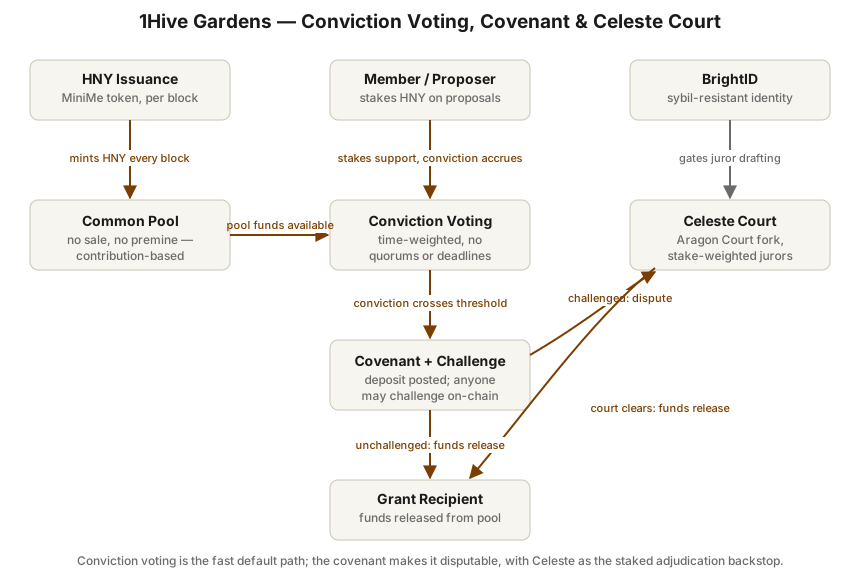 Open full-size diagram
Summary
1Hive is an open, permissionless online community — grown out of the Aragon ecosystem, with Luke Duncan as its best-known early initiator — that issues a community currency, Honey (HNY), on Gnosis Chain (then xDai). Rather than voting on every treasury spend, 1Hive pioneered the first production deployment of conviction voting: new HNY is continuously issued into a Common Pool, and members stake tokens on funding proposals whose "conviction" accumulates over time until a threshold is crossed and funds release automatically. Gardens (soft-launched September 2021, when 1Hive itself voted on Sept 10–15 to migrate its DAO to a Garden) packaged this operating system — conviction voting for money, "decision (Tao) voting" for parameter changes, a signed Community Covenant, and the Celeste dispute court (an Aragon Court fork with BrightID sybil resistance) — into a plug-and-play template any community could deploy. It is a canonical experiment in continuous, bottom-up public-goods funding and "disputable" governance, and it lives on today as Gardens v2 (gardens.fund) on Arbitrum and other L2s.
Design (Mechanism)
- Community currency + Common Pool. HNY (a MiniMe token at 0x71850b…Eef9 on Gnosis Chain) is issued every block into a Common Pool — initially ~60%/yr inflation, community-adjusted to 30%, then a dynamic issuance policy from April 2021. There was no sale or premine allocation to a company; distribution ran through contribution rewards (Pollen), a BrightID-gated faucet, and liquidity farming on Honeyswap.
- Conviction voting. Developed with BlockScience and Commons Stack from
2019 as an Aragon app. Members stake tokens behind proposals; support compounds toward a conviction score with a configurable decay half-life (48h default). Larger requests relative to the pool require more conviction; small requests pass with a small, persistent minority. No quorums, no deadlines, no discrete votes — funding is continuous and parallel. - Covenant + Celeste (disputable proposals). Every Garden adopts a written Covenant (values/terms stored on IPFS). Proposers post a deposit; anyone can challenge a proposal as violating the Covenant. Disputes go to Celeste, 1Hive's fork of Aragon Court on Gnosis Chain that uses staked HNY for juror drafting (probability proportional to stake, min 0.5 HNY) plus BrightID identity verification to cap per-person influence. This makes conviction voting disputable: fast by default, adjudicated only on challenge.
- Decision (Tao) voting. Time-boxed token voting with delegation for "dangerous" actions — changing governance parameters, upgrading contracts — separate from everyday money flows.
- Gardens template. The gardens-template repo composed these Aragon apps so any community could launch a new token (or import an ERC-20) and get the full stack "in minutes"; deployed on xDai and, from December 2021, Polygon. Gardens v2 (docs.gardens.fund; 1Hive/gardens-v2), built by the Gardens Swarm on Allo-protocol-era architecture, generalizes this into multiple governance "pools" per community with conviction voting, streaming proposals, and improved UX on Arbitrum and other chains.
Outcome
Partial success. As mechanism R&D, it is canonical: 1Hive was the first production conviction-voting system and ran its entire economy on it for years; the covenant + Celeste pattern prefigured today's "optimistic governance" designs. Gardens was adopted by notable communities in the Gnosis ecosystem — the Token Engineering Commons, Giveth, Agave, and others built on the 1Hive stack — and the framework spread to Polygon. Economically, however, HNY followed a boom-bust arc: after a speculative peak in early 2021 (DeFi-mania on xDai around Honeyswap), HNY's price collapsed by well over 99% (roughly $10 vs. four-figure highs; ~24k HNY circulating per the official FAQ), shrinking the Common Pool's real funding capacity, and Gardens v1 adoption plateaued. The community did not die: it retooled, and Gardens v2 shipped (2024) via a 1Hive-funded Swarm and remains active in the L2 grants ecosystem as of 2026. The 1Hive DAO itself is ongoing; no exploit or governance takeover of the core system was found in this research.
Why it worked
- Continuous funding matched continuous work. Conviction voting removed vote-scheduling overhead and quorum failure, letting many small proposals pass in parallel — well suited to an open community paying dozens of contributors.
- Cheap chain, real usage. xDai's negligible fees made per-block issuance, faucet claims, and frequent small on-chain actions economically viable in 2020–21.
- Subjective backstop. The Covenant + Celeste layer let the fast default path stay permissive because bad proposals could be challenged and adjudicated, instead of front-loading friction on every proposal.
- Fair-launch legitimacy. No sale, no company, contribution-based distribution and BrightID sybil resistance gave the token credible community legitimacy and attracted mechanism-design collaborators (BlockScience, Commons Stack, TEC).
Why it failed or underperformed
- Treasury denominated in its own token. The Common Pool held HNY, so the DAO's spending power was reflexively tied to HNY's price; the 2021 crash gutted funding capacity exactly when it was needed to sustain contributors.
- High issuance met thin demand. 60%→30% inflation paid contributors but created constant sell pressure with few structural demand sinks beyond farming and Celeste staking.
- Small-holder plutocracy limits. Conviction voting weights token stake and time, not breadth of support; persistent large holders could steer funds, and BrightID gating applied to the faucet/court more than to funding power itself.
- Complexity and niche footprint. The Aragon-app stack (five-plus interacting apps, a forked court, IPFS covenants) was hard to maintain and to explain; being centered on xDai kept it out of the main Ethereum-L2 attention economy until the v2 rebuild.
Lessons
- Disputable/optimistic governance is a durable pattern: make the default path fast and permissive, and route conflict to a staked adjudication layer (covenant + court) only when challenged.
- Continuous, threshold-based allocation (conviction voting) genuinely reduces governance overhead for many small grants — but it needs demand sinks and a treasury not solely denominated in the native token, or a bear market defunds the mission.
- "Fair launch" distribution buys legitimacy but not sustainability; paying contributors purely in inflationary native tokens converts community goodwill into structural sell pressure.
- Templates outlive their first economy: 1Hive's most lasting output was not the HNY economy but the reusable mechanism stack (conviction voting apps, Celeste, Gardens v1→v2) that other communities like TEC and Giveth adopted.
- Sybil resistance must sit at the same layer as power: BrightID gated the faucet and jurors, but funding weight remained purely token-weighted, limiting the "one-human" ethos where it mattered most.
Redesign (EDITORIAL — hypothesis, not fact)
This section is editorial analysis — a hypothesis, not a factual claim. A modern Garden would (1) hold its Common Pool mostly in outside assets (stables/ETH) replenished by scheduled native-token sales or protocol revenue, so funding capacity decouples from token reflexivity; (2) blend conviction with identity — e.g., quadratic or capped conviction per BrightID/passport-verified human — so persistence and breadth both matter, blunting whale steering; (3) replace the bespoke Aragon-court fork with a shared arbitration market (Kleros/UMA-style) or restaked-security court to cut maintenance burden; (4) stream funding by default (as Gardens v2 now does) with automatic clawback on failed milestone attestations; and (5) publish a real-time "runway and dilution" dashboard so issuance-rate votes are made against explicit solvency data rather than vibes. The bet is that 1Hive's core insight — continuous, challengeable funding under a covenant — was right, and its fragility was almost entirely treasury-denomination and demand-sink design.
Sources
- 1Hive FAQ (official site — links, HNY issuance, Gardens, Celeste) — primary (docs)
- 1Hive Wiki — FAQ / Gardens / Celeste — primary (docs)
- HNY Token (MiniMeToken) on GnosisScan — primary (contract)
- 1Hive/conviction-voting-app (Aragon app, first production conviction voting) — primary (contract)
- 1Hive/gardens-template (Aragon DAO template for Gardens) — primary (contract)
- 1Hive Monthly Recap September 2021 (Gardens soft launch; DAO migration vote Sept 10–15, 2021) — primary (retrospective)
- Gardens and its Protocols for Peergovernance — P2P Foundation Wiki (analysis)
- 1Hive Gardens live on Polygon (Dec 2021) (news)
- Gardens V2 documentation — primary (docs)
- Gardens Swarm December 2023 Funding Proposal (1Hive forum) — primary (governance)
- 1Hive/gardens-v2 (GitHub) — primary (contract)
Related experiments
Last verified: 2026-07-26 · Spot an error? Suggest a correction