Token Engineering Commons
A community-launched 'commons economy' for funding token-engineering public goods, run on an augmented bonding curve and conviction voting from 2021 until its deliberate sunset in December 2025.
▶ Run interactive simulation animated mechanism with editable parameters
How it works onchain
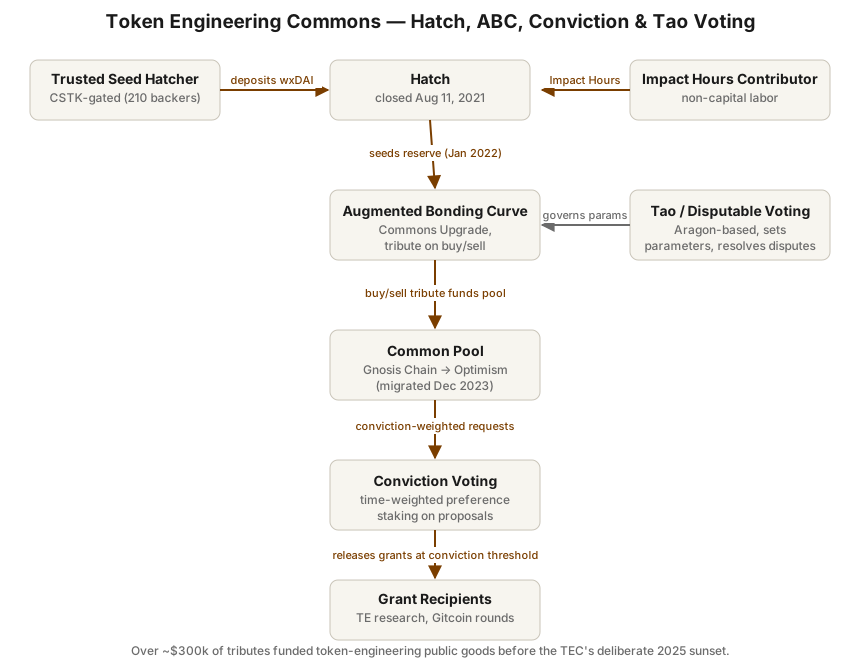 Open full-size diagram
Summary
The Token Engineering Commons (TEC) was the flagship real-world deployment of the Commons Stack's "commons economy" blueprint: a DAO that funds token-engineering public goods (research, education, tooling) through a continuously-funded treasury governed by its community. Incubated by Commons Stack alongside the Token Engineering Academy community starting with preliminary meetings in late 2019, it launched in two phases on Gnosis Chain (then xDai): the "Hatch" (closed 11 August 2021, raising 1,571,223.57 wxDAI from 210 backers drawn from the curated Trusted Seed, against an 800,000 wxDAI minimum), and the "Commons Upgrade" (live January 2022), which converted the HatchDAO into a full commons economy running an Augmented Bonding Curve (ABC), Conviction Voting, and Tao (disputable) Voting. Over 200 contributors participated during development. The TEC operated for roughly six years across research, grants (including Gitcoin token-engineering rounds), and governance experimentation, migrated its token infrastructure to Optimism in December 2023, then deliberately wound itself down: a token-sunsetting process was proposed in July–August 2025 and executed with the "TEC Token Sunset" in December 2025. A permanent public archive was published in July 2026.
Design (Mechanism)
- Two-phase launch. Phase 1 ("the Hatch") restricted fundraising to value-aligned members of the Commons Stack Trusted Seed (gated by a non-transferable CSTK reputation score), bootstrapping capital and community simultaneously. Hatchers received vesting TECH tokens; non-capital contributions (labor, expertise) were rewarded through "Impact Hours," minted into tokens at launch.
- Augmented Bonding Curve. Phase 2 initialized an ABC as the economic engine: token price and supply set algorithmically against a reserve, with a "Commons Tribute" splitting part of every buy into a Common Pool and entry/exit tributes taxing speculation to grow that pool. Parameters (reserve ratio, opening price, tributes) were chosen through community "parameter parties" and a final vote (Proposal #149 selected the winning parameter set in early 2022).
- Conviction Voting. Funding proposals drew from the Common Pool via conviction voting (time-weighted preference staking), so continuously accumulating support — not snapshot majorities — released funds.
- Tao/Disputable Voting. Aragon-based delegated voting with a dispute framework governed parameter changes and protocol-level decisions.
- Soft-governance layer. A "Praise" gratitude/recognition system, working groups, and Ostrom-inspired cultural norms complemented the on-chain machinery.
Outcome
The TEC ran its full mechanism stack in production for about four years — one of the longest-lived deployments of an ABC plus conviction voting. The Common Pool reportedly accrued over $300,000 from tributes after the 2021 launch, funding token-engineering grants, research, and Gitcoin matching rounds (16 projects in the May 2023 Token Engineering round). Strains appeared over time: in March 2023 the community proposed sidelining conviction voting as the primary funding mechanism, and in December 2023 it voted to migrate the token from Gnosis Chain to Optimism to shore up economic sustainability. In mid-2025 the community chose a "responsible wind-down through a sunsetting framework"; the token sunset completed in December 2025, and in July 2026 a curated, de-identified public archive (tecarchive.github.io/tec-archive) was published documenting history, mechanisms, economics, governance, and dissolution. Outcome: partial_success — the mechanisms and community worked as designed for years and produced substantial public-goods output and research data, but the economy did not prove self-sustaining and was intentionally retired.
Why it worked
- Curated launch aligned early capital with mission. Gating the Hatch to the Trusted Seed, plus vesting and Impact Hour rewards for labor, produced a genuinely mission-aligned holder base rather than mercenary capital.
- Legible, parameterized economics. Community parameter selection ("commons configuration dashboard," debate on reserve ratio and tributes) built unusual literacy and buy-in; the ABC guaranteed continuous liquidity while tributes recycled speculation into funding.
- Deep cultural infrastructure. Praise, working groups, and Ostrom-derived norms sustained 200+ contributors and made the TEC a durable Schelling point for the token-engineering field.
- Honest ending. The deliberate sunset and public archive converted even the shutdown into a research contribution.
Why it failed or underperformed
- Funding demand outran regenerative inflows. Tribute revenue (~$300k+ over years) was modest relative to contributor-compensation needs; the treasury depended heavily on the initial raise and token price.
- Bear-market reflexivity. An ABC treasury denominated partly in its own reserve dynamics suffers when buy pressure disappears; the small-cap token slid far from its early-2023 high.
- Governance overhead. Conviction voting was sidelined as primary funding mechanism by March 2023 — a signal that continuous token-weighted funding allocation was not matching the organization's budgeting needs.
- Mission markets are thin. "Funding token engineering" lacked a revenue-generating counterparty; the commons produced public goods but captured little value back.
Lessons
- A curated, vesting, labor-rewarding launch (Hatch + Trusted Seed + Impact Hours) is a replicable pattern for aligning early stakeholders — but alignment does not substitute for a recurring revenue source.
- Tributes on a bonding curve recycle speculation into funding, yet in low-volume regimes they yield too little to sustain full-time contributors; model treasury runway against realistic volume, not launch-window volume.
- Conviction voting is better suited to marginal/experimental grants than to core budgeting; mature DAOs tend to re-centralize recurring budgets into working groups.
- Planned dissolution with a public, de-identified archive is a best practice the whole field should copy: the experiment's data outlives the token.
Redesign (EDITORIAL — hypothesis, not fact)
This section is editorial analysis — a hypothesis, not fact. A revived TEC-style commons might keep the Hatch/Trusted Seed launch and the cultural layer but replace the ABC-as-treasury with an endowment model: raise once, hold reserves in productive, diversified assets (staked ETH, revenue-share positions in the tooling it funds), and spend only yield, making runway market-cycle-resistant. Tributes could be reframed as optional protocol fees on services the commons actually sells (certification, audits, simulation tooling), giving the flywheel a real revenue leg. Funding allocation would split explicitly: streaming budgets for core working groups via periodic ratification votes, with conviction voting reserved for a capped experimental-grants pool where its continuous-signal properties shine. Finally, bake the sunset in from day one — pre-committed dissolution triggers and archival obligations — so the "honest ending" the TEC improvised becomes a designed property.
Sources
- TEC Handbook — A Brief History — primary (docs)
- Official TEC Archive announcement (forum, July 2026) — primary (governance)
- TEC Archive (permanent public archive, incl. Timeline and Economics sections) — primary (archive)
- TEC Hatch: 'What's Next?!' — Nathan Suits (hatch results) — primary (retrospective)
- Token Engineering Commons — Analysis of Stakeholders, Tokens & Governance (Shermin Voshmgir) (analysis)
- $TEC Token Infrastructure & Utility Report (forum) — primary (governance)
- TEC token on Gnosis Chain Blockscout — primary (contract)
- Commons Stack — Augmented Bonding Curve (ABC) — primary (docs)
- tecommons.org (official site) — primary (docs)
Related experiments
Last verified: 2026-07-26 · Spot an error? Suggest a correction