Optimism Retro Funding
Optimism's retroactive public goods funding program that pays contributors in OP tokens for impact already delivered, as judged by a rotating body of 'badgeholder' voters.
▶ Run interactive simulation animated mechanism with editable parameters
How it works onchain
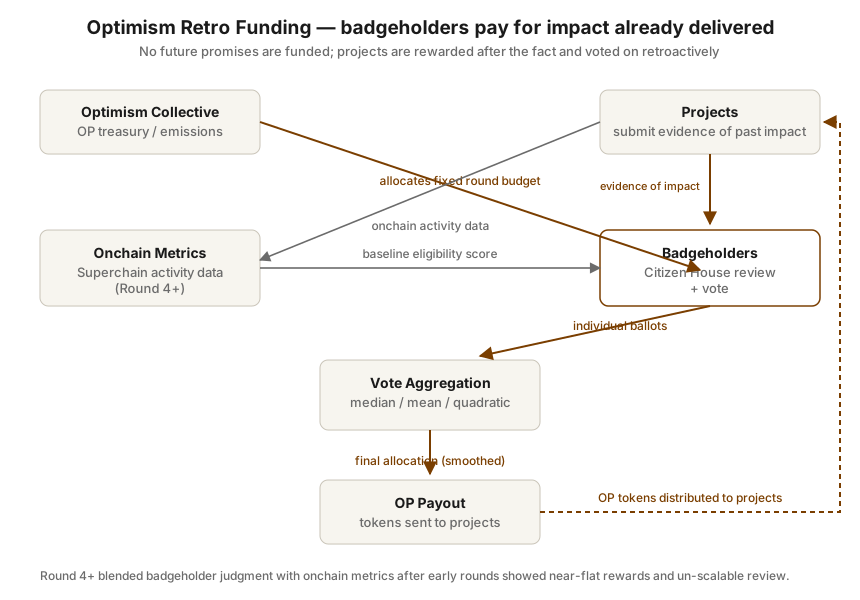 Open full-size diagram
Summary
Optimism Retro Funding (originally "Retroactive Public Goods Funding," or RetroPGF) is one of the largest and most-copied experiments in onchain public-goods financing. Its premise, formalized in a July 2021 essay co-authored by the Optimism team with Vitalik Buterin as guest author, is that "it's easier to agree on what was useful than what will be useful." Rather than funding proposals for future work (the model of most grants), Retro Funding pays contributors after they have delivered value, on the theory that hindsight makes impact easier to assess and creates "startup-style funding cycles" (an exit-like reward) for open-source and public-goods builders who otherwise lack a revenue model.
Optimism ran its first round in January 2022, distributing roughly $1M worth of value to ecosystem contributors. It then scaled the mechanism into a recurring program funded from the Optimism Collective's OP token treasury, run through the "Citizen House" — a body of vetted "badgeholders" who vote to allocate OP among nominated projects. Across seven-plus rounds since inception, the program has distributed tens of millions of OP tokens (widely cited at over 60M OP), making it the largest deployment of retroactive funding to date and the template for imitators (Filecoin RetroPGF, Gitcoin, and others).
Design (Mechanism)
The core mechanism separates who does the work from who evaluates it, and evaluates only after delivery:
- Retroactive allocation. Projects submit evidence of impact already delivered to the Optimism ecosystem. No future promises are funded.
- Badgeholders / Citizen House. A curated set of community members with demonstrated expertise ("badgeholders") receive voting power. They review applications and allocate a fixed OP budget for the round. Badgeholder rosters expanded round-over-round (e.g., 69 of 71 voted in Round 2; 145 in Round 3).
- Vote aggregation. Badgeholder ballots are aggregated using algorithms including median, mean, and quadratic methods, chosen to reduce the influence of outliers and manipulation. Median-style aggregation limits any single voter's ability to inflate an allocation.
- Funding source. Rewards are paid in OP tokens from the Collective's treasury. The original design imagined funding from protocol/sequencer revenue via a "Results Oracle" DAO; in practice early rounds were funded by token grants.
- Round structure. Early rounds had broad scope; later 2024 "Retro Funding" rounds were narrowed by domain — Round 4 (Onchain Builders, using onchain metrics like unique interacting addresses and deployment dates on Superchain chains), Round 5 (OP Stack / Ethereum core contributions), Round 6 (governance). This introduced measurable, semi-objective eligibility criteria to replace pure subjective voting.
Outcome
The program scaled dramatically and remains ongoing, but with acknowledged design problems:
- Round 1 (Jan 2022): ~$1M distributed to ecosystem contributors.
- Round 2 (Mar 30, 2023): 10M OP distributed across all 195 nominated projects; median award ~22,825 OP; top awards >140,000 OP; 69 of 71 badgeholders voted.
- Round 3 (late 2023): 30M OP to 501 recipients (from 1,594 applicants; 643 reached voting after ~967 exclusions); 145 badgeholders. Valued at roughly $100M at the time.
- 2024 "Retro Funding": ~20.4M OP across 3 domain-scoped rounds to 374 projects (Round 5 alone allocated ~3.1M OP to Ethereum core contributors).
- The Collective set aside large future reserves (hundreds of millions to >1B OP earmarked) and in 2025 announced a shift from discrete annual rounds toward ongoing impact evaluation and continuous rewards.
Outcome status is partial_success: it durably moved real capital to public-goods builders and became an industry reference model, but repeatedly failed to reward impact proportionally and struggled to scale evaluation.
Why it worked
- Right problem, credible framing. It addressed a genuine, chronic failure — public goods lack sustainable funding — with an intellectually clean insight (retrospection beats prediction) backed by Vitalik Buterin's endorsement, giving it legitimacy and copycats.
- Real money at scale. Unlike most public-goods experiments, it distributed tens of millions of dollars of OP, materially funding infrastructure, tooling, education, and Ethereum core work.
- Separation of evaluation from application. Delegating allocation to vetted badgeholders (rather than token-holder plutocracy or self-dealing applicants) created a defensible, semi-expert judgment layer.
- Iterative, public post-mortems. Optimism published candid "learnings" after rounds and re-scoped the mechanism, treating it as an evolving experiment rather than a fixed product.
Why it failed or underperformed
- Impact was not measured objectively. Optimism itself flagged the "absence of standardized, verifiable impact metrics," letting applicants selectively present data and "mislead badgeholders."
- Poor variance / flat rewards. In Round 3, top recipients received only ~6x the median (≈300K vs ≈45K OP), so genuinely outsized impact was not distinguished from average impact — undercutting the whole thesis.
- Popularity contest dynamics. Quorum requirements pushed applicants into aggressive self-promotion to badgeholders, turning evaluation into a marketing exercise rather than impact assessment.
- Evaluation didn't scale. Application volume exploded (330% round-over-round into Round 3); badgeholders self-selected which projects to review, so many received no fair minimum review.
- Sybil/manipulation and token pressure. Retroactive OP grants added recurring sell pressure to the OP token and were a persistent target of gaming concerns.
Lessons
- "Reward impact, profit" needs a measuring stick. Retrospection is only easier than prediction if impact is actually measurable; without verifiable, standardized metrics, human voters default to reputation, narrative, and popularity.
- Reward variance is a design output, not an accident. If a mechanism meant to reward outsized impact produces near-flat payouts, its aggregation rules (quorum, median smoothing, badgeholder incentives) are quietly overriding its stated goal and must be redesigned.
- Human evaluation does not scale linearly with applications. Once applicant counts reach the thousands, unstructured badgeholder review breaks down; scaling requires eligibility filters, sampling guarantees, or onchain metrics (the direction Round 4+ took).
- Curated voter bodies beat plutocracy but import their own biases. Badgeholders avoided pure token-weighted capture, yet self-selection and lobbying created new failure modes.
Redesign (EDITORIAL — hypothesis, not fact)
The following is the researcher's editorial hypothesis, not established fact.
A stronger Retro Funding would treat impact measurement as the primary engineering problem rather than an afterthought. Concretely: (1) Metric-first eligibility and scoring — extend the Round 4 onchain-metrics approach into a default, where each domain has published, pre-committed impact metrics (verifiable onchain data, dependency graphs, usage) that produce a baseline score, with badgeholder voting used only to adjust, not originate, allocations. This anchors payouts to observable reality and reduces marketing games. (2) Force reward variance — deliberately design aggregation (e.g., convex payout curves, top-k concentration, or a "impact certificate" auction) so that clearly outsized contributions receive order-of-magnitude more, restoring the exit-like incentive the original essay promised. (3) Guaranteed review coverage — replace self-selected review with randomized assignment so every eligible project gets a minimum number of independent evaluations, and pay/slash badgeholders based on inter-rater consistency to combat lobbying. (4) Streaming instead of lump sums — vest rewards over time (streaming payments) to dampen sell pressure on OP and to allow clawback if claimed impact proves fabricated. (5) Close the loop to revenue — return to the original "Results Oracle" vision by funding rounds from Superchain sequencer revenue rather than treasury emissions, tying public-goods funding to a sustainable, non-dilutive source. The tension to watch: heavier reliance on hard metrics risks rewarding what is easy to measure (transaction counts) over what actually matters (correctness, security, education), so any metric layer needs an explicit escape valve for qualitative, hard-to-quantify public goods.
Sources
- Retroactive Public Goods Funding (concept announcement, Optimism + Vitalik Buterin, guest author) — primary (docs)
- Announcing the Results of RetroPGF 2 (Optimism blog) — primary (governance)
- Announcing RetroPGF Round 3 (Optimism Mirror) — primary (governance)
- RetroPGF 3: Learnings & Reflections (Optimism blog) — primary (retrospective)
- Retro Funding 4: Onchain Builders — round details (Optimism governance forum) — primary (governance)
- community-hub: how-retro-funding-works.mdx (Optimism docs source) — primary (docs)
- RetroPGF/RF Rounds 1-7: participation, categories & OP allocation trends (analysis)
- A Social Choice Analysis of Optimism's Retroactive Project Funding (arXiv) (analysis)
Related experiments
Last verified: 2026-07-26 · Spot an error? Suggest a correction