Colony
A long-running Ethereum DAO framework built around non-transferable, decaying, work-earned reputation, lazy-consensus 'motions' governance, and off-chain reputation mining.
▶ Run interactive simulation animated mechanism with editable parameters
How it works onchain
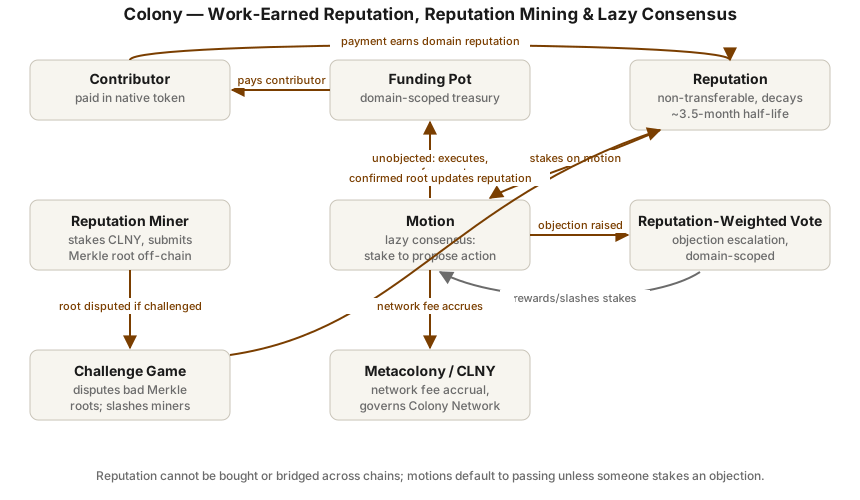 Open full-size diagram
Summary
Colony is one of Ethereum's oldest DAO-framework experiments: a protocol for "internet-native organizations" in which influence is earned through work rather than bought as tokens. Conceived around 2014 by Jack du Rose (the jewelry designer behind Damien Hirst's diamond skull "For the Love of God"), with Alex Rea and Collin Vine, and specified in a white paper co-authored by Rea, Aron Fischer, and du Rose, Colony spent years in research before shipping its "Glider" v1 contracts to Ethereum mainnet in early 2019. Because mainnet gas costs made day-to-day organizational use impractical, Colony v2 launched on xDai (later Gnosis Chain) on February 15, 2021, sold 20M CLNY through its own "Coin Machine" sale mechanism in December 2021, and migrated to Arbitrum One with a v3 app in 2024, where it continues today with a narrower focus on payments and treasury tooling for teams. Its core intellectual contributions — decaying, non-transferable, domain-scoped reputation; governance-by-exception ("lazy consensus" motions); and an off-chain reputation-mining game — remain among the most fully realized alternatives to plutocratic token voting ever deployed.
Design (Mechanism)
- Work-earned reputation. Members earn reputation by being paid in a colony's native token; reputation is non-transferable and cannot be bought. It is scoped to the domain (team) in which the payment occurred and propagates up the domain hierarchy, so influence tracks where you contributed.
- Reputation decay. Reputation decays continuously (documented at launch as a half-life of roughly 3.5 months), so past contributors cannot dominate indefinitely; power must be continually re-earned.
- Reputation mining. Because computing decaying, hierarchical reputation on-chain is infeasible, Colony computes the reputation tree off-chain. "Reputation miners" stake CLNY, submit Merkle-root hashes of the reputation state, and defend them in a challenge–response dispute game — an application-specific optimistic rollup avant la lettre.
- Lazy consensus (motions & disputes). Rather than voting on everything, any sufficiently-reputed member can stake tokens on a "motion" to take an action. If no one counter-stakes an objection within a window, the motion passes without a vote. Objections escalate to a reputation-weighted vote in the relevant domain, with stakes rewarded or slashed by outcome. Voting is the exception path, not the default.
- Domains, pots, and permissions. Colonies are hierarchies of domains with their own funding pots; role-based permissions (root, funding, administration, architecture, arbitration) allow progressive decentralization from admin-run to fully motion-governed.
- Metacolony and CLNY. The Colony Network itself is governed by the Metacolony, whose token CLNY is used for reputation mining and captures network fees.
- Coin Machine. An extension selling tokens in fixed-price batches, adjusting price between batches based on demand — designed to suppress front-running and pump-and-dump dynamics; used for Colony's own CLNY sale (Dec 14, 2021, on Gnosis Chain, KYC-whitelisted, wrapped-CLNY, 5% per-buyer cap).
Outcome
Partial success, still ongoing. The contracts work and have run continuously since 2019; the reputation and motions systems functioned in production; real DAOs used it — most notably ShapeShift DAO, which ran its workstream budgeting and contributor payments through Colony on Gnosis Chain. But adoption never approached that of the simpler stack (Snapshot + Gnosis Safe + token voting) that won the 2021 DAO boom. Colony repeatedly paid a heavy timing tax: a ~5-year research-to-launch gap (2014→2019), a v2 launch that had to abandon Ethereum mainnet over gas costs, and a 2024 forced migration off Gnosis Chain to Arbitrum One in which existing colonies could not be migrated automatically — reputation could not be bridged, and communities had to recreate colonies from scratch (Gnosis support ended December 31, 2024). The team acknowledged at v2 launch that the contracts were too large and fast-moving for practical audit, and, tellingly, that decentralized voting itself wasn't available at launch. By the mid-2020s Colony repositioned toward pragmatic "finance for teams": staged/split payments, multi-sig permissions, and treasury UX on Arbitrum. CLNY remains a niche asset.
Why it worked
- The mechanism design was unusually deep and actually shipped: decaying merit-based reputation plus lazy consensus is a genuine, working alternative to coin voting, not just a paper design.
- Governance-by-exception matched organizational reality — most decisions are uncontroversial, so defaulting to "proceed unless challenged" kept overhead low while preserving accountability via stakes.
- Domain-scoped budgets gave real DAOs (e.g., ShapeShift's workstreams) a practical way to delegate treasury authority without full centralized control.
- Longevity: open-source (GPL-3.0), continuously maintained contracts across three chains over seven-plus years.
Where the design broke
- Complexity tax: the full reputation/mining/motions machinery was hard to audit, hard to explain, and heavy to operate, while the market standardized on lightweight, legible tools (Snapshot votes, Safe multisigs).
- Timing: five years from concept to v1 meant Colony missed the 2017 ICO wave's energy and arrived just before the 2021 boom rewarded simpler tooling.
- Chain dependence: gas priced it off Ethereum mainnet; choosing xDai/Gnosis marginalized it from mainnet DeFi; the non-bridgeable reputation forced a destructive migration to Arbitrum that reset communities.
- Reputation-by-payment is gameable at the edges (self-dealing payments confer reputation) and made bootstrapping awkward for organizations that don't pay in their native token.
Lessons
- Non-transferable, decaying reputation is a viable, deployed answer to plutocracy — but its computation layer (off-chain mining, no bridgeability) can become the system's least portable, most fragile component.
- Lazy consensus / governance-by-exception dramatically reduces governance overhead and has quietly become the norm (optimistic governance, veto modules); Colony proved it on-chain years early.
- Mechanism sophistication does not win markets; legibility and composability do. A worse-but-simpler stack (token voting + multisig) captured the DAO boom.
- State that cannot move chains (reputation trees) is a strategic liability; design identity/merit systems for portability from day one.
- Long stealth research phases are dangerous in crypto: the environment (gas costs, L2 landscape, competitor norms) shifts faster than a five-year roadmap.
Redesign (EDITORIAL — hypothesis, not fact)
This is editorial hypothesis, not fact. A modern Colony would keep its two crown jewels — decaying work-earned reputation and lazy-consensus motions — and shed the bespoke infrastructure around them. Reputation mining would be replaced by a ZK- or validity-proven off-chain computation posting portable state roots readable from any chain, making reputation bridgeable and eliminating the migration trap that reset its communities in 2024. Reputation issuance would be decoupled from raw native-token payments (gameable via self-dealing) and instead attach to attestation-signed payments approved through motions, with peer challenge windows. Rather than a monolithic framework, it would ship as modules for the winning substrate — a Safe module and a Snapshot/optimistic-governance strategy — so existing DAOs could adopt "decaying reputation-weighted lazy consensus" incrementally instead of migrating wholesale. Coin Machine's demand-responsive batched sale mechanism deserves a standalone revival as a launch primitive. The wager is that Colony's ideas failed on packaging and portability, not on merit.
Sources
- Colony White Paper — primary (docs)
- colonyNetwork smart contracts (GitHub, GPL-3.0) — primary (contract)
- Glider: The first of many elementary spaceships (v1 mainnet release) — primary (docs)
- Colony v2 Launch on Ethereum mainnet and xDai — primary (docs)
- Au revoir, Gnosis Chain: Colony's chain migration — primary (docs)
- Colony is going multi-chain (Arbitrum expansion) — primary (docs)
- Colony Knowledge Realm (docs) — primary (docs)
- ShapeShift DAO x Colony (governance)
- Can the launch of Colony v2 relieve DeFi's governance woes? (Cointelegraph) (news)
- Colony — IQ.wiki (analysis)
Related experiments
Last verified: 2026-07-26 · Spot an error? Suggest a correction