Commons Stack
A toolkit-and-culture project (Augmented Bonding Curve, Conviction Voting, Trusted Seed) for funding and governing 'commons' microeconomies, best known through its flagship instantiation, the Token Engineering Commons.
▶ Run interactive simulation animated mechanism with editable parameters
How it works onchain
 Open full-size diagram
Summary
Commons Stack, co-founded in 2019 by Griff Green, Jeff Emmett, and Tamara Helenius (with research partner BlockScience/Michael Zargham), set out to give "impact communities" a reusable library of economic and governance primitives — most famously the Augmented Bonding Curve (ABC) and Conviction Voting — plus a "Cultural Build" methodology drawing on Elinor Ostrom's commons-governance principles. The idea grew out of conversations at Devcon IV in Prague (2018) between Green, Emmett, and Zargham, and out of the Giveth orbit of Ethereum public-goods projects. Rather than being a single protocol, Commons Stack is a template factory: its flagship instantiation was the Token Engineering Commons (TEC), which "hatched" on xDai/Gnosis Chain in 2021 with a 1.57M wxDAI raise and completed its "Commons Upgrade" (ABC + Conviction Voting + Disputable Voting) in early 2022. The TEC deliberately wound itself down after roughly six years (2019/2020–2025) and published a permanent public archive. Commons Stack itself continues as an association promoting its tool library; its membership arm, the Trusted Seed, became an independent Swiss entity (with the non-transferable CSTK score token, later renamed $TRUST).
Design (Mechanism)
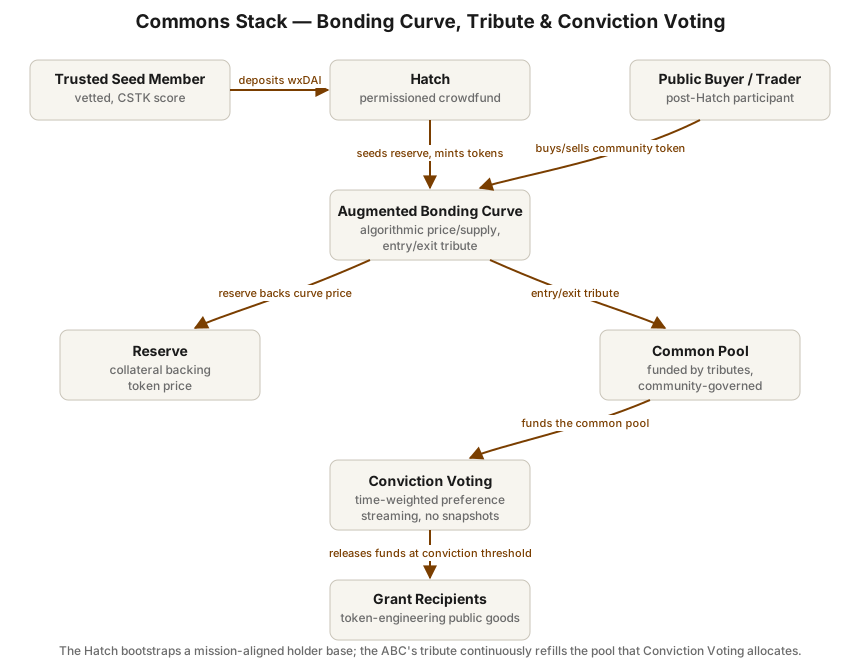
The Commons Stack "Commons" design composes several modules:
- Augmented Bonding Curve (ABC): an automated market maker for a community token where a configurable "tribute" (entry/exit fee) on every buy and sell is diverted from the reserve into a communally governed funding pool. The curve provides continuous liquidity while the tribute continuously funds the commons; the design came from BlockScience's complex-systems research and was first implemented in production for the TEC's 2021 launch.
- Conviction Voting: continuous, time-weighted "vote streaming" over funding proposals — support accrues conviction the longer it is held, and proposals pass when conviction crosses a threshold scaled by the amount requested. It replaces discrete majority votes with an always-on preference signal resistant to last-minute vote swings. Its first live use (2020) ranked Gitcoin grants for Panvala matching.
- Hatch: a permissioned initialization crowdfund (the TEC Hatch was open only to Trusted Seed members) that seeds the reserve and mints initial tokens before the ABC opens publicly; parameters were chosen by community "param parties" and dashboard-mediated parameter competitions (TEC proposal #83 for the Hatch, #149 for the Commons Upgrade).
- Trusted Seed / CSTK: a non-transferable reputation-style score token on xDai (contract 0xc4fbE68522ba81a28879763C3eE33e08b13c499E) representing vetted, values-aligned members with "skin in the game" — an identity/qualification layer intended to keep early speculation out of new Commons launches.
- Cultural Build: explicit Ostrom-inspired norms, Praise (peer-recognition contribution tracking feeding rewards), and deliberative parameter selection, treated as co-equal with the smart contracts.
Outcome
Mixed, and best judged through the TEC. The TEC Hatch raised 1,571,223.57 wxDAI in 30 days (against an 800k minimum), grew to 200+ contributors, and after the Commons Upgrade its ABC routed over $300,000 of tributes into the common pool, which funded token-engineering grants, education, and research via Conviction Voting. The TEC token fell roughly 98% from its all-time high (~$8.65 to ~$0.17), in line with the broader small-cap DAO collapse, and the TEC chose a deliberate wind-down, concluding around 2025 and publishing an official archive (announced July 2026) that pointedly "takes no position on the TEC's success or failure." Conviction Voting became a widely copied primitive (Gitcoin/Panvala ranking, 1Hive Gardens lineage, many DAO funding systems), which is arguably Commons Stack's most durable output. The Trusted Seed spun out as an independent Swiss association (2020, $TRUST token 2022), and Commons Stack the organization persists in a quieter, rebranded advocacy/tooling role.
Why it worked
- The mechanisms shipped and functioned as designed on-chain for years: the ABC provided continuous liquidity plus a real funding stream, and Conviction Voting allocated a real treasury without governance capture incidents.
- Rigorous engineering culture: cadCAD simulation with BlockScience, public parameter competitions, and deliberation gave participants genuine ownership of the economic design — a model for legitimacy-by-process.
- The permissioned Hatch (Trusted Seed) successfully filtered early holders for mission alignment rather than pure speculation.
- Ideas outlived the flagship: conviction voting and tribute-augmented curves entered the standard DAO design vocabulary.
Why it failed or underperformed
- The ABC's continuous-funding premise depends on sustained net buy pressure; in a bear market, tribute revenue and reserve value shrank together, so the "perpetual funding" loop underdelivered relative to the vision.
- A niche cause (funding token-engineering research) had a small natural buyer base; the token's ~98% drawdown from ATH left the flagship commons economically thin.
- Extremely high process overhead — months of param parties, two full parameter competitions, heavy cultural infrastructure — consumed contributor energy that a small community could not indefinitely sustain; the TEC ultimately chose dissolution.
- Commons Stack never became a widely reused "stack": few other Commons launched with the full template, versus many projects cherry-picking single components.
Lessons
- Continuous-funding mechanisms tied to token demand (ABC tributes) are procyclical: they fund least precisely when the community most needs runway. Pair them with countercyclical reserves or exogenous revenue.
- Legitimacy-by-deliberation is powerful but expensive; parameter co-creation should be time-boxed, because process cost scales faster than community capacity.
- Modular primitives spread further than integrated templates — conviction voting's independent adoption outperformed the full "Commons" bundle, so design for unbundling.
- A deliberate, documented wind-down with a public archive is itself a governance contribution; most DAOs simply fade, destroying the evidentiary record.
- Gating genesis participation by vetted reputation (Trusted Seed) can genuinely shape holder culture, but it also caps the demand side of the token economy.
Redesign (EDITORIAL — hypothesis, not fact)
This section is editorial hypothesis, not fact. A modern Commons Stack redesign might decouple the funding pool from token price: keep conviction voting over the treasury, but replace ABC tribute revenue with a diversified endowment (stables + staked ETH yield) seeded by the Hatch, so grants survive bear markets. The bonding curve could remain as an optional liquidity venue with a small tribute rather than the primary funding engine. Second, ship the stack as audited, one-click deployable modules (a "commons factory" on an L2) with default parameters derived from the TEC's empirical data, offering a 30-day rather than multi-month launch path. Third, keep Trusted Seed-style vetting for governance weight but not for capital contribution — non-transferable governance score plus open economic participation — to widen the demand base without surrendering culture. Finally, institutionalize the TEC's best late-stage decision: a pre-committed dissolution/archive protocol triggered by runway or participation thresholds, so every Commons ends legibly or renews deliberately.
Sources
- Commons Stack — About us (team, timeline) — primary (docs)
- Introducing the Commons Stack (Jeff Emmett, 2019) — primary (docs)
- CSTK: The Token of the Commons Stack Trusted Seed — primary (docs)
- Deep Dive: Augmented Bonding Curves (Commons Stack) — primary (docs)
- TEC Handbook — A Brief History (Hatch and Commons Upgrade) — primary (docs)
- A Brief History of Conviction Voting (Michael Zargham, BlockScience) — primary (analysis)
- Official TEC Archive (dissolution announcement, TEC forum) — primary (governance)
- Token Engineering Commons — stakeholder/token analysis (Shermin Voshmgir) (analysis)
- The Commons Stack: Realigning Incentives Towards Public Goods — Case Study (Felix Fritsch) (analysis)
- Token Engineering Commons (token.kitchen analysis) (analysis)
Related experiments
Last verified: 2026-07-26 · Spot an error? Suggest a correction