MolochDAO
A minimalist 'minimum viable DAO' launched in 2019 to pool ETH and fund Ethereum public goods, whose ragequit exit mechanism became a foundational primitive for onchain governance.
▶ Run interactive simulation animated mechanism with editable parameters
How it works onchain
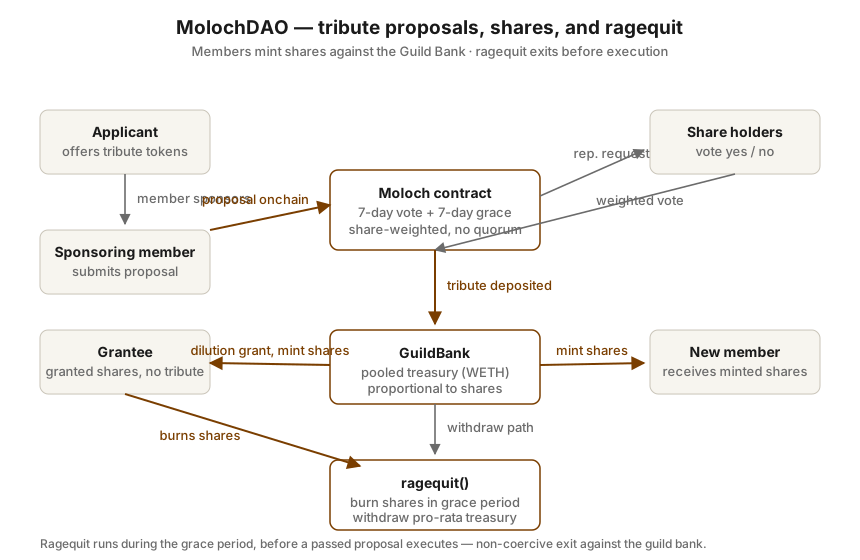 Open full-size diagram
Summary
MolochDAO is a minimalist grant DAO deployed to Ethereum mainnet on 14 February 2019 (summoned at ETHDenver) to solve the "tragedy of the commons" around funding Ethereum public goods — initially research, clients, and tooling for Eth2. It was summoned by Ameen Soleimani (co-founder of SpankChain), with a whitepaper authored by Arjun Bhuptani, James Young, Layne Haber, and Rahul Sethuram. Roughly 22 founding members each contributed ~100 ETH, and the DAO later drew high-profile deposits (including reported 1,000-ETH commitments associated with Vitalik Buterin and the Ethereum Foundation). Its defining contribution was less the money than the design: a deliberately tiny, auditable smart contract ("minimum viable DAO") whose ragequit exit primitive influenced almost every DAO framework that followed. The name derives from Scott Alexander's essay "Meditations on Moloch," invoking Moloch as the god of destructive coordination failures — the DAO being the counter-coordination mechanism.
Design (Mechanism)
Moloch v1 is two small Solidity contracts: the Moloch governance contract and a GuildBank holding pooled funds (originally a single approved token, WETH).
- Shares & voting: Membership is denominated in non-transferable voting shares. Each share represents a proportional claim on the guild bank and one vote.
- Tribute proposals: An existing member sponsors a proposal on behalf of an applicant, who offers a "tribute" (tokens) in exchange for newly minted shares. Grant recipients can be granted shares without tribute.
- Dilution-based grants: Rather than transferring ETH out, the DAO typically mints new shares to a grantee, diluting existing members — grantees can then ragequit to withdraw their proportional treasury share as funds.
- Voting period + grace period: A ~7-day voting period is followed by a ~7-day grace period, with no quorum requirement (proposals can pass with minimal turnout).
- Ragequit: The signature primitive. During the grace period, any member who did not vote yes can burn their shares and withdraw their exact proportional share of the guild bank before a decision executes. This makes majority governance non-coercive: you can never be forced to fund something you object to, so hostile capture of the treasury is economically pointless.
- Dilution bound: A safety parameter limiting how much a single proposal can dilute members if many ragequit simultaneously.
Moloch v2 (a later collaborative standard with MetaCartel and ConsenSys's The LAO) added multi-token treasuries (whitelisted ERC-20s), non-voting "loot" shares for contributor compensation, a "guild kick" to jail non-performing members, a submit-then-sponsor workflow that removed an unsafe token-approval vector (flagged by Nomic Labs), and pull-based internal accounting. v3 (Baal) further modularized the design.
Outcome
Outcome status: major_success — as a mechanism, not as a large capital allocator.
- In 2019 the DAO grew to 75+ members across 20+ countries, voted on 100+ proposals, and distributed roughly $285k across 20+ grants. Recipients included Sigma Prime (
$40k security audit), Lodestar ($30k Eth2 tooling), NodeFactory, Kyokan, and Tornado Cash (~$40k). Cumulative distributions have been cited at "over $1M" across later years. - The v1 treasury contract (0x1fd1…9f1) remains live on Ethereum with an ongoing balance and thousands of transactions; a v3 treasury (0x519f…f5b) is also active as of 2026.
- The far larger legacy is architectural: Moloch spawned MetaCartel, The LAO, and the DAOhaus platform, and its ragequit/minimal-contract pattern became a template copied by dozens of grant DAOs and studied as canonical DAO design.
Why it worked
- Radical minimalism: A tiny codebase meant a small attack surface, cheap auditing, and high trust — a direct reaction to The DAO (2016) hack. Simplicity was the security model.
- Ragequit removed the trust problem: Non-coercive exit meant members did not have to trust the majority or each other, lowering the bar to pooling capital with strangers.
- Speed and legitimacy: Funding decisions in ~10 days, plus a founder and early cohort embedded in the Ethereum core community, gave it credibility and real deal flow that generic grant programs lacked.
- Forkability: The MIT-licensed, self-contained design was trivial to copy, seeding an ecosystem of Moloch forks rather than competing with them.
Limitations and criticisms
- Small scale relative to ambition: A few hundred thousand dollars in year-one grants was modest relative to Ethereum's funding gap; Moloch never became the primary Eth2 funding vehicle it aspired to be.
- Whale-weighted, low-quorum governance: One-share-one-vote with no quorum concentrated influence in large depositors and left many proposals decided by thin participation — a persistent critique.
- Sustainability: The dilution-for-grants model steadily draws down a fixed treasury with no built-in replenishment; commentators argued the model was structurally unsustainable without continuous new tribute.
- v1 rigidity: The single-token, immutable v1 was too constrained for broader use, which is precisely why v2/v3 had to be built.
Lessons
- Constraints can be the feature: Shipping the smallest possible correct contract bought security and trust that a feature-rich DAO could not; minimalism was a governance choice, not just an engineering one.
- Exit rights beat voting rights: Guaranteed, proportional, pre-execution exit (ragequit) neutralizes treasury capture more effectively than elaborate voting rules — a primitive worth copying wherever pooled funds face contested decisions.
- A primitive can outlive its program: Moloch's dollar impact was modest, but by being forkable and legible it propagated a design pattern across the entire DAO landscape — optimize mechanisms for reuse, not just for the founding org.
- No-quorum + share-weighting invites plutocracy: Cheap-to-reason-about voting rules have real distributional consequences; simplicity in governance math can quietly centralize power.
Redesign (EDITORIAL — hypothesis, not fact)
The following is the researcher's opinion, not established fact.
If rebuilt today, a Moloch successor should keep the ragequit core untouched — it remains the design's crown jewel — while addressing sustainability and participation. Concrete hypotheses: (1) Replace the drawdown-only treasury with a replenishing endowment — pair grant issuance with a yield-bearing or streaming-revenue guild bank (e.g., productive stablecoin/LST holdings) so the DAO can fund in perpetuity rather than spending to zero. (2) Add conviction voting or quadratic weighting on top of shares to dampen whale dominance and reward sustained rather than one-shot preference, mitigating the no-quorum plutocracy problem without reintroducing coercion. (3) Introduce milestone-based, streamed grants (superfluid-style) with clawback via a guild-kick analog, so funding tracks delivery instead of paying upfront and hoping. (4) Move ragequit accounting to an L2 to cut the gas cost that historically made exit and voting expensive for small members, broadening real participation. The through-line: preserve costless exit as the trust anchor, but make entry, participation, and funding renewable so the mechanism can outgrow the "small pool of aligned insiders" ceiling that capped the original.
Sources
- Moloch v1/v2 smart contracts (MolochVentures/moloch) — primary (contract)
- MolochDAO: Moloch Treasury (v1) — Etherscan — primary (contract)
- MolochDAO Whitepaper (MolochVentures) — primary (docs)
- Moloch — 2019 Year in Review (official Medium) — primary (retrospective)
- Epicenter EP 297 — Ameen Soleimani on Moloch DAO — primary (retrospective)
- AMA: Ameen Soleimani, Co-Creator of Moloch DAO (Messari) — primary (retrospective)
- Dystopian Ethereum fund MolochDAO approves first grant (Decrypt) (news)
- DAOrayaki Research — MolochDAO v1, v2, v3 (analysis)
Related experiments
Last verified: 2026-07-26 · Spot an error? Suggest a correction