Aave
Pooled-liquidity lending protocol that pioneered flash loans and aTokens, migrated from ETHLend's P2P model to become DeFi's largest money market with staked-token backstop insurance and its own GHO stablecoin.
▶ Run interactive simulation animated mechanism with editable parameters
How it works onchain
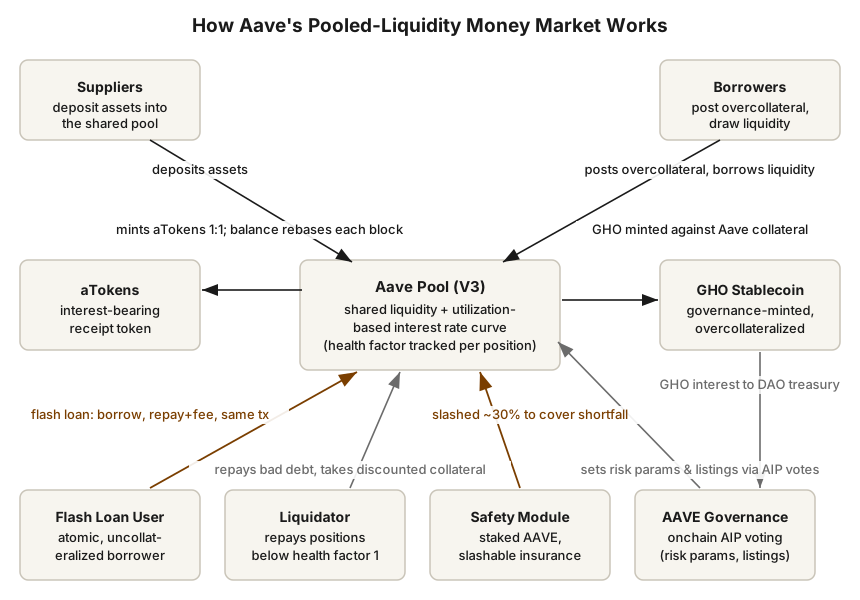 Open full-size diagram
Summary
Aave is the archetypal pooled-liquidity money market and, by most measures, the largest lending protocol in DeFi. It began life as ETHLend, a peer-to-peer loan-matching marketplace founded in 2017 by Finnish law student Stani Kulechov, which raised roughly $16M in a November 2017 ICO for its LEND token. P2P order matching proved illiquid and slow, so the team rebranded to Aave ("ghost" in Finnish) in 2018 and rebuilt around shared liquidity pools. Aave V1 launched on Ethereum mainnet on January 8, 2020, introducing two mechanisms that became DeFi primitives: aTokens (interest-bearing deposit receipts whose balances rebase upward in real time) and flash loans (uncollateralized loans that must be repaid within a single transaction). In October 2020 the protocol executed the "Aavenomics" migration — 100 LEND per 1 AAVE — handing governance to token holders and creating a staked-AAVE Safety Module as a slashable insurance backstop. Successive versions (V2 in Dec 2020, V3 in 2022) and deployments across a dozen-plus chains carried Aave to a peak TVL above $40B in late 2025; the protocol also issues GHO, a native overcollateralized stablecoin, and reports trillions of dollars in lifetime deposit volume.
Design (Mechanism)
- Pooled liquidity, algorithmic rates. Suppliers deposit assets into a shared pool and receive aTokens 1:1; borrowers post overcollateral and draw from the pool. Interest rates follow a utilization-based kinked curve: cheap below an optimal utilization point, steeply rising above it to pull rates back toward liquidity. Interest accrues continuously to aToken balances.
- aTokens. Transferable, composable claim tokens whose balance grows block-by-block — a design that let other protocols treat Aave deposits as yield-bearing collateral and helped kick off DeFi's "money Lego" era.
- Flash loans. Any amount of pool liquidity can be borrowed with zero collateral if repaid plus fee within one atomic transaction. This turned atomicity itself into a credit primitive — used for arbitrage, collateral swaps, self-liquidation, and (by attackers) for capital-free exploits of other protocols.
- Liquidations. Positions whose health factor drops below 1 can be partially repaid by anyone in exchange for discounted collateral, keeping the pool solvent.
- Safety Module. AAVE (and later AAVE/ETH LP tokens) staked in the Safety Module earn incentives but can be slashed (up to ~30%) to cover shortfall events — an explicit, tokenized insurance-of-last-resort. In 2025 governance began replacing it with "Umbrella," an aToken-based coverage system.
- Governance. Fully onchain AAVE-token voting (AIPs), starting with AIP-1, which executed the LEND migration. Risk parameters, listings, and deployments are set by governance, supported by professional service providers (e.g., BGD Labs, risk managers).
- V3 refinements. Efficiency mode (higher LTV among price-correlated assets), isolation mode for riskier collateral, supply/borrow caps, and cross-chain "portals."
- GHO. A governance-minted, overcollateralized stablecoin borrowed directly against Aave collateral, with interest paid to the DAO treasury; sGHO savings and multi-chain expansion followed.
Outcome
Aave is a major success and one of DeFi's most systemically important protocols. It was the second DeFi protocol to cross $1B TVL (August 2020), and by late September 2025 exceeded $40B TVL — the largest lending market onchain. Official site metrics claim $3.46T in lifetime deposits, ~$1T in lifetime borrows, and ~$1.9B in lifetime interest paid to suppliers over 6+ years of uninterrupted operation. The core protocol has never suffered a solvency-breaking hack; the most notable stress event was the November 2022 CRV short-squeeze manipulation, which left roughly $1.6M in bad debt that the DAO absorbed — a validation, at small scale, of the backstop design. GHO surpassed a ~$500–580M market cap by early 2026, and V3 deployments span Ethereum, L2s, and alt-L1s (most recently Monad in July 2026), with a hub-and-spoke V4 architecture in rollout per official docs. TVL remains cyclical — down from ~$30B peaks to ~$14.5B in May 2026 amid market drawdown — but Aave's market share among lenders has stayed dominant.
Why it worked
- Right abstraction at the right time: replacing P2P matching with pooled liquidity removed the coincidence-of-wants problem that killed ETHLend, just as DeFi summer created demand for passive yield and leverage.
- Genuine mechanism invention: flash loans and rebasing aTokens were novel, composable primitives that made Aave infrastructure other builders depended on.
- Credible risk management: conservative overcollateralization, per-asset parameters governed by professional risk teams, caps and isolation in V3, plus a funded, slashable insurance backstop gave large depositors institutional-grade confidence.
- Clean decentralization path: the Aavenomics migration converted an ICO-era token into a governance and insurance asset with real function, and governance has demonstrably steered upgrades for years.
- Relentless iteration: V1→V2→V3→V4, multichain deployment, and GHO kept Aave ahead of forks (which were numerous) rather than being displaced by them.
Limitations and criticisms
Several real weaknesses persist alongside the protocol's success: flash loans lowered the cost of attacking other protocols, an externality Aave's design imposed on the ecosystem; the 2022 CRV incident showed thin-liquidity collateral could be weaponized against the pool; "stable rate" borrowing was eventually deprecated after proving mispriced and exploitable in edge cases; governance concentration and reliance on a few service providers remain fair criticisms; and TVL is strongly pro-cyclical, halving in the 2026 drawdown. GHO also spent its early months persistently below peg before mechanisms (e.g., the GHO Stability Module and savings rate) tightened it.
Lessons
- Pooled liquidity beats P2P matching for credit markets onchain — the ETHLend→Aave pivot is the canonical proof that market structure, not demand, was the bottleneck.
- Atomicity is a mechanism-design resource: flash loans showed that transaction-level atomicity can substitute for collateral, creating both enormous utility and a new attack-capital channel for the whole ecosystem.
- An explicit, funded backstop (slashable staking) is worth more than implicit promises — small shortfall events become absorbable line items instead of death spirals.
- Collateral risk is market-microstructure risk: the CRV squeeze proved that listing decisions must price manipulability and exit liquidity, not just volatility — motivating V3's caps and isolation mode.
- Progressive decentralization via a purposeful token migration (utility + insurance + governance) ages far better than a fundraising-only token.
Redesign (EDITORIAL — hypothesis, not fact)
This section is editorial hypothesis, not a factual account. A modern redesign might: (1) price flash-loan fees dynamically by pool utilization and by downstream systemic-risk heuristics, partially internalizing the externality flash loans impose on other protocols; (2) make the backstop pre-positioned per-market (as Umbrella attempts) rather than a global slashing pool, so coverage scales with each market's actual tail risk and stakers can price specific exposures; (3) replace listing-by-governance-vote with permissionless, isolated markets plus a curated "prime" tier — capturing Morpho/Euler-style modularity without giving up Aave's blue-chip trust core; and (4) route a fixed share of interest revenue into an onchain, transparent bad-debt reserve from day one, so insurance capacity grows mechanically with borrow volume instead of depending on token-price-sensitive staking incentives.
Sources
- Aave official site (stats, social links) — primary (docs)
- Aave Address Book — AaveV3Ethereum (BGD Labs) — primary (contract)
- Aavenomics — token migration & Safety Module design — primary (docs)
- AIP-1: LEND to AAVE migration — primary (governance)
- Aave documentation (V4 addresses, protocol resources) — primary (docs)
- Wikipedia — Aave (history: ETHLend 2017, V1 Jan 2020) (archive)
- Glassnode Research — AAVE token migration and staking analysis (analysis)
- CoinLaw — Aave statistics (TVL trajectory 2025–2026) (analysis)
Related experiments
Last verified: 2026-07-27 · Spot an error? Suggest a correction