Compound (COMP Liquidity Mining)
Compound's June 2020 COMP distribution paid protocol users a governance token per block for supplying and borrowing, inventing modern liquidity mining and igniting DeFi Summer.
▶ Run interactive simulation animated mechanism with editable parameters
How it works onchain
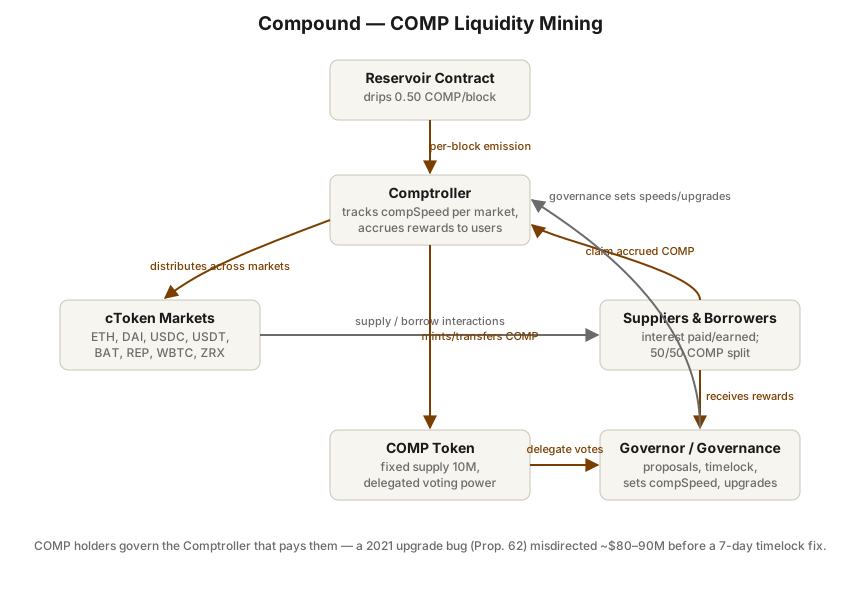 Open full-size diagram
Summary
Compound is an Ethereum money-market protocol (founded by Robert Leshner and Geoffrey Hayes) where users supply assets to earn interest and borrow against collateral. In early 2020 Compound Labs announced it would decentralize control of the protocol by distributing a governance token, COMP, to the people actually using it. Governance Proposal 007 activated the distribution on June 15, 2020: roughly 2,880 COMP per day (0.50 COMP per Ethereum block from a Reservoir contract) streamed to suppliers and borrowers across the protocol's markets, split 50/50 between the two sides and allocated across markets proportionally. Because COMP immediately traded at a high price, using Compound suddenly paid users to borrow — sometimes at net-negative effective interest rates. This was the spark of "DeFi Summer": total value locked exploded, "yield farming" entered the lexicon, and within months nearly every DeFi protocol had copied the mechanism. As a decentralization and growth experiment it worked; as an incentive design it also demonstrated the now-canonical failure modes of liquidity mining — mercenary capital, reward-driven distortion of markets, and a costly upgrade bug in 2021 that misdirected tens of millions of dollars of COMP.
Design (Mechanism)
- Token: COMP, a fixed-supply (10,000,000) ERC-20 with delegated vote weight; token holders govern the protocol (propose/vote on parameter changes, new markets, upgrades). 4,229,949 COMP was set aside for users; a September 2020 update brought community-directed allocation to 5,004,949 COMP (just over half of supply), including 500,000 COMP for Coinbase Earn.
- Emission: A Reservoir contract dripped 0.50 COMP per block (~2,880/day) to the Comptroller, the protocol's central risk/accounting contract, which distributed it continuously to users. At that rate the user allocation would take roughly four years to distribute.
- Allocation rule (launch): Emissions were divided across the eight initial markets (ETH, DAI, USDC, USDT, BAT, REP, WBTC, ZRX) in proportion to the interest accrued in each market; within each market, half went to suppliers and half to borrowers, pro-rata to their balances. Users claimed accrued COMP when interacting with markets (above a 0.001 COMP threshold) or via an explicit claim.
- Governance-tunable: The interest-accrual weighting rewarded high-rate markets and was quickly gamed (farmers piled into BAT, then ZRX/USDT). Proposal 011 (passed July 2, 2020) changed allocation to be proportional to borrowing demand (USD borrowed) per market instead. Later, per-market "compSpeed" parameters let governance set emissions market by market, and Proposal 62 (September 2021) replaced the fixed 50/50 supplier/borrower split with governance-set ratios.
- Distribution philosophy: No public sale and no airdrop to non-users — COMP went to shareholders/team/investors (with vesting) and to protocol users, on the thesis that governance should belong to those with skin in the game.
Outcome
Immediate, enormous growth: within days of the June 15, 2020 launch COMP became the largest DeFi token by market cap, and Compound's TVL multiplied as farmers recursively supplied and borrowed to maximize rewards. The mechanism was cloned ecosystem-wide (Balancer, Curve, Yearn, Sushiswap's "vampire attack" on Uniswap, and hundreds of food-token forks), making liquidity mining the default go-to-market for DeFi in 2020–2021. Governance genuinely activated: 15 proposals in the first ~3 months, with parameter changes, oracle migration, and borrow caps all executed on-chain. Costs were also real: farming distorted Compound's own markets (BAT briefly became the most-borrowed asset for no economic reason), much of the emitted COMP was immediately sold, and on September 30, 2021 Proposal 62's Comptroller upgrade shipped a bug that let users claim wildly excessive COMP — roughly $80–90M at risk, with a fix (Proposal 64) only executable after the protocol's 7-day governance timelock; Compound Labs subsequently notified users who did not return excess COMP that the amounts could be reported to the IRS as taxable income. Emissions were repeatedly cut by governance in later years as the subsidy's marginal value faded. The protocol survived, remains a blue-chip lending market governed by COMP holders, and the distribution completed its decentralization goal — hence partial (not unqualified) success.
Why it worked
- Aligned distribution: Rewarding actual usage put governance power in the hands of users and applications rather than only speculators, and did so credibly on-chain, block by block.
- Bootstrapping flywheel: Paying both sides of the market subsidized rates, attracting liquidity, which improved rates organically, which attracted more users — the cold-start subsidy every marketplace needs, denominated in equity-like upside instead of cash.
- Composability and legibility: A simple per-block drip through one contract (Comptroller) was easy to audit, integrate, fork, and reason about; aggregators like Yearn could build on it immediately.
- Governance as product: Because COMP had real control (including over the emissions themselves), the token had a function beyond farming, and the community could iterate the mechanism (Proposals 011, 62) without the founding team.
Why it failed or underperformed
- Mercenary capital: Much of the attracted liquidity was rented, not earned; farmers dumped COMP and rotated to the next farm, imposing continuous sell pressure and decoupling TVL from durable usage.
- Reflexive gaming: Tying rewards to interest accrued made farmers inflate rates in thin markets (the BAT episode), distorting the very markets the protocol existed to serve; the rule had to be patched within two weeks.
- Wash-borrowing: Rewarding borrowers pro-rata paid users to borrow assets they didn't need, creating recursive supply/borrow loops that added risk without real demand.
- Upgrade fragility: The 2021 Proposal 62 bug showed that a governance-upgraded distribution contract is a live financial target; full decentralization meant the fix itself had to wait out a 7-day timelock while COMP drained.
- Subsidy dependence: Emissions bought growth but not loyalty; usage tied to incentives faded as emissions were cut, and the four-year drip diluted holders regardless of marginal benefit.
Lessons
- Liquidity mining is a customer-acquisition cost paid in equity: it is extremely effective at bootstrapping and extremely bad at retention unless the underlying product is sticky on its own.
- Reward formulas are adversarial surfaces. Any proxy metric (interest accrued, TVL, borrow volume) will be Goodharted within days; design for the farmed equilibrium, not the intended behavior, and keep parameters governance-tunable.
- Distributing governance to users, not just investors, is achievable on-chain and creates a legitimate path to decentralization — but paired with a timelock it also means bugs in the incentive plumbing cannot be hotfixed; incentive contracts deserve the same audit rigor and guardians (caps, circuit breakers) as custody contracts.
- Paying borrowers is paying for leverage: subsidizing both sides of a money market invites recursive positions that inflate metrics and systemic risk.
Redesign (EDITORIAL — hypothesis, not fact)
This section is editorial hypothesis, not fact. A redesigned COMP distribution might: (1) vest farmed rewards (e.g., 6–12 month linear vesting or lockup-boosted rewards à la later ve-designs) to filter mercenary capital and align sellers with governance; (2) reward only organic-demand signals — fees actually paid, borrow positions held against non-recursive collateral — rather than raw balances, to kill wash-borrowing loops; (3) cap per-market emissions with automatic decay and require governance action to renew, making the subsidy's cost visible instead of a default; (4) route a fraction of protocol reserves to buy back or match emissions so incentives taper into fee-backed rewards; and (5) protect the incentive plumbing with an emergency guardian empowered only to pause claims (not change parameters), which would have contained the 2021 Proposal 62 leak without compromising the timelock's protections. The trade-off is honest: every one of these frictions would have slowed the explosive, fork-driven network effects that made the original design historically important.
Sources
- Expanding Compound Governance (Robert Leshner, Compound Labs) — primary (retrospective)
- COMP Governance & Distribution Update (Robert Leshner, Compound Labs) — primary (retrospective)
- Compound v2 Docs — Comptroller (COMP distribution / compSpeed) — primary (docs)
- COMP token contract on Etherscan — primary (contract)
- compound-finance/compound-protocol (Comptroller.sol) — primary (contract)
- Compound Changes COMP Distribution Rules Following 'Yield Farming' Frenzy (CoinDesk) (news)
- Compound bug leaves $80 million in COMP at risk of being misrewarded (The Block) (news)
- DeFi protocol Compound mistakenly gives away $90 million to users (CNBC) (news)
- Exploring the Design Space of Liquidity Mining (Multicoin Capital) (analysis)
Related experiments
Last verified: 2026-07-26 · Spot an error? Suggest a correction