Redacted Cartel
An Olympus DAO fork that weaponized protocol-owned treasury assets for the Curve gauge wars, then pivoted from reflexive (3,3) tokenomics into a real-yield meta-governance business (Hidden Hand, Pirex) before rebranding as Dinero.
▶ Run interactive simulation animated mechanism with editable parameters
How it works onchain
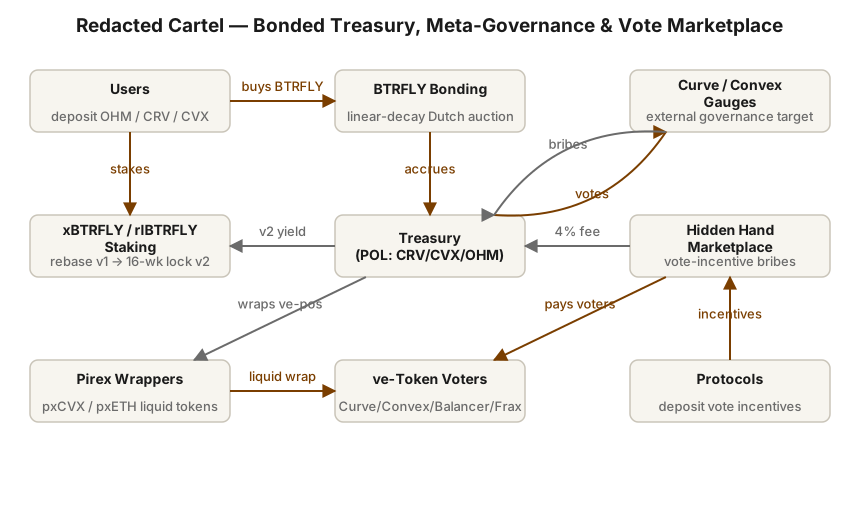 Open full-size diagram
Summary
Redacted Cartel launched on December 15, 2021 as an officially sanctioned Olympus DAO fork (approved by OHM governance with >99% support) with a sharper thesis than most OHM clones: instead of accumulating stablecoin liquidity, its protocol-owned treasury would hoard governance tokens — CRV, CVX, and OHM itself — and sell that aggregated voting power into the Curve gauge wars. Its two-day "Operation: Swallowtail" Treasury Bootstrapping Event, a modified Dutch auction with a linearly declining price, raised roughly $73.3M in OHM, CRV, and CVX for BTRFLY. When rebase tokenomics collapsed across the OHM-fork sector in 2022, Redacted executed one of the cleanest pivots of the cycle: it shipped Hidden Hand (a general-purpose vote-incentive "bribe" marketplace), Pirex (liquid wrappers for vote-escrowed positions), migrated BTRFLY to a fixed-supply v2 with a revenue-locked staking model (rlBTRFLY), and in July 2024 rebranded entirely to Dinero Protocol (BTRFLY→DINERO at 1:2000), focused on pxETH liquid staking. The Cartel brand died; the team, treasury, and product line survived.
Design (Mechanism)
Phase 1 — weaponized POL (2021–2022). Classic Olympus machinery — bonding (sell BTRFLY at discount for treasury assets), rebase staking (xBTRFLY), and (3,3) reflexivity — but pointed at governance assets. The treasury's CRV/CVX (later TOKE, FXS, and others) generated "bribe" yield and meta-governance influence over Curve/Convex gauge emissions, which the DAO could rent out. The TBE's high-start, linearly-decaying Dutch auction was designed to defeat bots and let the market find a clearing price.
Phase 2 — vote-market infrastructure (2022). Hidden Hand generalized the bribe marketplace across protocols (Balancer, Frax, Tokemak — via the January 2022 acquisition of Votemak — and more): protocols deposit incentives, ve-token voters claim them for voting a certain way; roughly 96% of incentives flow to voters and ~4% is taken as protocol fee, split between treasury, rlBTRFLY lockers, and a DAO reserve. Pirex created liquid, auto-compounding wrappers (e.g., pxCVX) over locked vote-escrow positions.
Phase 3 — real yield and exit from reflexivity. Redacted v2 (announced 2022) hard-capped supply, migrated v1 BTRFLY (0xC0d4…) to v2 (0xC5512…), and replaced rebase APY with rlBTRFLY: a 16-week revenue lock paying biweekly distributions from actual protocol cash flow (Hidden Hand fees, Pirex fees, treasury yield). In May–July 2024, a governance vote (unanimous among rlBTRFLY voters) rebranded the protocol to Dinero; BTRFLY migrated to DINERO at 1:2000, rlBTRFLY was replaced by simpler DINERO staking, and the flagship product became Pirex ETH (pxETH/apxETH liquid staking), which surpassed 50,000 ETH staked by January 2025.
Outcome
Partial success. The original experiment — an OHM-fork whose (3,3) flywheel would durably concentrate Curve governance power — failed as designed: BTRFLY's price collapsed with the rest of the rebase sector in 2022, and the dilutive rebase model was abandoned within a year. But the underlying bet (aggregated governance influence is a sellable product) proved correct: Hidden Hand became one of DeFi's principal vote-incentive marketplaces, the treasury raised in the TBE was never lost or hacked, and the team converted it into a durable product business. The 1:2000 migration ratio in 2024 is an honest ledger of how much the original token design underperformed, while the protocol itself continued operating as Dinero (pxETH, pxUSD in development), with institutional engagement (e.g., a reported Nomura-linked ETH staking fund collaboration) by 2025. No major exploit of core Redacted contracts was found in this research.
Why it worked
- A real revenue thesis under the memes. Unlike most OHM forks, the treasury bought productive assets (CRV/CVX bribe yield, meta-governance rent) rather than just liquidity, so there was a business to pivot to when reflexivity died.
- Fast, decisive pivots. Votemak acquisition (Jan 2022), Hidden Hand, Pirex, v2/rlBTRFLY real-yield migration, then the Dinero rebrand — each abandoned a broken mechanism instead of defending it.
- Aligned distribution at launch. The Dutch-auction TBE raised $73M from participants who self-selected as gauge-war stakeholders (paying in OHM/CRV/CVX), seeding both capital and a relevant community.
- Selling picks and shovels. Hidden Hand monetized the gauge wars regardless of which protocol won them — a marketplace fee model with ~4% take.
Where the design broke
- Rebase tokenomics were structurally unsound. High-APY dilution plus a token trading far above backing meant BTRFLY holders absorbed catastrophic drawdowns when (3,3) confidence broke sector-wide in early 2022.
- Launch valuation front-ran the business. The TBE priced BTRFLY against a narrative, not cash flows; the 1:2000 DINERO migration ratio implicitly records the gap.
- Meta-governance demand was cyclical. Bribe volumes and treasury yields tracked the Curve-wars bull market; when emissions-driven liquidity mining cooled, so did the core revenue line, pushing the team toward ETH staking instead.
- Brand debt. "Cartel" and "bribes" branding, edgy and effective in 2021, became a liability for institutional partnerships — a stated motivation for the Dinero rebrand.
Lessons
- Protocol-owned treasuries are only as good as what they buy: acquiring cash-flowing governance assets gave Redacted a second act that stablecoin-farming OHM forks never had.
- Token mechanics and business models can be decoupled: the team survived by migrating tokenomics twice (rebase → revenue-lock → plain staking) while keeping treasury and products continuous.
- A marketplace on top of a war beats a position in the war: Hidden Hand's fee on all bribes outlasted the value of any single vote-power hoard.
- Migration ratios are truth serum: a 1:2000 conversion is a public, onchain admission of how much value the original design destroyed — better than pretending, but a warning about launch-time overpricing.
- Names are mechanisms too: aggressive branding can bootstrap a community in a bull market and block institutional distribution later.
Redesign (EDITORIAL — hypothesis, not fact)
This section is editorial hypothesis, not fact. A redesigned Redacted would skip the rebase phase entirely: bootstrap the treasury with the same Dutch auction, but issue a fixed-supply token whose only claim is a share of vote-market and wrapper fees (the rlBTRFLY model from day one), removing the reflexive APY that manufactured, then vaporized, billions in paper value. The bribe marketplace should have been the launch product, with the treasury's own CRV/CVX serving as seed inventory and a credibility bond rather than the headline. Emissions, if any, should vest against realized protocol revenue (emit only when fees are earned), making dilution self-limiting in bear markets. Finally, governance-asset treasuries should publish a mandate (target portfolio, yield floor, divestment rules) so holders can price the treasury as a fund instead of a black box — and the brand should be boring enough to sign a bank.
Sources
- Operation: Swallowtail — Treasury Bootstrapping Event (official Mirror post) — primary (docs)
- Redacted v2 Guide: Token Migration & rlBTRFLY (official Mirror post) — primary (docs)
- BTRFLY to DINERO Token Migration is Live (official Mirror post) — primary (docs)
- Etherscan: Redacted Cartel BTRFLY V2 Token — primary (contract)
- Dinero Docs (official, successor brand) — primary (docs)
- 0xSami tweet on the rebrand to @dinero_xyz — primary (retrospective)
- Dinero Protocol GitHub (hidden-hand-contracts, pirex-eth-contracts) — primary (contract)
- DeSpread Research: Redacted Cartel — The Hidden Hand of the DeFi World (analysis)
- Crypto Briefing: Redacted Cartel, DeFi's Meta-Governance Protocol (analysis)
- Wintermute DeFi Governance Digest (27 May 2024): rebrand to Dinero, 1:2000 migration (analysis)
- IQ.wiki: REDACTED (analysis)
- Multifarm: Hidden Hand by Redacted Cartel (fee mechanics) (analysis)
Related experiments
Last verified: 2026-07-26 · Spot an error? Suggest a correction