Aerodrome
A ve(3,3) AMM launched as Base's designated liquidity hub, forking Velodrome's fee-to-voter model to route 100% of trading fees and bribes to locked veAERO holders rather than a protocol treasury.
▶ Run interactive simulation animated mechanism with editable parameters
How it works onchain
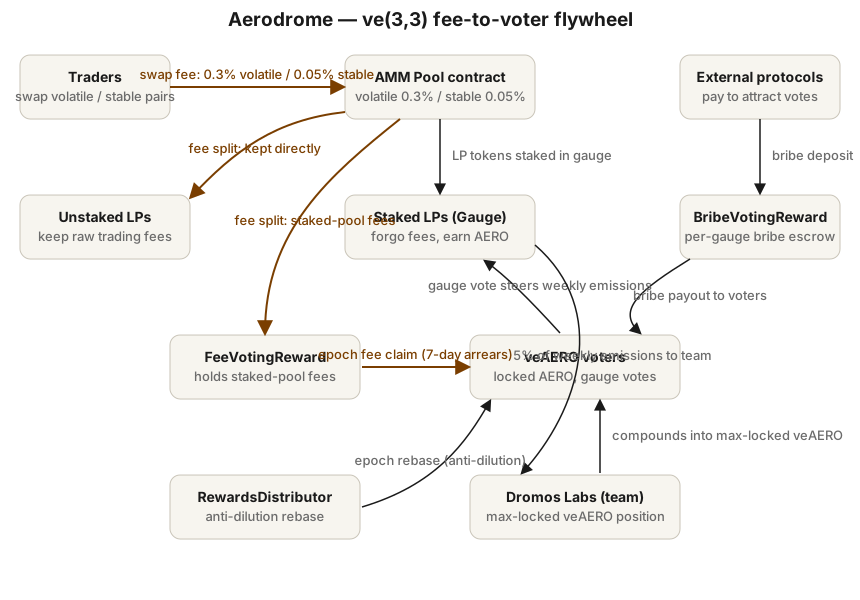 Open full-size diagram
Summary
Aerodrome Finance launched on August 28, 2023 as the designated central liquidity venue for Coinbase's Base network, deployed by the team behind Velodrome (Optimism's leading ve(3,3) exchange) together with roughly twenty ecosystem partners. It is a direct fork of Velodrome's "ve(3,3)" design — itself derived from Andre Cronje's Solidly — combining a Uniswap/Curve-style AMM (separate volatile 0.3%-fee pools and stable 0.05%-fee pools) with a vote-escrow governance token, veAERO. AERO holders can lock their tokens for up to four years to receive veAERO, a non-transferable, vote-weighted NFT that directs weekly AERO emissions to specific liquidity pools via gauge votes and, in exchange, claims essentially all of the trading fees and third-party "bribes" (voter incentives) paid to that pool. The protocol itself keeps no swap-fee cut — it launched with $0 in VC funding and no public token sale, framing itself as public infrastructure for Base rather than a fee-taking business. Within roughly two years it became Base's dominant DEX by both TVL and volume.
Design (Mechanism)
Aerodrome's core loop is the same fee-for-votes flywheel introduced by Solidly and refined by Velodrome:
- Pools and swap fees. Liquidity pools are split into "volatile" pairs (uncorrelated assets, 0.3% swap fee) and "stable" pairs (like-valued assets such as stablecoin/stablecoin, 0.05% fee), each an isolated pool contract. Fees accrue per-pool in the pool's own tokens.
- Gauges and emissions. Each pool can be assigned a
Gaugecontract. LPs who stake their LP tokens in a pool's gauge earn a share of that week's AERO emissions, proportional to the gauge's total vote weight relative to all gauges. - The fee/emissions trade-off. LPs who stake into a gauge to earn emissions forgo their pool's trading-fee reward; those fees are instead routed to the
FeeVotingRewardcontract and, per the contracts' specification, accrue to the veAERO holders who voted for that pool — paid out one epoch (7 days) in arrears. LPs who choose not to stake keep the raw trading fees on their position instead of emissions. This means 100% of protocol trading-fee revenue is claimed either by unstaked LPs directly or by veAERO voters, with no fee ever routed to a protocol treasury. - veAERO voting and bribes. Every epoch, veAERO holders vote across gauges to steer that week's AERO emissions. Because emissions inflate supply and drive liquidity toward whichever pools attract votes, external protocols pay "bribes" — voter incentive tokens deposited directly into a pool's
BribeVotingRewardcontract — to attract veAERO votes toward their pool. Bribes, like redirected trading fees, flow entirely to the voters who chose that pool. - Rebasing anti-dilution. To offset dilution from emissions for locked (non-participating) holders, a
RewardsDistributorcontract rebases veAERO positions proportional to their share of total locked AERO, calculated each epoch transition. - Emission schedule. Emissions began near 15,000,000 AERO/week, decaying roughly 1% weekly; once weekly issuance fell under ~6,000,000 AERO (around week 92, mid-2025), the schedule switched to a supply-relative model issuing a small fixed percentage (initially ~30 basis points) of circulating supply per week, preventing emissions from ever reaching zero while keeping long-run inflation low and predictable.
- Team allocation. 5% of weekly emissions are routed to Dromos Labs (the operating team), which compounds them into a permanently max-locked veAERO position rather than receiving a direct treasury cut of swap fees — aligning the team's incentive with long-term protocol health rather than short-term revenue extraction.
Outcome
Status: major_success. Aerodrome became Base's dominant decentralized exchange within roughly a year of Base's mainnet maturing, and by mid-2025 was reported to hold on the order of $600M–$1.3B in TVL depending on measurement window, capturing roughly half of all DEX trading volume on Base and generating estimated annualized swap revenue in the $200M range (with essentially none of it retained by a protocol treasury — it all flows to LPs and veAERO holders). Cumulative lifetime trading volume was reported approaching $250B by mid-2025. AERO itself became one of the more liquid Base-native governance tokens, and the protocol's gauge-vote/bribe market attracted an ecosystem of vote-market aggregators analogous to Convex/Votium on Curve.
Why it worked
- Fork of a proven, battle-tested mechanism. Rather than designing a novel incentive system, Aerodrome inherited Velodrome's already-refined ve(3,3) implementation (which itself fixed known flaws in the original Solidly design, such as unbounded veNFT proliferation and mercenary-emission gaming), reducing mechanism-design risk.
- Ecosystem-anointed distribution. Launching as the de facto official liquidity layer for a major, well-marketed L2 (Base) gave Aerodrome an immediate, durable source of demand: new Base projects needed liquidity, and Aerodrome was the default venue partners and Coinbase-adjacent projects pointed to.
- Zero fee leakage to a treasury. Directing 100% of trading fees and bribes to LPs/voters (rather than skimming a protocol cut) made providing liquidity and locking AERO strictly more attractive than on fee-extracting competitors, which helped bootstrap TVL quickly.
- No VC allocation, no public sale. The absence of a large VC unlock overhang reduced a structural sell-pressure risk common to many DEX tokens' first 12–24 months.
Limitations and criticisms
- Emissions-driven TVL is mercenary by construction. Because gauge votes chase bribes and emissions rather than durable fee yield in many pools, a meaningful share of "TVL" is incentive-farmed and can rotate out quickly if emissions or bribe budgets fall, a structural feature inherited from every ve(3,3)/Solidly-style design.
- Governance concentrates around the largest lockers. As with Curve's veCRV, voting power in veAERO accrues to whoever locks the most AERO for the longest duration; sophisticated actors and vote-market aggregators can out-influence smaller, longer-term-aligned holders, converting gauge weight into a de facto auction for emissions.
- Complexity risk. The fee/emissions trade-off, epoch-lagged fee payouts, rebase mechanics, and dual pool types create a system with many interacting contracts (
Voter,Gauge,FeeVotingReward,BribeVotingReward,RewardsDistributor,VotingEscrow), each a potential surface for implementation bugs even though the underlying economic logic is well understood from Velodrome's prior operation. - Reflexive dependency on Base's growth. Aerodrome's revenue and relevance are structurally tied to activity on a single L2; a slowdown in Base-native trading volume or new-project deployment directly compresses fee revenue with no diversification cushion.
Lessons
- Forking a mechanism that has already been production-hardened elsewhere (Velodrome on Optimism) meaningfully de-risks a new deployment compared with launching a novel incentive design from scratch on a new chain.
- Routing 100% of fees to LPs/voters and zero to a protocol treasury can be a competitive advantage during the bootstrap phase, even though it forgoes a direct, sustainable revenue stream for the operating entity — the team instead captured value through a compounding, max-locked emissions allocation rather than fee-skimming.
- Being anointed as the "official" liquidity layer of an ecosystem is a distribution advantage that mechanism design alone cannot replicate — Aerodrome's growth trajectory is inseparable from Base's own growth and marketing, not purely a function of superior tokenomics.
- Fee-to-voter redirection and bribe markets recreate the same governance-financialization dynamics seen in the Curve Wars — any protocol adopting ve(3,3) inherits both its liquidity-bootstrapping strengths and its tendency to turn governance into a purchasable emissions-direction service.
Redesign (EDITORIAL — hypothesis, not fact)
The following is the researcher's editorial hypothesis, not established fact.
A next iteration could address Aerodrome's two main structural risks — mercenary/reflexive TVL and single-chain revenue concentration — without discarding the ve(3,3) core that clearly works. First, introduce a time-weighted fee-eligibility curve so that bribe-chasing capital which enters and exits a gauge within a single epoch receives a smaller share of that epoch's redirected fees than capital that has been staked for several consecutive epochs, dampening the incentive to rotate purely for one-off bribe payouts while preserving the core fee-for-votes flywheel for genuinely sticky liquidity. Second, generalize the Voter/Gauge/VotingEscrow stack into a chain-abstracted deployment so a single veAERO lock could direct emissions and claim fees across Aerodrome-standard pools deployed on multiple chains (not just Base), diversifying the protocol's revenue base the way a multi-chain Curve deployment diversifies veCRV's exposure. Third, since bribes already exist as an emergent market layer, formalize and cap bribe-driven vote share (e.g., a maximum fraction of a gauge's votes that can be attributed to bribed veAERO in a given epoch) so organic trading-fee yield remains a visible, comparable signal alongside pay-to-play emissions direction — preserving price discovery for "real" pool quality rather than letting emissions allocation be fully auctioned to the highest bribing protocol.
Sources
- Aerodrome Finance official site — primary (docs)
- Aerodrome Finance docs — primary (docs)
- aerodrome-finance/contracts — SPECIFICATION.md (GitHub) — primary (contract)
- Aerodrome (AERO) token contract — BaseScan — primary (contract)
- Aerodrome TVL, Fees, Revenue & Volume — DefiLlama (analysis)
- Aerodrome tops $1b in TVL amid dominance on Base — crypto.news (news)
- Aerodrome Tokenomics — How AERO Accrues 100% of Protocol Fees — Tokenomics.com (analysis)
- What Is Aerodrome Finance? Ultimate Guide to Base's Principal DEX — CoinGecko Learn (analysis)
- Has Aerodrome Finance Become the Leading DeFi Protocol on Base — DWF Labs Research (analysis)
Related experiments
Last verified: 2026-07-28 · Spot an error? Suggest a correction