Maverick Protocol
A 'Dynamic Distribution AMM' whose liquidity bins automatically shift with price, letting LPs run directional and auto-recentering strategies — a technically influential DEX design whose volume-to-TVL efficiency never converted into durable liquidity or market share.
▶ Run interactive simulation animated mechanism with editable parameters
How it works onchain
 Open full-size diagram
Summary
Maverick Protocol is a decentralized exchange built around the "Dynamic Distribution AMM," launched on Ethereum mainnet on March 8, 2023 after roughly two years of development, and subsequently deployed to zkSync Era (April 2023), BNB Chain (June 2023), and later Base, Arbitrum, and Scroll. Its core idea: instead of LPs manually rebalancing concentrated-liquidity ranges (the Uniswap v3 chore), the AMM itself mechanically shifts liquidity bins as price moves, according to a "movement mode" the LP chooses once at deposit. The project was co-founded by Alvin Xu (CEO) and Bob Baxley (CTO) and raised a $9M seed led by Founders Fund with Pantera, Binance Labs, Coinbase Ventures and others; the MAV token launched via Binance Launchpool in June 2023. Maverick became famous for extreme capital efficiency — routinely posting among the highest volume-to-TVL ratios of any DEX and briefly ranking as high as #2 DEX by 24-hour volume, with $17B+ volume in its first nine months — yet its TVL peaked around $62M (July 2023, DefiLlama) and by mid-2026 had decayed to roughly $2M across all chains, even as V2 (June/July 2024) shipped further gas and programmability improvements.
Design (Mechanism)
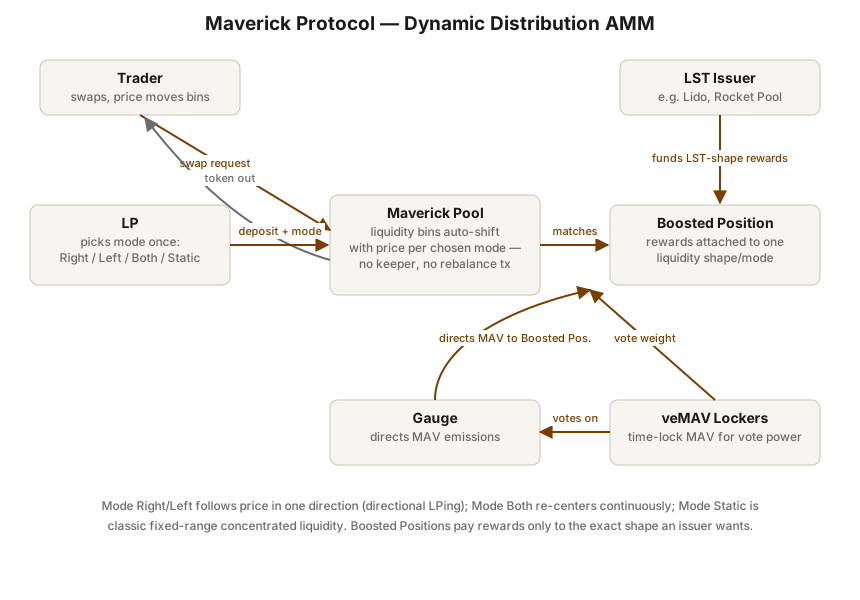
Maverick's AMM organizes liquidity into discrete price "bins" (similar in spirit to Trader Joe's Liquidity Book) and adds native automation on top. At deposit, an LP selects one of four modes:
- Mode Right: liquidity follows price only upward; the LP supplies quote asset below the active bin, and the AMM re-concentrates it as price rises — effectively a directional bullish LP strategy.
- Mode Left: the mirror image — liquidity follows price downward; a bearish/single-sided strategy.
- Mode Both: liquidity chases price in both directions, acting as a perpetually re-centering dynamic range order (maximum fee capture, maximum exposure to permanent loss in choppy markets).
- Mode Static: classic non-moving concentrated liquidity, with preset distributions (exponential, flat, single-bin).
Crucially, the rebalancing is performed natively by the pool contract as swaps move price — no keepers, no external vault managers, no rebalance transactions for the LP to pay. This turned "active liquidity management" from an off-chain service (Arrakis, Gamma) into a protocol primitive.
The second layer was incentives. Boosted Positions (Phase 2, mid-2023) let any project attach token rewards to a specific liquidity shape in a specific mode rather than to a whole pool — so an LST issuer like Lido or Rocket Pool could pay only for liquidity concentrated exactly where it keeps the peg tight. This attracted Lido, Frax, Rocket Pool, Liquity, and Swell, and made Maverick a hub for LST/LRT liquidity. The veMAV vote-escrow layer (staking MAV for time-weighted voting power) was added to direct emissions toward Boosted Positions; V2 (2024) generalized this with a "veFactory" allowing any token to have its own vote-escrow flywheel, plus programmable pools (hook-like custom logic) and significantly lower swap gas costs.
Outcome
Technically, Maverick delivered. Its capital efficiency claims were borne out on-chain: it repeatedly topped volume/TVL rankings, processed $17B+ volume in nine months on modest TVL, and V2 reported ~$32B cumulative volume by its first anniversary (July 2025). It became a preferred venue for pegged-asset pairs (LSTs, stables) where its auto-concentration is most valuable, and V2 on Scroll entered that chain's top-3 DEXes by volume within a week of the July 2024 deployment.
Commercially, it underperformed. TVL peaked near $62M in July 2023 and slid persistently — roughly $2M by July 2026 (DefiLlama) — while Uniswap, Curve, and aggregator-fed rivals retained the liquidity war. The MAV token (Binance Launchpool, June 2023) fell far from its highs, weakening the veMAV incentive flywheel. Much of Maverick's volume was aggregator-routed and mercenary; when Boosted Position rewards from LST projects rotated elsewhere (and the 2023–24 LST incentive wave ebbed), TVL followed. The protocol continues to operate across six mainnets — it is alive, audited-infrastructure-grade DeFi plumbing — but it did not durably convert design superiority into market share.
Why it worked
- It automated a real, universal pain point. Uniswap v3 proved concentrated liquidity but outsourced rebalancing to LPs; Maverick internalized it at the contract level, with zero keeper cost and one-time strategy selection.
- Directional LPing was genuinely novel. Modes Right/Left created an instrument between limit orders and passive LPing that no major AMM offered natively.
- Surgical incentives. Boosted Positions let issuers pay only for the liquidity shape they actually wanted — dramatically better incentive ROI than pool-wide farming, which is why serious LST projects adopted it.
- Excellent product-market fit for pegged pairs, where price lives in a narrow band and auto-recentering maximizes fee capture per dollar of TVL.
Where the design broke
- Capital efficiency is a double-edged sword: needing less TVL per unit of volume means the protocol accumulates less sticky capital, a smaller ve-locked base, and a smaller balance-sheet moat; TVL is also the metric narratives and listings reward.
- Mode Both / dynamic modes concentrate losses as well as fees — in volatile ranging markets they systematically buy high and sell low ("permanent loss"), and sophisticated LPs learned this, limiting organic non-incentivized deposits.
- Mercenary flows: volume came largely via aggregators and TVL via Boosted Position rewards; neither built user-level loyalty, so when incentives rotated, both left.
- Liquidity-war incumbency: Uniswap's brand/integrations and Curve's entrenched ve-bribery ecosystem meant Maverick's better mousetrap faced enormous switching costs; MAV's price decline further sapped its own ve flywheel.
Lessons
- Automating LP strategy at the protocol layer works — Maverick proved keeper-less, contract-native liquidity movement is feasible and gas-viable, an idea echoed in later hook/programmable-pool designs.
- Volume/TVL efficiency is not a business model by itself. Fee revenue accrues per unit volume, but defensibility accrues per unit of locked, loyal capital; optimizing away TVL can optimize away your moat.
- Position-level incentives beat pool-level incentives for issuers — but incentive-attracted liquidity is rented, not owned, and churns with the reward schedule.
- Directional liquidity is a trading product and must be marketed as one: it carries strategy risk (adverse selection in ranging markets) that passive-yield framing obscures, limiting mainstream LP adoption.
- Being better late is worse than being adequate first in liquidity networks: incumbents' integration surface (aggregators, wallets, listings, LP tooling) is the real competitive terrain.
Redesign (EDITORIAL — hypothesis, not fact)
This section is editorial hypothesis, not fact. A redesigned Maverick might accept that its true customers were token issuers, not retail LPs, and productize accordingly: sell "liquidity-as-SLA" contracts where issuers pay for a guaranteed depth profile around a peg, with Maverick's modes as the execution engine and protocol-owned liquidity absorbing the permanent-loss risk in exchange for the fee stream — converting mercenary Boosted Position rentals into multi-quarter commitments. Second, the ve-flywheel could be collateralized by fee revenue rather than the MAV price (revenue-share escrow instead of emissions voting), decoupling incentive strength from token beta. Third, launching as the default embedded AMM of one or two rollups (exclusive sequencer-level integration, native gas rebates) rather than competing horizontally on six chains might have concentrated network effects where its gas advantage was decisive. Finally, packaging Modes Right/Left explicitly as structured products ("onchain covered-call-like LP notes") with clear risk disclosure could reach the sophisticated LP audience the mechanism actually suits.
Sources
- Maverick Protocol Docs (docs.mav.xyz) — AMM overview, liquidity modes, V2 contract addresses — primary (docs)
- Maverick AMM: The Revolutionary Dynamic Distribution AMM (official Medium) — primary (docs)
- Maverick Protocol 2024 Outlook (official Medium) — primary (retrospective)
- Maverick Ecosystem Incentive Program (Boosted Positions, official Medium) — primary (docs)
- Maverick Voting-Escrow Update (official Medium) — primary (governance)
- DefiLlama — Maverick Protocol TVL, fees and volume (analysis)
- Bitget News — DeFi infrastructure Maverick Protocol launches v2 (news)
- IQ.wiki — Maverick Protocol (analysis)
Related experiments
Last verified: 2026-07-26 · Spot an error? Suggest a correction