Trader Joe Liquidity Book
Trader Joe's bin-based concentrated-liquidity AMM that made LP positions fungible and priced fees dynamically with an on-chain volatility accumulator.
▶ Run interactive simulation animated mechanism with editable parameters
How it works onchain
 Open full-size diagram
Summary
Liquidity Book (LB) is the "v2" AMM design launched on November 16, 2022 by Trader Joe, the Avalanche-native DEX founded in 2021 by pseudonymous developers Cryptofish and 0xMurloc (the project rebranded to LFJ in September 2024). LB was one of the first serious attempts to rethink concentrated liquidity after Uniswap v3: instead of continuous price ranges with NFT positions, it discretizes the price axis into fixed-width "bins," each acting as a constant-sum mini-pool, and issues fungible ERC-1155-style receipts for liquidity in each bin. It also introduced an oracle-free dynamic fee ("surge pricing") driven by an on-chain volatility accumulator. The design worked: it powered Trader Joe's breakout moment on Arbitrum in early 2023 (top-5 DEX by volume, ~15.7% of all ARB trading in the token's first week) and peaked above $400M TVL in v2.1 in April 2024. But the edge proved temporary — competitors copied or out-iterated the model, incentives rotated elsewhere, and combined LB TVL has since fallen to under $10M across versions as of mid-2026, even after a v2.2 hooks upgrade and expansion to Monad.
Design (Mechanism)
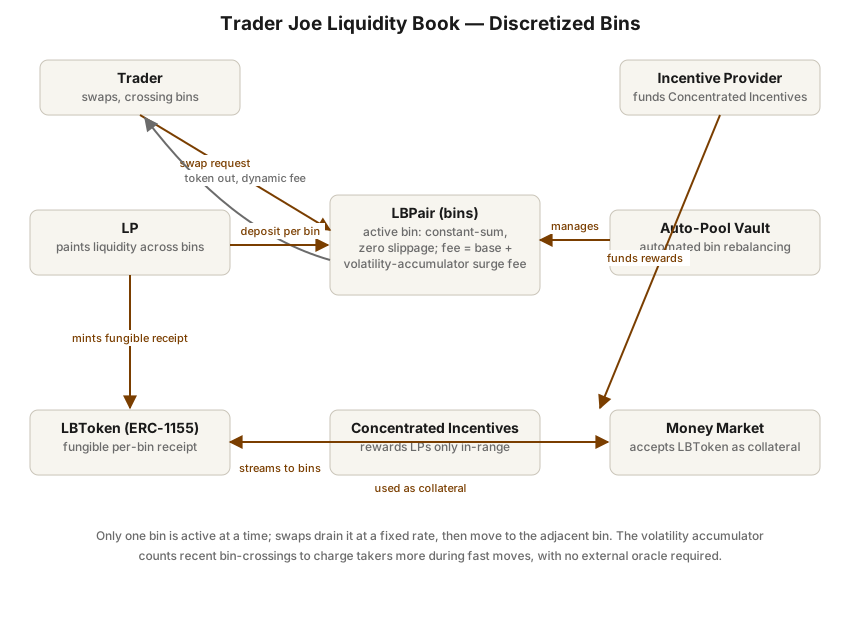
- Discretized bins. The price continuum is divided into discrete bins, each assigned a fixed exchange rate. Only one bin is "active" at a time; swaps consume its reserves at zero slippage within the bin (constant-sum, x + y = k), then move to the adjacent bin. Bin width is set by a per-pair "bin step" (e.g., 1 basis point for stable pairs), letting pool deployers tune granularity.
- Fungible liquidity receipts. Each bin's liquidity shares are fungible tokens (an ERC-1155-like LBToken), unlike Uniswap v3's NFT positions. This makes LP positions composable — vaults, money markets, and incentive programs can hold and account for them like normal tokens.
- Surge pricing via a volatility accumulator. Fees = base fee + variable fee. The variable fee is computed from an on-chain "volatility accumulator" that counts how many bins recent swaps have crossed and decays over time — no external oracle. Fast, large price moves (when LPs suffer most adverse selection) automatically charge takers more, compensating LPs for impermanent loss during volatility.
- Flexible liquidity shapes. Because deposits are per-bin, LPs can paint arbitrary distributions (uniform, curve, bid-ask) across bins in a single transaction; the whitepaper claimed capital efficiency up to thousands of times the constant-product baseline for tightly concentrated positions.
- Stack. Core contracts: LBFactory (pair registry/deployer), LBPair (swap/liquidity logic), LBRouter, LBQuoter; MIT-licensed, audited via a Code4rena contest (October 2022), with v2.1 additionally audited by Paladin and run through an Immunefi audit contest. v2.1 (April 2023) added permissionless pool creation and "Auto-Pools" (automated LP rebalancing vaults); v2.2 (June 2024) added hooks and fully on-chain "Concentrated Incentives" that stream rewards only to LPs inside a defined reward range.
Outcome
Phase one launched on Avalanche in November 2022 with stable and pegged pairs (USDC/USDT, sAVAX/AVAX). The defining test came with the February 2023 Arbitrum deployment: when the ARB token launched in March 2023, LB pools captured roughly 15.7% of total ARB volume in week one, Trader Joe's Arbitrum TVL rose over 300% to about $30M, JOE rallied, and the DEX briefly entered the top five by volume — a genuine product-market-fit moment for the bin model on high-volatility pairs. DefiLlama data shows Joe v2 peaking around $63M TVL (April 2023) and v2.1 around $418M (April 2024). Afterward the franchise faded: liquidity migrated to Uniswap deployments, aggregator-dominated flow, and newer venues; the September 2024 LFJ rebrand and v2.2's hooks/Concentrated Incentives (including a 755,000 ARB incentive program) did not reverse the trend. v2.2 peaked near $120M (September 2025, boosted by a Monad deployment) but combined LB TVL sits around $7M in July 2026. Outcome: partial_success — a validated, influential mechanism whose commercial lead eroded.
Why it worked
- The constant-sum bin gives zero slippage inside the active bin, which is measurably better execution for stable pairs and made LB the venue of choice during the ARB launch's volatility.
- Fungible per-bin receipts solved Uniswap v3's biggest composability complaint, enabling Auto-Pools and third-party vaults (e.g., SteakHut) without NFT-position plumbing.
- The volatility accumulator aligned fees with LP risk automatically and credibly (no oracle), attracting LPs to volatile pairs where flat-fee AMMs bleed.
- Shipping on cheap, fast chains (Avalanche, then Arbitrum at the right moment) let an active-management-heavy design actually be used.
Where the design broke
- Concentrated liquidity is a commodity: Uniswap v3's license expiry, forks, and ve(3,3)-style DEXes competed away the differentiation; the bin model itself was forked (including to other ecosystems).
- LB rewards active, sophisticated LPs; passive LPs in bins get run over during trends, so sustained TVL required continuous incentives (STIP, ARB programs) that eventually rotated elsewhere.
- The protocol's fortunes stayed coupled to its home chains' cycles — Avalanche's DeFi decline and Arbitrum's incentive churn drained flow, and aggregators made routing, not venue loyalty, decisive.
- Repeated re-launches (v2 → v2.1 → v2.2, plus a rebrand) fragmented liquidity and mindshare rather than compounding them.
Lessons
- Mechanism innovation buys a temporary edge, not a moat: LB's best week (ARB launch) proved the design, but execution quality is quickly copied; distribution and routing integrations are the durable asset.
- Making LP positions fungible is a large, underrated design win — composability with vaults and incentive systems is what turned bins into an ecosystem (Auto-Pools, Concentrated Incentives).
- Oracle-free dynamic fees (volatility accumulator) are a robust way to charge for adverse selection and have been widely imitated; static-fee AMMs systematically undercharge during volatility.
- Concentrated liquidity shifts risk to LPs' operational skill; a protocol that needs active LPs must either automate management natively or accept mercenary, incentive-dependent TVL.
- Version migrations are liquidity-fragmentation events; each one must offer LPs a migration path strong enough to overcome inertia, or the old and new pools cannibalize each other.
Redesign (EDITORIAL — hypothesis, not fact)
This section is editorial hypothesis, not established fact. A redesigned Liquidity Book would treat the volatility accumulator as the product, not a feature: expose it as a standardized, chain-native volatility oracle that any hook or vault can read, and route a share of surge fees to a protocol-owned insurance buffer that rebates LPs who were in-range during volatility spikes — converting the mechanism's honest pricing of adverse selection into a retention tool. Second, make Auto-Pools the default UX and the raw bin interface an expert mode, since the data suggests passive LPs cannot safely use bins directly. Third, avoid discrete v2.x re-deployments: with v2.2's hooks in place, fee logic and incentives should upgrade in place via hook modules so liquidity never fragments across versions. Finally, lean into the fungible-receipt advantage by pushing LB bin tokens as collateral primitives in lending markets, giving LP capital a second yield stream that flat incentives cannot match.
Sources
- Trader Joe Presents: Liquidity Book (official announcement, Nov 16, 2022) — primary (docs)
- LFJ Developer Docs — Liquidity Book contracts and deployment addresses — primary (docs)
- joe-v2 — The Liquidity Book AMM (source code, MIT) — primary (contract)
- Liquidity Book Whitepaper (Joe v2) — primary (docs)
- Code4rena audit contest repo (2022-10-traderjoe) — primary (audit)
- Introducing: Liquidity Book V2.1 (official) — primary (docs)
- Trader Joe joins top 5 DEX list as Liquidity Book model thrives on Arbitrum (news)
- Crypto Exchange Trader Joe Booms on Arbitrum, Spurring JOE Token Rally (news)
- Trader Joe Launches Liquidity Book V2.2 with hooks and Concentrated Incentives (news)
- Avalanche DEX Trader Joe rebrands to LFJ (Sept 2024) (news)
- DefiLlama — Joe V2 / V2.1 / V2.2 TVL (analysis)
- The Tie Research — Trader Joe's New AMM: Liquidity Book (analysis)
Related experiments
Last verified: 2026-07-26 · Spot an error? Suggest a correction