crvUSD (LLAMMA)
Curve's overcollateralized stablecoin that replaced cliff-edge liquidations with LLAMMA, an AMM that continuously converts collateral to stablecoin and back across price bands.
▶ Run interactive simulation animated mechanism with editable parameters
How it works onchain
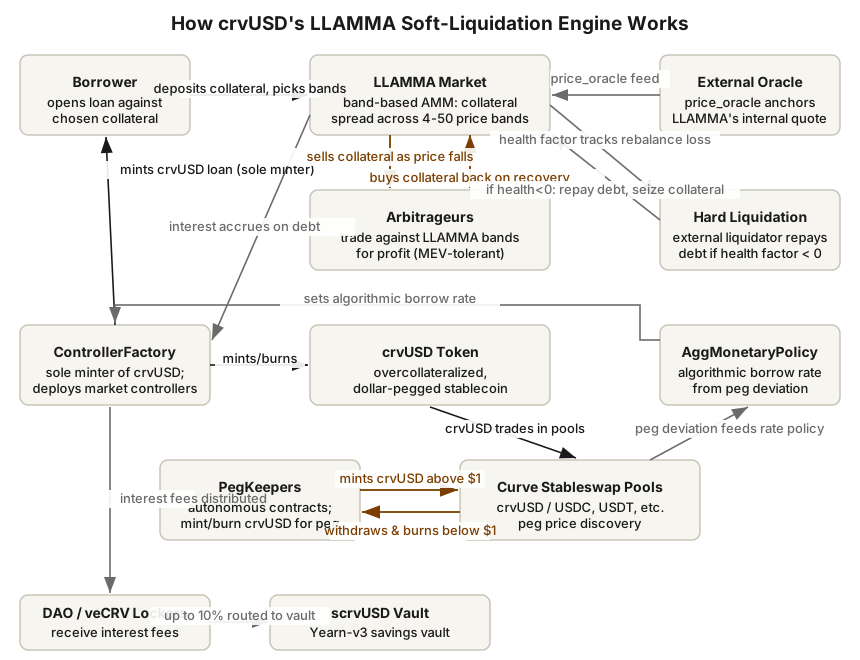 Open full-size diagram
Summary
crvUSD is Curve Finance's overcollateralized, dollar-pegged stablecoin, designed by Curve founder Michael Egorov. Its defining experiment is LLAMMA — the "Lending-Liquidating AMM Algorithm" — which discards the industry-standard liquidation model (a single price threshold at which a keeper seizes and auctions collateral) and replaces it with a special-purpose AMM in which each borrower's collateral is the liquidity. As the collateral's oracle price falls through a borrower-chosen range of price bands, arbitrageurs trading against the AMM progressively convert the collateral (e.g., ETH) into crvUSD; if the price recovers, the same mechanism converts it back ("de-liquidation"). The whitepaper and code were released in November 2022, and contracts were deployed to Ethereum mainnet on May 3, 2023. Three years on, crvUSD is a functioning mid-sized stablecoin (all-time-high supply around $181M entering 2025) whose core mechanism has performed largely as designed — a genuine mechanism-design success that has nonetheless remained an order of magnitude smaller than incumbents like DAI/USDS.
Design (Mechanism)
- Band-based collateral AMM. When opening a loan, a borrower deposits collateral into a LLAMMA market and selects 4–50 price bands; the collateral is spread evenly across them, Uniswap-v3-style. The bands collectively define a "liquidation range" rather than a single liquidation price.
- Soft liquidation and de-liquidation. LLAMMA's internal quote is anchored to an external oracle price (
price_oracle), but deliberately overshoots it inside the liquidation range. When the oracle price falls into a band, arbitrageurs profitably buy collateral from the AMM for crvUSD, converting that band's collateral into stablecoin; when price rises back, the skew reverses and arbitrageurs sell collateral back. The borrower's position thus rebalances continuously and automatically in both directions, with no keeper auctions. - Health and hard liquidation. Rebalancing is not free — each pass through bands costs the position a small percentage. A health factor tracks accumulated losses; only if health falls below zero can an external liquidator repay the debt and seize remaining collateral (hard liquidation).
- PegKeepers. Autonomous contracts mint uncollateralized crvUSD into designated Curve stableswap pools (against USDC, USDT, etc.) when crvUSD trades above $1 and withdraw/burn it when below, performing algorithmic open-market operations that also serve as the system's price feed.
- Monetary policy. Borrow rates are set algorithmically (AggMonetaryPolicy) as a function of crvUSD's deviation from peg and the fraction of supply held by PegKeepers: below-peg conditions raise rates to force debt repayment; above-peg conditions lower them.
- Fee flow. Interest accrues to the DAO and is distributed to veCRV lockers; since late 2024 up to 10% of crvUSD fees can be routed to the scrvUSD savings vault. Key contracts: crvUSD token
0xf939E0A0…c1B4Eand ControllerFactory (the token's sole minter)0xC9332fdC…738BC.
Outcome
crvUSD launched with ETH liquid-staking derivatives as flagship collateral and expanded to WETH, WBTC/tBTC and others; the same LLAMMA engine was later generalized into LlamaLend, Curve's permissionless lending market. Supply grew to a peak of roughly $181M going into 2025 — solid but modest next to DAI or later entrants like Ethena. The peg has held tightly through several stress events, including the June 12, 2024 episode (documented by LlamaRisk) around the UwU Lend exploit, when crvUSD briefly deviated upward. The mechanism's harshest live test came on June 13, 2024, when CRV fell 25%+ and Michael Egorov's own CRV-collateralized loans ($95M across five venues, including Curve's LlamaLend CRV market) were force-liquidated; the CRV market accrued roughly $10M of bad debt — too large a position for market depth, as Egorov publicly acknowledged — which he subsequently worked to repay. The crvUSD stablecoin itself remained solvent and pegged. In October–November 2024 Curve launched scrvUSD, a Yearn-v3-based savings vault, to bootstrap demand. The system remains live and actively developed; outcome is best read as a technically excellent, commercially middling partial success (ongoing).
Why it worked
Soft liquidation genuinely reduces borrower tail risk: instead of losing everything at one price tick with auction slippage, borrowers in volatile-but-recovering markets exit soft liquidation with only a few percent of value lost, and simulations and live history broadly confirmed this. Outsourcing liquidation execution to arbitrageurs made the system keeper-less and MEV-tolerant — arbitrage profit is the liquidation incentive. Anchoring the AMM to an external oracle while letting internal price overshoot created exactly the right incentive gradient. PegKeepers plus peg-sensitive interest rates gave crvUSD two mutually reinforcing stabilizers, and building atop Curve's existing stableswap liquidity and veCRV fee flywheel gave it distribution most new stablecoins lack.
Where the design broke
Adoption stayed modest: crvUSD launched into a market where DAI had incumbency and Ethena soon offered native yield, and holding crvUSD paid nothing until scrvUSD (18 months post-launch). Soft liquidation has a hidden cost — positions that chop sideways inside the liquidation range get repeatedly rebalanced and "ground down," a loss profile some borrowers found worse than expected. Peg defense concentrates liquidity and oracle authority in PegKeeper pools, a recognized fragility if incentives lapse. And the June 2024 CRV market bad debt showed LLAMMA does not repeal the oldest lending rule: collateral positions larger than market depth cannot be unwound cleanly, softly or otherwise — especially when the collateral is the protocol's own governance token borrowed by its founder.
Lessons
- Liquidation can be a continuous curve rather than a cliff: converting collateral gradually via arbitrage-driven AMM rebalancing materially reduces borrower losses in volatile markets and removes keeper/auction infrastructure entirely.
- Soft liquidation trades tail risk for grind risk — borrowers pay a small continuous toll in ranging markets instead of a catastrophic one-time loss; mechanism designers should surface this tradeoff explicitly.
- No liquidation mechanism protects against positions that exceed market depth; concentration limits (especially for self-referential collateral like a protocol's own token, held by insiders) matter more than liquidation math.
- A stablecoin's peg machinery (PegKeepers + rate policy) can be elegant and still insufficient for growth; demand-side yield (scrvUSD) proved necessary, arriving late.
- Novel mechanisms benefit from shipping whitepaper and code publicly months before launch — crvUSD's November 2022 code release enabled external review and simulation before real funds were at stake.
Redesign (EDITORIAL — hypothesis, not fact)
This section is editorial speculation, not a record of fact. A redesigned crvUSD might: (1) enforce per-market and per-address debt ceilings tied to on-chain liquidity depth of the collateral, which would have capped the June 2024 CRV exposure automatically; (2) share soft-liquidation arbitrage profit with the borrower (e.g., an internalized rebalancing auction) to reduce the sideways-chop grind; (3) diversify the peg oracle away from PegKeeper pools toward a redundant aggregate so peg defense and price discovery are not the same point of failure; and (4) launch a native savings rate on day one, treating demand generation as a first-class mechanism rather than an afterthought. The band-AMM core seems worth preserving unchanged — it is arguably the most successful new liquidation primitive since the keeper auction.
Sources
- LLAMMA Explainer — Curve Knowledge Hub — primary (docs)
- crvUSD ControllerFactory — Etherscan verified contract — primary (contract)
- curvefi/curve-stablecoin (official code repository) — primary (contract)
- Curve releases whitepaper and official code for its stablecoin — The Block (Nov 2022) (news)
- Curve Finance deploys native stablecoin on mainnet — CoinDesk (May 3, 2023) (news)
- Curve 2024 Report — Curve News — primary (retrospective)
- Introducing Savings crvUSD (scrvUSD) — Curve News — primary (docs)
- crvUSD Upward Depeg (June 12, 2024) Incident Report — LlamaRisk (analysis)
- Michael Egorov statement on June 2024 liquidations and $10M bad debt — primary (retrospective)
- crvUSD: a novel stablecoin by Curve — Galaxy Research (May 2023) (analysis)
- Curve Stablecoin — Deep Dive — Statemind (analysis)
Related experiments
Last verified: 2026-07-27 · Spot an error? Suggest a correction