Alex Masmej Personal Token
A 23-year-old founder sold $20,000 of his own ERC-20 token ($ALEX) as a tokenized income-share agreement — the canonical 'human IPO' that seeded the 2020-21 social-token wave.
▶ Run interactive simulation animated mechanism with editable parameters
How it works onchain
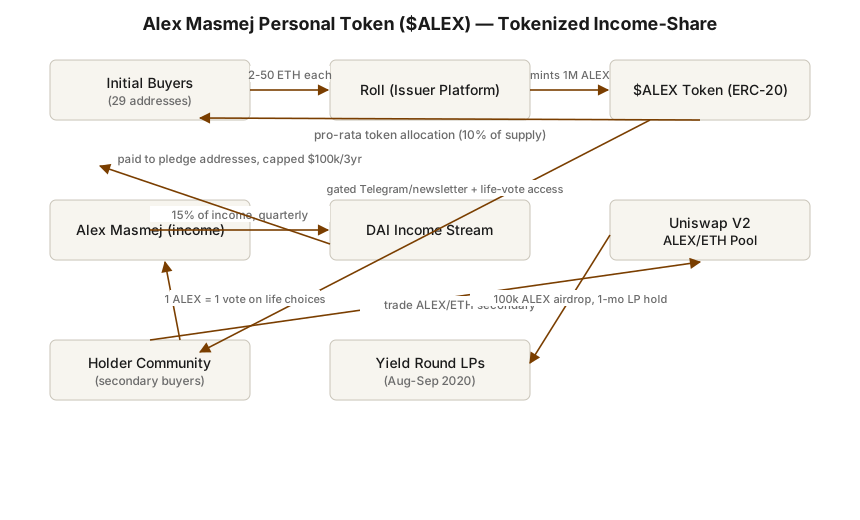 Open full-size diagram
Summary
In March–April 2020, Alex Masmej, a then-23-year-old French crypto founder whose income had collapsed at the start of COVID, sold 1,000,000 units of a personal ERC-20 token, $ALEX, for $20,000 — an event widely covered as the first "human IPO" on Ethereum. He described the instrument as "a blend between a small Income Sharing Agreement and a human IPO": buyers in the initial sale were entitled to 15% of all his income for three years, capped at $100,000 total, to be distributed quarterly in DAI. The sale, run with the social-money platform Roll (which issued the token), sold out in about five days to 29 participants. Masmej then ran a series of follow-on mechanism experiments — token-weighted voting over his own life choices ("Control My Life"), token-gated chat and newsletter access, and a liquidity-mining "Yield Round" on Uniswap V2. He used the proceeds to relocate to San Francisco and eventually co-founded the NFT social network Showtime (which raised a $7.6M seed round in 2021). $ALEX is the canonical reference point for the personal/social-token category that followed ($WHALE, BitClout, friend.tech, etc.).
Design (Mechanism)
- Instrument. $ALEX: 10,000,000 fixed supply ERC-20 issued via Roll on Ethereum mainnet (contract 0x8BA6DcC667d3FF64C1A2123cE72FF5F0199E5315). The initial offering sold 10% of supply (1,000,000 tokens) for a $20,000 target. Roll retained a large share of supply (6M+ per Masmej's August 2020 post) per its platform model.
- Tokenized ISA. Initial-sale buyers were promised 15% of Masmej's income for 3 years, capped at $100k (a nominal max ~5x on the $20k raised), paid quarterly in DAI pro rata to sale participants' pledge addresses. Explicitly, only the initial-round buyers were owed cash flows — secondary buyers got only "utility," avoiding open-ended dilution of the income claim.
- Sale structure. Minimum 2 ETH (
$250 at the time), maximum 50 ETH ($5,000) per participant; allocation proportional to contribution. Masmej candidly disclaimed enforceability ("I could run away with the money") — trust, reputation, and social skin-in-the-game were the actual collateral. - Governance-as-entertainment. "Control My Life" (June–July 2020): a ~50-hour token-weighted poll (1 $ALEX = 1 vote) letting holders pick a daily habit he must adopt for a month — options included running daily, eating no red meat, waking at 6am, and living only on Bitcoin. Holders chose daily running.
- Token-gated utility. Holder-only Telegram chat and newsletter (minimum-balance gating), paid 1:1 time via Superpeer, promised access to a future seed round, and "social signaling" perks.
- Liquidity bootstrapping. The August 2020 "Yield Round" airdropped 100,000 $ALEX to ALEX/ETH Uniswap V2 LPs who held LP tokens for a full month (Aug 8–Sep 8, 2020), addressing >5% price impact on ~2.5 ETH buys; market cap was then roughly $330k.
Outcome
The raise itself succeeded quickly: $20,000 from 29 buyers in ~5 days, with token-holder count later growing past 100. The attention flywheel worked spectacularly — mainstream and crypto press coverage, and a personal brand that helped Masmej move to San Francisco, join the a16z-backed startup world, and co-found Showtime (a $7.6M seed in 2021; he later founded the crypto social app Drakula in 2024). "Control My Life" executed as designed and was completed (he ran daily for a month). The monthly holder newsletter ran from May to November 2020 and then stopped. Whether the quarterly DAI income-share distributions were actually paid through the full three-year term (to ~April 2023), and how much was ultimately distributed, is Unknown / not found in the public record — no completion report, payout accounting, or holder dispute surfaced in research. The token still exists on-chain but trades with negligible liquidity; the experiment effectively wound down quietly as Masmej's career outgrew it.
Why it worked
- Right-sized, capped, legible terms. $20k, 15%, 3 years, $100k cap: small enough that buyers underwrote a person rather than a business plan, capped so the seller wasn't selling unbounded upside on his own life.
- Timing and narrative. Launched into peak-COVID uncertainty as a genuinely novel primitive; the "human IPO" framing was irresistibly mediagenic, and attention was the real product.
- Aligned micro-community. 29 capped-allocation buyers became advisors and amplifiers; the ISA made his personal success their financial upside.
- Rapid mechanism iteration. Voting, gating, and liquidity mining were shipped as lightweight experiments within months, keeping holders engaged beyond the initial sale.
Where the design broke
- Unenforceable claim. The income share was pure social contract — no legal wrapper, escrow, or on-chain enforcement — so the instrument couldn't scale beyond a trusted micro-community, and its final settlement is unverifiable.
- Cash-flow opacity. No public accounting of quarterly payouts was ever published; the experiment's core financial promise has no auditable trail.
- Utility decayed with the founder's opportunity cost. Once Showtime succeeded, the marginal value of servicing a $20k token community collapsed; updates stopped after November 2020.
- Thin, reflexive market. With 90% of supply outside the sale (largely with Roll) and shallow Uniswap liquidity, secondary price was mostly noise; secondary buyers held a token with perks but no cash-flow claim.
Lessons
- Personal tokens are reputation-collateralized loans. They work at the scale at which a person's reputation is worth more than the raise — and stop working precisely when the issuer succeeds enough to not need them.
- Separate the cash-flow claim from the tradable token deliberately. Restricting the ISA to initial-round pledge addresses was elegant, but it meant the floating token had no fundamental anchor; any redesign must decide which of the two things the market is actually pricing.
- Novel financial promises need an exit report. The absence of a final payout accounting is the biggest hole in an otherwise well-documented experiment; credibility of the whole category depends on issuers publishing settlement, not just launch.
- Governance-as-content is a real mechanism. "Control My Life" showed token voting can be an engagement/marketing engine even when the stakes are trivial — a pattern later industrialized by ConstitutionDAO-style spectacles and streamer tokens.
Redesign (EDITORIAL — hypothesis, not fact)
This section is editorial analysis — a hypothesis, not established fact. A modern $ALEX would put the ISA itself on-chain: income routed through a transparent splitter contract (e.g., a Sablier/Superfluid stream or 0xSplits) from disclosed income addresses, with quarterly attestations — ideally signed statements from employers/clients or a lightweight oracle — so payouts are auditable and the $100k cap enforces itself and auto-terminates the claim. The cash-flow right should be a non-transferable (or transfer-restricted) claim NFT held by the 29 backers, cleanly separated from a free-floating social token used for gating and voting, eliminating the ambiguity that let secondary buyers imagine a claim they never had. A small legal wrapper (a real ISA contract referencing the token IDs) would make the promise survivable across jurisdictions and career changes. Finally, bake in an explicit sunset: at the cap or the 3-year mark, the contract publishes final accounting and converts the community token to pure memorabilia — turning the weakest part of the original (a quiet fade-out with unverifiable settlement) into a designed, credibility-preserving ending.
Sources
- Taking risks during chaos: Initial $ALEX Offering (Alex Masmej, Medium) — primary (docs)
- Introducing 'Control My Life': use my cryptocurrency $ALEX to vote on my life choices (Alex Masmej, Medium) — primary (docs)
- Introducing the $ALEX Yield Round (Alex Masmej, Medium) — primary (docs)
- $ALEX Token Sale: Recap, Early Lessons, MetaCartel citizenship (Alex Masmej, Medium) — primary (retrospective)
- AlexMasmej (ALEX) Token Tracker — Etherscan — primary (contract)
- $ALEX Monthly Update archive (Substack, #1 May 2020 – #5 Nov 2020) — primary (archive)
- This crypto entrepreneur just had a $20,000 'human IPO' on Ethereum — The Block (news)
- The Man Who Tokenized Himself Gives Holders Power Over His Life — CoinDesk (news)
- Ethereum token now lets you control one man's life choices — Decrypt (news)
- How Showtime Raised a $7.6M Seed Round — On Deck founder story (analysis)
Related experiments
Last verified: 2026-07-26 · Spot an error? Suggest a correction