Friends With Benefits
Token-gated social DAO that used an ERC-20 ($FWB) plus a curated application process to gate a global creative members club, becoming the canonical 'social token' experiment of the 2020-2022 cycle.
▶ Run interactive simulation animated mechanism with editable parameters
How it works onchain
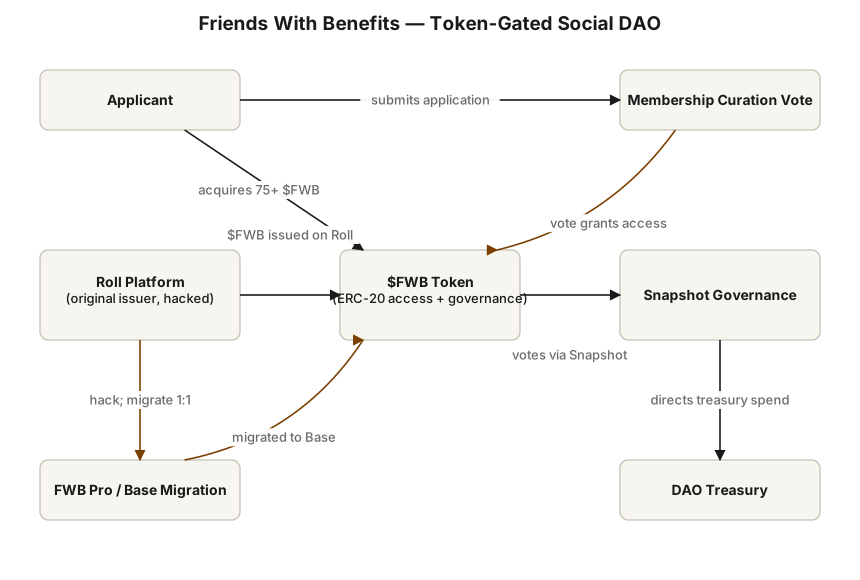 Open full-size diagram
Summary
Friends With Benefits (FWB) is the canonical "social DAO": a members club for people "building culture on the internet" whose front door is an ERC-20 token. Founded in September 2020 by Trevor McFedries (co-founder of Brud, the studio behind virtual influencer Lil Miquela), FWB began as a token-gated Discord and grew into a full cultural organization with an editorial arm, city chapters, a members-only social app (app.fwb.help), and its own festival (FWB FEST). Membership required both a community-reviewed written application and a minimum holding of $FWB tokens (75 $FWB for full membership in the mature model), making the token simultaneously an access pass, a governance right, and a tradable asset. FWB attracted high-profile creative members (Erykah Badu, Azealia Banks, Pussy Riot's Nadya Tolokonnikova, per contemporaneous coverage), raised $10M in a September/October 2021 round led by a16z at a reported ~$100M valuation, and at its peak was the most visible proof that a token could bootstrap a real cultural institution. It survived a platform-level token exploit (the March 2021 Roll hack), a brutal bear market, and multiple restructurings; as of 2025 it continues in a leaner form under CEO Greg Bresnitz, having migrated $FWB from Ethereum mainnet to Base in June 2025.
Design (Mechanism)
- Token-gated membership. Access to the community (Discord, later the FWB app and events) required holding a threshold of $FWB in a connected Ethereum wallet. The token was framed as "a means of access," not a recurring fee: sell below the threshold and access lapses; hold and membership persists. Earlier seasons used tiers (a smaller "local" tier and a 75-token full tier); by January 2023 FWB consolidated to a single 75-token tier.
- Curation on top of capital. Unlike purely financial gates, FWB layered a written application reviewed and voted on by existing members. Money alone could not buy entry; the token was necessary but not sufficient. This dual gate (capital + curation) is FWB's core mechanism-design contribution.
- Token as ownership and governance. $FWB holders governed treasury spending and community direction via Snapshot votes, with later experiments toward one-member-one-vote structures. The treasury funded events, editorial, product development, grants, and city chapters.
- Token history. The original $FWB (10M supply) was issued on the social-token platform Roll. After Roll's hot wallet was hacked on March 14, 2021 — crashing $FWB from tens of dollars to fractions of a cent — the community voted to migrate to a new token, "$FWB Pro" (1M supply, contract 0x35bd01fc9d6d5d81ca9e055db88dc49aa2c699a8), reimbursing pre-hack holders 1:1 and post-hack buyers at 0.25:1. In June 2025 the DAO migrated $FWB to Base (announced contract 0xaa5aD1F869b910E5F794b9366E05E5F2cAb4bFAD) alongside a TWAMM-based liquidity thesis.
- Seasonal cadence. FWB organized itself in "Seasons," each with revised structure, pricing, and programs — an explicit iterate-in-public governance rhythm.
Outcome
Partial success (still ongoing). FWB is arguably the most successful social DAO ever launched by cultural footprint: roughly 2,000 members around the a16z investment (about 6,000 token holders at various points per CoinDesk), a $10M raise at a reported ~$100M valuation, mainstream press, a real festival, a shipped social app (February 2023), and durable institutional survival where nearly every peer social DAO died. But the token economics badly underperformed: $FWB fell from bull-market highs to single-digit dollars and below through the bear market, the ~$800 cost of entry (75 tokens, 2023 pricing) whipsawed with price, and the DAO repeatedly shrank staff and scope. By April 2025 FWB had deliberately repositioned away from crypto-first identity toward practical product programs (e.g., "Friends With Builders," an AI-agent-focused cohort program with ~20 infrastructure partners including AWS, Alchemy, Base, and Thirdweb). The experiment proved a token can bootstrap a cultural institution; it did not prove the token can sustainably capture that institution's value.
Why it worked
- Curation made the token meaningful. The application process kept quality high, so the token gated something genuinely scarce (a vetted creative network), giving $FWB real utility demand beyond speculation.
- Cultural capital first, crypto second. Founding by a music/entertainment insider brought members whom crypto could not otherwise reach, generating outsized press and network effects.
- Skin-in-the-game alignment. Members were owners; early members were directly enriched by growth, powering evangelism and volunteer labor (events, editorial, products).
- Governance resilience. The community twice executed hard collective decisions well: the post-Roll-hack token migration (a fair reimbursement scheme voted through in days) and the later Base migration.
Where the design broke
- Reflexive membership pricing. Pegging access to a fixed token count meant the "door price" swung with the market — prohibitively expensive at the top (excluding the very creatives it targeted), and signaling collapse on the way down.
- Token value capture was weak. Treasury spending funded great experiences, but little flowed back to the token; $FWB was mostly a claim on vibes plus governance, so bear markets crushed it.
- Treasury concentrated in own token. Like most 2021 DAOs, much of FWB's balance sheet was its native token, so operating capacity fell exactly when morale did.
- Platform dependency risk realized. Issuing on Roll put the community one hot-wallet compromise away from a token crash — which happened in March 2021.
- Governance drama at scale. High-profile moderation events (e.g., removing prominent contributor Cooper Turley in January 2022 over resurfaced 2013 tweets) showed the cost of running a membership club through public, tokenized institutions.
Lessons
- Capital + curation beats capital alone. A token gate combined with human vetting creates a defensible community; a pure price gate only creates a speculator pool.
- Denominate access in fiat, settle in tokens. Fixed token-count thresholds make membership pricing hostage to market cycles; a fiat-referenced, token-settled threshold would decouple community access from volatility.
- A community token needs a value-return loop. Without revenue or buyback/utility sinks flowing back to holders, "membership token" prices are pure sentiment and will round-trip with the market.
- Don't build your monetary base on someone else's hot wallet. Issuance-platform custody risk (Roll) is a systemic risk to the whole community, not just the treasury.
- Institutions can outlive their token thesis. FWB survived by de-emphasizing the token and re-anchoring on programs and partners — evidence that the durable asset was the network, not the asset.
Redesign (EDITORIAL — hypothesis, not fact)
This section is editorial hypothesis, not a description of anything FWB did or plans. A redesigned FWB would separate the three roles its single token conflated. (1) Access: a non-transferable or soulbound membership pass, priced in fiat terms and purchasable/renewable by burning or locking $FWB at oracle-referenced value, so the door price is stable across cycles and membership is not automatically for sale. (2) Ownership/governance: the liquid token, but with explicit value-return — a share of event, festival, partnership, and app revenue routed on-chain to stakers, making it a claim on the institution's cash flows rather than sentiment. (3) Reputation: non-transferable contribution records (events hosted, proposals shipped) that weight curation votes, so long-term contributors — not the largest wallets — control who gets in. Treasury policy would mandate diversification (majority stables/ETH) with the native token treated as equity, not cash. This design plausibly preserves what worked (curated scarcity, aligned ownership) while removing the reflexivity that made FWB's front door a price chart — at the acknowledged cost of lower token liquidity/speculative upside, which was itself part of FWB's early growth engine.
Sources
- Friends With Benefits Pro (FWB) Token Tracker — Etherscan — primary (contract)
- Introducing $FWB Pro — Cooper Turley (FWB Medium) — primary (docs)
- FWB Wiki — FAQ — primary (docs)
- Investing in Friends With Benefits (a DAO) — a16z crypto — primary (analysis)
- FWB announcement: $FWB migration from Ethereum Mainnet to Base (X post) — primary (docs)
- Social tokens plummet after Roll loses $6M to crypto hackers — Protos (news)
- What's Next for Friends With Benefits? — CoinDesk (news)
- Crypto Influencer Cooper Turley Removed From FWB Over 2013 Bigoted Tweets — CoinDesk (news)
- Friends With Benefits DAO Releases Social Networking App — CoinDesk (news)
- Friends With Benefits Grows Up — CoinDesk (April 2025) (news)
Related experiments
Last verified: 2026-07-26 · Spot an error? Suggest a correction