Rally
A social-token network where creators launched 'Creator Coins' priced by RLY-collateralized token bonding curves on a dedicated Ethereum sidechain.
▶ Run interactive simulation animated mechanism with editable parameters
How it works onchain
 Open full-size diagram
Summary
Rally was one of the flagship "social token" experiments of the 2020–2021 creator-economy wave. It let any creator — musicians, streamers, athletes, YouTubers — mint a personally branded "Creator Coin" that fans could buy to unlock perks, gated content, and community status, without the creator writing code or seeding DEX liquidity. The economic core was a governance/reserve token, RLY (ERC-20, 0xf1f955016ecbcd7321c7266bccfb96c68ea5e49b, 15B fixed supply), which served as the reserve currency backing every Creator Coin through automated token bonding curves (TBCs). The consumer product, Rally.io, was built by a company co-founded by Kevin Chou (previously Kabam, Forte) and Mahesh Vellanki (ex-Redpoint). The RLY governance token launched October 15, 2020, and the protocol layer was later stewarded by the Swiss-based RLY Network Association. To keep fees low and UX simple, Rally ran its own Ethereum sidechain (built in 2018) bridged to mainnet. The consumer platform effectively wound down when Rally shut that sidechain on January 31, 2023, stranding NFTs and severely impairing Creator Coin value.
Design (Mechanism)
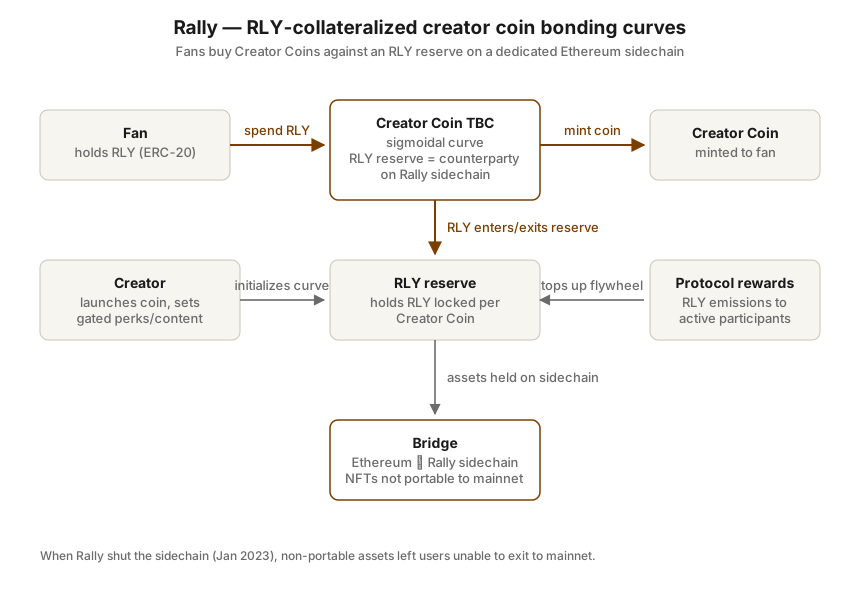
The central mechanism was a reserve-backed token bonding curve. Rather than pairing a Creator Coin against liquidity in a DEX pool, each coin was minted and burned against a smart-contract curve that used RLY as the reserve asset. When a fan bought a coin, RLY entered the reserve and new coins were minted higher up the curve; on sale, coins were burned and RLY returned to the seller. The contract itself was always the counterparty, giving instant pricing and continuous liquidity with no order book and no manual market-making.
The V1 curve was Sigmoidal (an S-curve), tuned for mid-size communities so prices could rise on relatively modest purchase volume. Per Rally's documentation, a representative V1 coin had a genesis supply of 50,000 coins (about 24% of a 210,000 total-supply cap), vesting to the creator over ten months, with a peak price around ~600 RLY per coin and up to ~30M RLY of total possible backing. The curve had four zones — a low-liquidity supply floor, a growth ramp for early adopters, a steep peak-activity segment, and a plateau near the cap designed to blunt late speculation.
RLY's own tokenomics reinforced the loop: a fixed 15B supply minted at genesis, with roughly half earmarked for programmatic network rewards (running through at least 2028) distributed to active participants and creators. Because every Creator Coin locked RLY into its reserve, growth in creator/fan activity was meant to increase RLY demand — an ecosystem flywheel with RLY at the center.
Infrastructure evolved over time: the network operated a private Ethereum sidechain with a bridge to keep minting and trading cheap and fast, and RLY was later made multi-chain (Solana sRLY..., plus Polygon and Flow in development) via official bridges and canonical swaps.
Outcome
Status: failed (for the flagship consumer platform). At its 2021 peak RLY traded around $1.38; by late 2022 it had collapsed to roughly $0.01, a ~93% decline that continued as usage evaporated. On January 31, 2023, Rally announced it would stop supporting its sidechain. Because sidechain NFTs were not transferable to Ethereum mainnet, users' assets were effectively stranded and inaccessible after the shutdown; Creator Coin economies dependent on the sidechain were impaired. CEO Rob Collier attributed the closure to funding pressure and cost, noting the 2018-era sidechain was "very expensive to maintain compared to all of the new layer-1 tech stacks," and citing an earlier August 2022 withdrawal-service disruption caused by loss of third-party support. Notable creators affected included actress Felicia Day, musician BT, and NFL player Brandon Powell. The RLY protocol and token persisted separately under the RLY Network Association, repositioning toward mobile developer SDKs (rly.network), so the token itself was not fully abandoned — but the original social-token experiment did not succeed.
Why it worked
- UX abstraction: Creators launched a tradable coin with instant liquidity and no coding, no seeding DEX pools, and no gas-heavy mainnet friction — a genuinely novel onboarding path for non-crypto-native creators in 2020–2021.
- Continuous liquidity by construction: The bonding-curve-as-counterparty model guaranteed buyers and sellers always had a price, avoiding the cold-start liquidity problem that killed many peer social tokens.
- Strong tailwinds and capital: It rode the peak creator-economy and social-token narrative, attracting marquee backers (a16z, Coinbase Ventures) and tens of millions in funding, which bought time and creator partnerships.
Where the design broke
- Reflexive, RLY-pegged pricing: Because coins were denominated in an RLY reserve, the collapse of RLY's own price dragged down every Creator Coin regardless of a given creator's engagement — a systemic single-point-of-failure.
- Proprietary sidechain lock-in: The custom 2018 sidechain became a liability: costly to maintain, dependent on third parties, and — critically — its NFTs and assets were non-portable to mainnet, so users could not exit when it shut down.
- Weak durable demand: Fan speculation, not sustained utility, drove most volume; when the macro cycle turned, perk-access value could not sustain coin prices.
- Funding and market timing: The 2022 downturn removed the growth capital that a subsidized rewards-and-infrastructure model required to keep running.
Lessons
- Don't peg community assets to a single volatile reserve token. Backing every Creator Coin with RLY coupled thousands of independent creators to one asset's price, converting an idiosyncratic asset class into a correlated one.
- Custody and exit paths must survive the platform. Assets that cannot be withdrawn to a neutral, credibly-neutral base layer (mainnet) are only as durable as the operating company; non-transferable sidechain NFTs left users with nothing when funding ran out.
- Bonding curves guarantee price, not demand. Continuous liquidity solved cold-start but did nothing to create lasting reasons to hold; mechanism elegance is not a substitute for retained utility.
- Subsidized infrastructure is a bet on the next fundraise. Running a bespoke chain plus a rewards emission program required perpetual capital; when the market turned, the cost structure forced shutdown.
Redesign (EDITORIAL — hypothesis, not fact)
The following is the researcher's editorial hypothesis, not established fact.
A modern redesign would start by decoupling each Creator Coin from a shared reserve token. Instead of pricing coins in RLY, curves could reserve a neutral, liquid asset (ETH or a stablecoin), so a creator's coin reflects that creator's demand rather than the platform token's price — removing the systemic correlation that sank the whole book at once. RLY-style rewards, if kept, should be an incentive overlay, not the pricing denominator.
Second, abandon the proprietary sidechain in favor of a modern L2 (an OP-stack or Arbitrum-based rollup) or app-specific rollup that inherits Ethereum data availability and settlement, guaranteeing that Creator Coins and NFTs are always withdrawable to mainnet even if the company disappears. Credible exit is the single most important property the original design lacked.
Third, replace pure speculation with enforceable, on-chain utility — token-gated content via signature checks, revenue-share streams, or redeemable claims — so holding is justified by cash-flow or access rather than curve dynamics alone. Finally, the treasury and rewards program should be runway-independent: modest emissions, protocol fees that cover operating costs at realistic volume, and a governance-controlled sunset procedure that lets communities self-custody and migrate their economies before any shutdown, rather than after.
Sources
- Introducing Rally: RLY Governance Token to launch October 15, 2020 (Kevin Chou / Medium) — primary (retrospective)
- V1 Token Bonding Curve (TBC) Design on Rally.io (Rally wiki) — primary (docs)
- RLY Token / tokenomics (RLY Network wiki) — primary (docs)
- Rally (RLY) ERC-20 token contract (Etherscan) — primary (contract)
- Social Token Project Rally Shuts Ethereum Sidechain, Stranding Users' Crypto Assets (CoinDesk) (news)
- Social Token Platform Rally Shutting Down (Decrypt) (news)
- Rally: Crypto Network for Social Tokens (Gemini Cryptopedia) (analysis)
Related experiments
Last verified: 2026-07-26 · Spot an error? Suggest a correction