Friend.tech
A SocialFi app on Base that let users tokenize their social influence into tradable 'keys' priced on a quadratic bonding curve, unlocking gated chats with the key holder.
▶ Run interactive simulation animated mechanism with editable parameters
How it works onchain
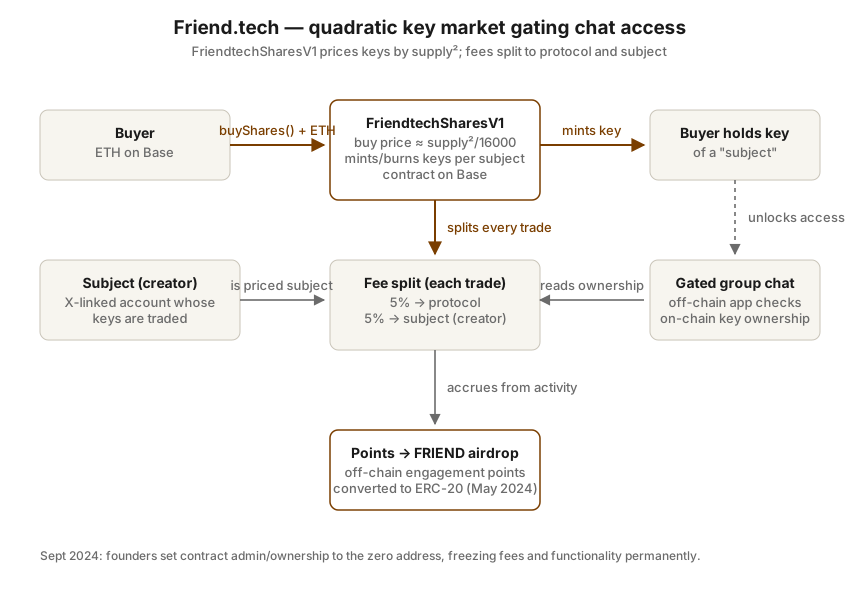 Open full-size diagram
Summary
Friend.tech was a SocialFi application launched on Coinbase's Base L2 on 10 August 2023 (one day after Base's public mainnet launch). It let anyone tokenize their social reputation: each user's account had "shares" (later rebranded "keys") that others could buy and sell. Holding a creator's key unlocked access to a token-gated group chat with that creator, so the key doubled as both a speculative asset and an access pass. Keys were priced by an on-chain quadratic bonding curve — early buyers paid little, later buyers paid progressively more — which turned attention and follower counts into liquid, tradable markets. The app was invite-only and tied to X (Twitter) identities, and it ran a points program that culminated in the FRIEND token airdrop and a "v2" in May 2024. It generated enormous fees at its peak, but activity collapsed through 2024, and on 8-9 September 2024 the founders renounced control of the contracts (setting admin/ownership to the zero address), effectively ending the project while leaving the immutable contracts live on Base.
Design (Mechanism)
The core primitive was a per-user share market implemented in the FriendtechSharesV1 contract (0xcf205808ed36593aa40a44f10c7f7c2f67d4a4d4, verified on BaseScan). Each "subject" (user) had a supply of shares. The buy price of the next share followed a quadratic curve: price ≈ (supply²) / 16000 ETH, meaning the first share was free/cheap and price scaled with the square of outstanding supply. Selling burned a share and returned the corresponding curve value. Every trade charged two fees, widely reported as 5% to the protocol and 5% to the share subject (creator), so creators earned a royalty every time their own keys changed hands and had a direct incentive to drive trading. Because supply increases price convexly, early buyers of a rising personality could realize large paper gains, which created a reflexive "buy the person before they get popular" dynamic. Access control (the group chat) was enforced off-chain by the app based on on-chain key ownership. Growth was gated by an invite-code system, and engagement was rewarded via off-chain "points" that were later converted into the FRIEND ERC-20 token. The v2 release (May 2024) added features like clubs and the token economy, but the underlying share/bonding-curve mechanic remained the defining design.
Outcome
Technically the mechanism worked exactly as designed and was never exploited at the contract level; commercially it was a boom-and-bust. Friend.tech rocketed to prominence in August-October 2023, at times generating multi-million-dollar daily fees and becoming Base's flagship consumer app, with deposits peaking around $52M in October 2023. Activity then decayed. The long-awaited FRIEND token launch and v2 in May 2024 disappointed: the token fell roughly 98% from launch as large holders sold, and the airdrop failed to re-ignite retention. By the 2024 wind-down, deposits were down ~92% (to ~$4M), daily new users had fallen to single digits, and daily fees had collapsed from ~$2M to under $100. On 8-9 September 2024 the team announced they had set admin and ownership parameters to 0x000…000, permanently freezing the contracts' fees and functionality and ending official development. Reporting estimated the team walked away with roughly $44M — about half of the ~$90M in lifetime protocol fees. The contracts remain live and usable on Base, so the outcome is best described as technically successful but commercially unsuccessful / effectively abandoned.
Why it worked
- Reflexive financialization of attention. By pricing a person on a convex curve, the app made "being early to someone" directly profitable, fusing speculation with social status — a powerful growth loop during a bull-adjacent, points-farming meta.
- Frictionless UX on Base. Cheap L2 gas, a mobile-first PWA, and X-based onboarding let non-crypto-native users trade in seconds; it became the showcase app for Base's launch and rode Coinbase/Paradigm-adjacent attention.
- Aligned creator incentives. The 5% subject fee gave influencers a reason to promote their own key markets and show up in gated chats, bootstrapping supply-side content.
- Scarcity and FOMO engineering. Invite-only access plus an ambiguous, ever-teased points/airdrop kept speculators farming and re-engaging.
Where the design broke
- Speculation dominated utility. Key prices reflected trading momentum, not the value of the chat access. Once prices fell, the "access" left behind was thin, and there was little reason to hold.
- Adverse curve dynamics on exit. The same convex curve that rewarded early buyers punished latecomers and made downside brutal; as sentiment turned, everyone selling into the curve accelerated the collapse, and value flowed from later entrants to earlier exits on the way down.
- The airdrop concentrated sell pressure at launch. The May 2024 airdrop/v2 — the event meant to convert usage into durable value — instead triggered a ~98% token crash, eroding trust rather than rewarding loyal users.
- No retention beyond the trade. Once the airdrop catalyst passed, there was no compelling ongoing product; DAU cratered to single digits.
- Pseudonymity removed any accountability channel. The founders operated pseudonymously, so when the team retained an estimated $44M in fees while renouncing contract control, there was no named party subject to disclosure requirements or further public explanation.
Lessons
- A bonding curve is a distribution and speculation engine, not a retention engine. Convex pricing brilliantly bootstraps a market and rewards early participants, but it manufactures fragility — value that is created reflexively can evaporate reflexively, and the mechanism itself does nothing to make people stay.
- The token/airdrop is a one-shot trust event; fumbling it is often fatal. Deferring the "why does this asset matter" question to a future airdrop concentrates existential risk on a single launch, and a mispriced or dumpable token can permanently poison the community.
- Tie the tradable asset to durable, non-speculative utility, or the utility gets ignored. When the access grant is worth far less than the trading upside, users optimize for the trade and the product hollows out once prices stop rising.
- Immutability plus discretionary exit is a governance smell. Renouncing contracts sounds like credible neutrality, but doing it as an exit — after collecting fees and with no ongoing stewardship — reads as abandonment; timing and communication define how it lands.
Redesign (EDITORIAL — hypothesis, not fact)
This section is the researcher's opinion, not established fact. A redesign should attack the core flaw: the tradable asset's value was almost entirely speculative and decoupled from access utility. One approach is to cap or dampen the curve's convexity and add a holding-based access model — e.g., a much flatter (near-linear or logistic) price curve so latecomers aren't structurally rugged, combined with access that requires holding for a duration rather than merely owning at a snapshot, reducing pure flip incentives. Second, redirect a share of trading fees into a locked, creator-controlled reward pool that funds ongoing content or perks, so that key value is partly backed by a stream of benefits rather than pure momentum; think of the key as a subscription NFT with a resale market rather than a pure bonding-curve chip. Third, make the token an integral, day-one utility (fee discounts, chat gating, governance over creator payouts) with vesting and anti-dump mechanics instead of a deferred, dumpable airdrop — the single most damaging event here was the token launch, so a gradual, utility-first token distribution with lockups and possibly transfer restrictions at launch could have preserved trust. Finally, credible-neutrality by design from the start (published fee splits, a transparent treasury, and pre-committed decentralization milestones) would have made the eventual immutability feel like a promise kept rather than an exit. The open question is whether any personal-token market can retain users once the speculative phase ends; the honest hypothesis is that SocialFi keys work best as a thin financial layer bolted onto an already-sticky social product, not as the product itself.
Sources
- FriendtechSharesV1 — verified contract on BaseScan — primary (contract)
- friend.tech ownership renouncement announcement (X) — primary (governance)
- Friend.tech creators walk off with $44m as project shuts down (DL News) (news)
- Is Friend.tech a Friend or Foe? (CoinDesk) (news)
- Friend.tech founders' ties to failed NFT project Kosetto (CryptoSlate) (analysis)
- Come for the points, stay for the frens (Token Terminal research) (analysis)
- The once-popular SocialFi platform Friend.tech has finally shut down (ChainCatcher) (analysis)
Related experiments
Last verified: 2026-07-26 · Spot an error? Suggest a correction