Allo Protocol
Gitcoin's open-source smart-contract framework for programmable onchain capital allocation — pools plus pluggable strategy contracts — that powered Gitcoin Grants rounds before entering maintenance mode after Gitcoin Labs and the Allo.Capital spinout wound down.
▶ Run interactive simulation animated mechanism with editable parameters
How it works onchain
 Open full-size diagram
Summary
Allo Protocol is Gitcoin's attempt to turn the smart-contract plumbing behind its quadratic-funding grant rounds into a general-purpose, open-source framework for "programmable onchain capital allocation." Announced publicly in 2023 as the contract layer under Grants Stack, then rebuilt and relaunched as Allo v2 on Ethereum mainnet and multiple L2s in November 2023, Allo let any community deploy a funding pool and plug in an allocation strategy — quadratic funding, direct grants, RFPs, committee votes, milestone payouts — as an interchangeable contract module. It reliably powered Gitcoin Grants rounds (GG18 through the mid-2025 rounds) and dozens of ecosystem partner programs. But the protocol never found a durable business or broad third-party developer adoption independent of Gitcoin: Gitcoin Labs and Grants Stack wound down in May 2025, Allo entered maintenance mode, and the Allo.Capital spinout founded by Kevin Owocki announced its own wind-down in May 2026 after failing to reach product-market fit. The contracts remain deployed, open-source, and forkable.
Design (Mechanism)
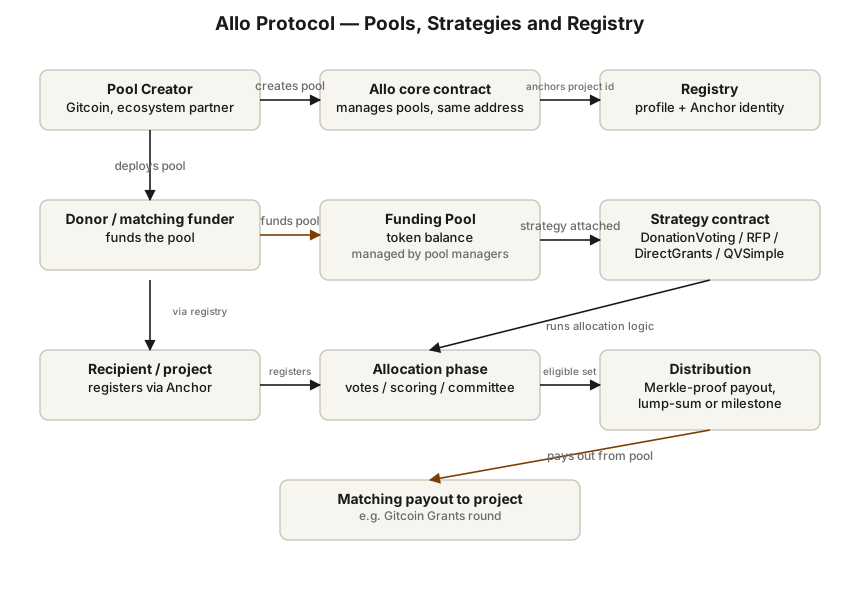
Allo's core bet was that capital allocation mechanisms could be decomposed into standardized, composable parts:
- Registry and identity anchors. A universal
Registrycontract (v2:0x4AAcca72145e1dF2aeC137E1f3C5E3D75DB8b5f3) gives each project/profile a deterministic identity. Each profile gets anAnchorcontract — an address that can hold NFTs, receive attestations, and accrue portable reputation across funding programs, decoupling "the project" from any one grant round. - Pools. The core
Allocontract (v2 proxy0x1133eA7Af70876e64665ecD07C0A0476d09465a1, deployed at consistent addresses across Ethereum mainnet, Optimism, Arbitrum, Celo, PGN, and other EVM chains) manages funding pools: anyone can create a pool, fund it with a token, and assign pool managers. - Strategy contracts. The allocation logic lives in swappable strategy contracts implementing a common interface with three phases: recipient registration/eligibility, allocation (voting or scoring), and distribution (payouts). Shipped strategies included
DonationVotingMerkleDistribution(the QF-style donation round used by Grants Stack, with Merkle-proof matching payouts),DirectGrantsSimple,RFPSimple,RFPCommittee, andQVSimple(quadratic voting). Payouts could be lump-sum, milestone-based, or streamed; approval could be manual, committee-gated, or token-gated. - Developer surface. An SDK, indexer, and docs aimed at making Allo a backend other funding apps would build on, not just Gitcoin's own Grants Stack.
Security: Allo v2 went through a public Sherlock audit contest in September 2023 (findings included QV voice-credit accounting and fee-circumvention issues, resolved pre-launch). v1 was audited by Sherlock in March 2023.
Outcome
Technically, Allo did its job. It was the settlement layer for the Gitcoin Grants Program from 2023 to May 2025: GG19 (Dec 2023) distributed ~$1.09M across 471 projects in program rounds with 57k+ unique donors; GG20 (April–May 2024), the first Gitcoin round fully on Allo v2, distributed over $2.2M including ~$681k in crowdfunded donations. Dozens of ecosystem partner rounds (Optimism, Arbitrum, Celo communities, etc.) ran on the same rails. No major exploit of the deployed protocol was reported.
Commercially and organizationally, it underperformed. Third-party adoption beyond the Gitcoin orbit stayed thin. In January 2025 Kevin Owocki proposed spinning Allo out as Allo.Capital, a standalone business building "the capital allocation layer of the tokenized internet," with Gitcoin as anchor customer. In May 2025 Gitcoin Labs and Grants Stack wound down and Allo entered maintenance mode — active development ceased, contracts left deployed and forkable. On May 12, 2026, Owocki announced Allo.Capital was winding down as well, citing failure to achieve product-market fit or secure institutional investment, with remaining assets returned to backers (Protocol Labs and Gitcoin).
Why it worked
- Real production load. Unlike many "protocol-ification" efforts, Allo had a guaranteed first customer (Gitcoin Grants) pushing millions of dollars and hundreds of thousands of donations through it, which forced the contracts to be robust and battle-tested.
- Good decomposition. The pool/strategy/registry separation was a genuinely clean abstraction; adding a new funding mechanism meant writing one strategy contract, not a new platform.
- Credible neutrality and multichain consistency. Same contract addresses across chains, open source, public audits — easy for ecosystem partners to trust and deploy.
Where the design broke
- Demand was for grant programs, not a grants protocol. The buyers (ecosystems, foundations) wanted a managed product (Grants Stack) or full-service program operation; almost nobody's problem was "I need a permissionless allocation contract framework." The protocol layer had no independent revenue or moat.
- Coupled fate with Gitcoin. When Gitcoin Labs restructured and Grants Stack wound down (May 2025), Allo lost its only large customer and its development funding simultaneously.
- Spinout came too late and without a business model. Allo.Capital launched into a shrinking public-goods-funding market in 2025 and could not convert the developer-tooling vision into paying adoption or investment within ~16 months.
- Generalization tax. Building for hypothetical future mechanisms (v1 → v2 rewrite, SDKs, indexers) consumed years of engineering while the actually-used strategy set remained small and Gitcoin-shaped.
Lessons
- A protocol extracted from a product needs a second anchor customer before it's a protocol. If usage is 90%+ one app, you have an internal backend with extra governance overhead, not an ecosystem primitive.
- Infrastructure for allocation is not scarce; funders and operators are. The binding constraint in public-goods funding was matching capital and program demand, not contract tooling — protocolizing the non-bottleneck doesn't capture value.
- Modular strategy interfaces are a durable design contribution even when the business fails. Allo's registry/pool/strategy pattern (and the Merkle-payout donation-voting strategy) has been forked and referenced; open-source, consistently-deployed, audited contracts outlive their org.
- Sequencing spinouts matters. Spinning out a protocol after its parent's product line is already contracting means inheriting the downtrend without the distribution.
Redesign (EDITORIAL — hypothesis, not fact)
This section is editorial speculation, not sourced fact. A redesigned Allo would invert the go-to-market: instead of a general framework seeking apps, launch as a protocol-with-a-fee attached to the one mechanism with proven recurring demand (QF/donation rounds with Merkle matching payouts), taking a small protocol fee on matching pools from day one so protocol sustainability is measurable rather than deferred to a future token. Second, make the registry/anchor layer the product: portable, attestation-backed project identities that accrue funding history across ecosystems are a genuine network-effect asset, and could have been marketed to L2 foundations (the actual payers) as sybil-resistant grantee reputation infrastructure independent of any single round UI. Third, ship strategies as a curated, bounty-funded marketplace with revenue share for strategy authors, giving third-party developers a reason to build on Allo rather than fork it. Finally, spin out (or sunset) at the peak of Gitcoin's grants volume, with two or more committed non-Gitcoin anchor programs signed, rather than after the parent's contraction.
Sources
- Allo Docs (official documentation) — primary (docs)
- allo-protocol/allo-v2 core contracts (GitHub) — primary (contract)
- All About Allo: Gitcoin's newest protocol (Gitcoin Blog, 2023) — primary (docs)
- Introducing Allo v2 (Gitcoin Blog, Nate Gosselin, 2023-07-27) — primary (docs)
- Sherlock audit of Allo v2 (2023-09) — primary (audit)
- [ANNOUNCEMENT] Introducing Allo.Capital (Gitcoin governance, 2025-01; wind-down update 2026-05) — primary (governance)
- Allo Protocol status page (Gitcoin apps directory; maintenance-mode notice) — primary (docs)
- Gitcoin launches Allo v2 on mainnet (Binance Square news, 2023-11-10) (news)
- GG20 Results & Recap (first Gitcoin round on Allo v2) — primary (docs)
- GG19 Results and Recap (Gitcoin Blog) — primary (docs)
Related experiments
Last verified: 2026-07-26 · Spot an error? Suggest a correction