Nouns DAO
A CC0 NFT project that mints and auctions exactly one Noun every 24 hours forever, routing 100% of proceeds into an on-chain treasury governed by Noun holders (one Noun = one vote).
▶ Run interactive simulation animated mechanism with editable parameters
How it works onchain
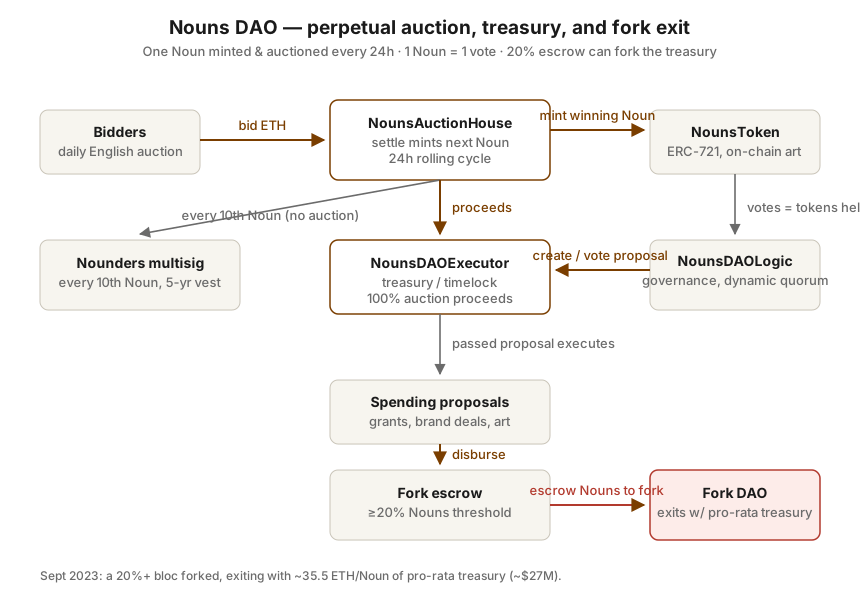 Open full-size diagram
Summary
Nouns DAO launched on Ethereum on 8 August 2021 as a fully on-chain NFT-and-governance experiment built around a single simple rule: one Noun is minted and auctioned every 24 hours, forever, with 100% of each auction's proceeds flowing into a community-controlled treasury. Each Noun is a pixel-art avatar (glasses called "noggles," plus body/accessory/head traits) generated and stored entirely on-chain, and released into the public domain under CC0 — anyone can use, remix, or commercialize Noun art without permission. Every Noun is simultaneously a collectible, a perpetual funding instrument, and one vote in the DAO. Founded by an anonymous-ish collective of ten builders known as the "Nounders" (including Vine co-founder Dom Hofmann, CrypToadz creator gremplin, and punk4156), Nouns became the canonical reference design for perpetual-auction DAO funding and on-chain generative art, and later pioneered the "DAO fork / ragequit" exit mechanism now widely copied.
Design (Mechanism)
The system is composed of a small set of audited, verified contracts (a fork/extension of Compound's Governor Bravo for governance):
- NounsAuctionHouse (
0x830BD73E4184ceF73443C15111a1DF14e495C706, V3): Runs a rolling 24-hour English auction. Settling one auction atomically mints the next Noun and starts a fresh auction, so the cadence is trustless and continues "as long as Ethereum is running." All ETH proceeds go to the treasury. - NounsToken (
0x9c8ff314c9bc7f6e59a9d9225fb22946427edc03): An ERC-721 whose art is generated on-chain via the descriptor/seeder contracts, so images do not depend on off-chain storage. - NounsDescriptor (
0x33A9c445fb4Fb21f2c030A6b2d3e2F12D017BFAC, V3): Stores compressed trait art on-chain and renders SVGs; underpins the CC0 art commons. - NounsDAOExecutor / Treasury (
0xb1a32FC9F9D8b2cf86C068Cae13108809547ef71, V2): The timelock that holds and disburses funds only via passed proposals. - NounsDAOLogic (
0x6f3E6272A167e8AcCb32072d08E0957F9c79223d, V4): Governance logic — proposal creation/voting, plus additions over vanilla Governor Bravo: editable proposals, dynamic quorum (quorum scales with against-votes to resist low-turnout capture), gas refunds for voters, a proposal objection period, and the fork module. - NounsDAOData (
0xf790A5f59678dd733fb3De93493A91f472ca1365): On-chain candidate proposals and feedback.
Governance is strictly one Noun = one vote. Anyone holding a Noun (or delegated votes) above the proposal threshold can submit spending proposals against the treasury. Founder reward: during the first five years, every 10th Noun (Nouns #0, #10, #20, …) is automatically routed to the Nounders' multisig instead of being auctioned, vesting founder compensation without diverting auction cash flow. The Fork mechanism (added in NounsDAOLogicV3, 2023): if holders representing at least a 20% "fork threshold" escrow their Nouns, the DAO splits — forkers exit into a new "Fork DAO," taking their pro-rata share of the treasury and forfeiting their original Nouns. This functions as a structural minority-protection / ragequit valve against a hostile or wasteful majority.
Outcome
Status: major_success (ongoing). Nouns has run its daily auction continuously for roughly five years, minting and selling a Noun every day and accumulating one of the largest DAO treasuries in crypto (reported in the tens of thousands of ETH / tens of millions of USD range at various points; exact figure fluctuates). It funded hundreds of proposals — art, open-source software, real-world brand collaborations (Bud Light Super Bowl, the Nouns coffee/plush lines), a "Nounstown" animated series, and countless grants — becoming the flagship example of a self-funding on-chain public-goods engine. Its CC0 art spawned dozens of derivative "Nounish" projects (Lil Nouns, gnars, and many sub-DAOs). In 2024 it adopted a Wyoming DUNA legal wrapper to address member liability and tax uncertainty. The most significant stress event was the September 2023 fork/ragequit: a large bloc of holders, arguing the treasury traded far below NAV and that spending was wasteful, triggered the fork and exited with roughly 35.5 ETH per Noun (about $27M total, a majority of the treasury at the time). The original DAO survived, restructured, and continued.
Why it worked
- Trustless perpetual funding: tying minting to a self-restarting auction removed dependence on a team, a sale event, or off-chain infrastructure — the machine simply keeps running.
- CC0 as a growth engine: releasing art into the public domain turned every meme, fork, and derivative into free marketing and gave the brand cultural reach far beyond token holders.
- Aligned founder incentives: the every-10th-Noun vesting reward paid founders in the same asset holders bought, over five years, avoiding an upfront cash grab.
- Fully on-chain art + governance: no IPFS/AWS dependency and a Compound-derived, audited governance stack gave credibility and durability.
Limitations and criticisms
- Treasury-vs-NAV disconnect: for long stretches the Noun floor price implied a market value below each Noun's pro-rata treasury claim, creating a standing arbitrage incentive to break the DAO apart — the direct cause of the 2023 fork.
- Governance friction and spending fatigue: high-value one-token-one-vote combined with subjective spending led to closely contested votes, perceptions of wasteful or vanity spending, and whale dominance.
- The fork was costly: the ragequit drained a majority of the treasury and split the community, showing that a minority-exit valve designed to protect against capture can itself become a coordinated capital-extraction event when the collective trades below book value.
Lessons
- A perpetual auction can create a durable, permissionless funding stream, but pricing the token far below its treasury backing invites governance attacks and forks — treasury/NAV alignment matters as much as the auction itself.
- Exit mechanisms (ragequit/fork) are powerful minority protections, yet if the collective's market value drops below book value they flip into extraction incentives; the trigger design and valuation context are critical.
- CC0 licensing can massively amplify reach and legitimacy for a culture-first project, decoupling brand value from token custody.
- Founder compensation paid in the native asset and vested over years (rather than a cash cut of proceeds) is a credible way to align builders with long-term holders.
- On-chain art and audited, forked-from-battle-tested (Compound) governance buy durability; novel mechanics (dynamic quorum, objection period) can be layered on incrementally rather than at genesis.
Redesign (EDITORIAL — hypothesis, not fact)
The following is the researcher's editorial analysis, not established fact. The single deepest flaw was the persistent treasury-vs-market-value gap that turned the fork valve into an arbitrage. A redesign might: (1) build in a floor/NAV mechanism — e.g., a protocol-native redemption or buyback that lets holders convert a Noun to its pro-rata treasury share on-chain at any time, collapsing the arbitrage so a "fork" is never needed to capture book value; (2) variable auction cadence or supply throttling tied to treasury health and demand, so issuance slows when demand is weak instead of relentlessly diluting into a soft market; (3) conviction- or quadratic-weighted voting for spending to blunt whale dominance and reduce the "is this wasteful?" contention that fueled exit sentiment; and (4) milestone-gated streaming of grants from the treasury (escrowed, clawback-able) so capital deployment is legibly tied to delivered public goods, strengthening the perceived value that keeps market price near NAV. The core primitives — perpetual auction, CC0, on-chain art, one-Noun-one-vote — are sound and worth preserving; the redesign targets the valuation and capital-allocation layers that produced the 2023 crisis.
Sources
- Nouns DAO official site — primary (docs)
- Nouns DAO documentation (protocol, governance, deployments) — primary (docs)
- nounsDAO/nouns-monorepo (Solidity contracts, webapp, SDK) — primary (contract)
- NounsToken contract on Etherscan — primary (contract)
- Exploring a New Legal Framework for Nouns DAO | The Wyoming DUNA (Nouns Foundation) — primary (governance)
- Nouns Fork: Disgruntled NFT Holders Exit With $27 Million From Treasury (Decrypt) (news)
- NounsDAO Barrels Toward Treasury Split After NFT Holders Rally for 'Rage Quit' (CoinDesk) (news)
- An NFT Every Day: A Guide to the Nouns NFT Project, DAO, and Ecosystem (nftnow) (analysis)
Related experiments
Last verified: 2026-07-26 · Spot an error? Suggest a correction