Ambient Finance
A single-contract DEX (formerly CrocSwap) that fused full-range, concentrated, and knockout limit-order liquidity into one AMM — technically ahead of Uniswap v4 but commercially eclipsed after points-driven TVL evaporated.
▶ Run interactive simulation animated mechanism with editable parameters
How it works onchain
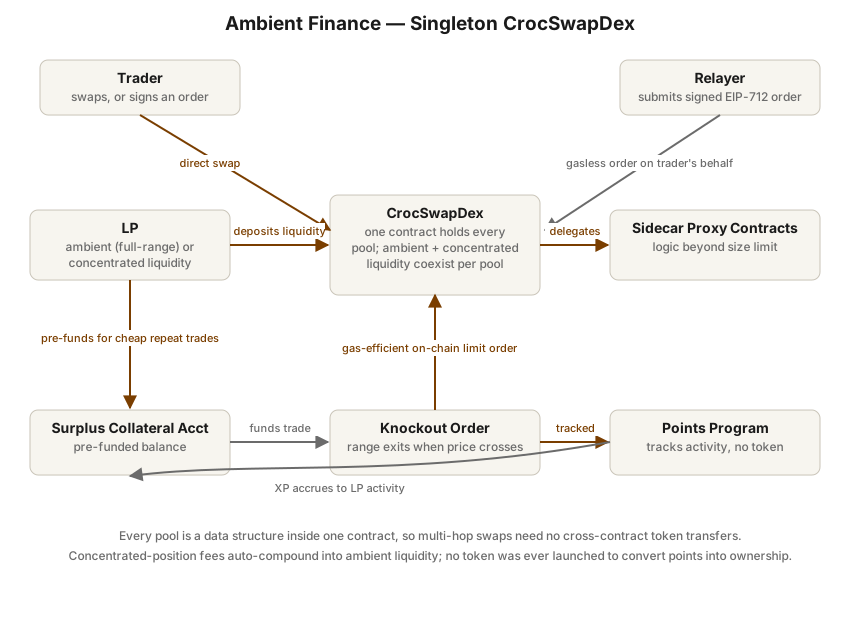 Open full-size diagram
Summary
Ambient Finance (originally CrocSwap, built by Crocodile Labs) is a decentralized exchange founded by Doug Colkitt, a former Citadel Securities high-frequency-trading quant. It launched on Ethereum mainnet in June 2023 and shortly after announced a $6.5M seed round at an $80M valuation led by BlockTower, with Jane Street, Circle, Quantstamp, Susa Ventures, Hypotenuse Labs, and angels including Naval Ravikant (announced July 11, 2023). Its core bet was architectural: run the entire DEX — every pool, every position — inside one smart contract, and let a single pool simultaneously host full-range ("ambient") liquidity, Uniswap-v3-style concentrated liquidity, and "knockout" limit orders. Much of this design (singleton contract, flat pool accounting, native limit orders, dynamic fees) predated Uniswap v4's announcement of similar ideas via hooks. Ambient expanded to Canto, Scroll, Blast, Swellchain, and Plume, and rode L2 points-farming seasons to a peak TVL of roughly $130M in July 2024 (DefiLlama). After those incentive seasons ended and with no token launched, TVL collapsed to roughly $2M by mid-2026, with most remaining liquidity on Scroll.
Design (Mechanism)
- Singleton architecture. One contract,
CrocSwapDex(deployed at the vanity address 0xAaaaaAAAA24eEeb8d57D431224f73832bC34f688 on Ethereum), holds every pool as a lightweight data structure rather than a separate contract. This makes multi-hop swaps and pool creation dramatically cheaper in gas, since no cross-contract token transfers are needed between hops. Logic exceeding the EVM contract-size limit lives in proxy "sidecar" contracts. - Hybrid liquidity in one pool. Each pool concurrently supports ambient (full-range, v2-style) liquidity and concentrated (range-bound, v3-style) liquidity, so passive and active LPs share one venue instead of fragmenting across pool versions.
- Knockout liquidity. Range positions that automatically "knock out" when price crosses them, functioning as gas-efficient, fee-earning onchain limit orders — a primitive Uniswap v3 could only approximate.
- LP-favoring economics. Concentrated-position fees auto-compound into ambient liquidity without manual harvesting; dynamic fee policies can adjust to market conditions; a minimum time-to-live parameter on fresh liquidity deters just-in-time (JIT) liquidity sniping of organic LPs.
- Trader ergonomics. Surplus-collateral accounts let users pre-fund balances inside the DEX for cheaper repeat trading, and EIP-712 signed "relayer calls" enable gasless order submission.
- Security posture. Quantstamp audited CrocSwap V2; a Code4rena contest (October 2023) covered the Canto liquidity-mining sidecar. No major exploit of the core DEX was found in this research.
Outcome
Technically successful, commercially outcompeted. The protocol shipped its full design, ran for three-plus years without a known hack, and was validated intellectually when Uniswap v4 adopted a singleton architecture and hook-based extensibility. Commercially, Ambient became the flagship DEX on Scroll and an early Blast deployment, peaking near $130M TVL in July 2024 during the height of L2 points farming (Ambient ran its own points program and passed 100% of Blast points to users). But it never launched a token; as of a 2026 airdrop-guide ecosystem, distribution remained speculative. When points seasons faded and incentivized mercenary liquidity rotated out, TVL fell >98% from peak to about $2M (DefiLlama, July 2026), with Ethereum mainnet holding under $200K. Founder Doug Colkitt's public attention shifted substantially to Fogo, an SVM L1 he co-founded as a founding contributor. The protocol remains live and usable — "ongoing" operationally — but as a business experiment it did not convert technical superiority into durable market share against Uniswap's liquidity network effects.
Why it worked
- Real gas and capital-efficiency advantages. The singleton design measurably cut swap and pool-creation costs years before Uniswap v4 shipped the same insight, and knockout orders offered genuinely novel LP/trader functionality.
- Credible founder-market fit. A former Citadel HFT quant designing microstructure (JIT protection, dynamic fees, toxic-flow mitigation) gave the protocol unusual mechanism-design depth and credibility with sophisticated investors (Jane Street, BlockTower, Circle).
- Smart beachhead strategy. Rather than fighting Uniswap head-on, Ambient became the canonical DEX on new chains (Scroll, Blast), capturing early-ecosystem liquidity where incumbents were absent.
Where the design broke
- Liquidity network effects beat better technology. Traders route to depth, and depth follows volume; Uniswap's incumbency, aggregator integrations, and brand mostly nullified Ambient's efficiency edge on mainnet.
- Points-dependent TVL was mercenary. Growth was concentrated in Blast/Scroll incentive seasons; without a token or sustained rewards, liquidity left when the farming meta rotated (peak ~$130M → ~$2M).
- No token, delayed for years. The absent token limited both liquidity-mining firepower and community lock-in, while competitors (and the chains Ambient built on) distributed theirs.
- Single-team dependency, no separate funding track for the DEX. Ambient's differentiation relied on a small core group actively extending the singleton architecture; once that group's building capacity shifted toward a separate venture (Fogo Chain), no independent, funded organization existed to keep pushing Ambient's roadmap forward.
Lessons
- A structurally superior AMM design is not a moat: DEX competition is won on liquidity network effects, integrations, and distribution, not gas benchmarks.
- Points-farmed TVL is rented, not owned; if the incentive bridge doesn't land on a token or sticky yield, the liquidity retreats as fast as it arrived.
- Shipping an innovation first (singleton, native limit orders) can still lose to the incumbent that ships it second with a bigger ecosystem — being early is only an advantage if you convert it into lock-in before the incumbent copies you.
- Being the "house DEX" of a new L2 ties your fate to that L2's success; Ambient's Scroll/Blast concentration meant it inherited their post-airdrop decline.
Redesign (EDITORIAL — hypothesis, not fact)
This section is editorial hypothesis, not established fact. A redesigned Ambient would have tokenized within 12 months of the 2023–24 points mania, converting peak mercenary TVL (~$130M) into vested, protocol-owned or ve-locked liquidity before the farming meta rotated — the Maverick playbook it was widely compared to. Second, it could have leaned into its singleton architecture as B2B infrastructure: licensing the knockout-order and JIT-protection primitives as an embedded DEX engine for new chains and rollups (a "DEX-in-a-box" with revenue share), rather than competing for retail order flow against Uniswap's front-end gravity. Third, its microstructure edge (dynamic fees, toxic-flow mitigation) suggests a natural pivot toward an intent/RFQ hybrid where passive LPs are shielded from arbitrage flow — the direction the market later moved (UniswapX, CoW). The counterfactual is untestable, but the pattern generalizes: convert technical leads into distribution and lock-in fast, because architectural ideas are unpatentable and get absorbed by incumbents within one release cycle.
Sources
- Introduction to Ambient — Ambient Docs — primary (docs)
- Ambient Finance Raises Seed Round Funding (official CrocSwap Medium) — primary (retrospective)
- Ambient Finance: CrocSwapDex — Etherscan — primary (contract)
- Ambient — DefiLlama protocol TVL data (analysis)
- CrocSwap V2 — Quantstamp audit report — primary (audit)
- Code4rena: 2023-10 Canto (Ambient liquidity-mining sidecar contest) — primary (audit)
- How Ambient Finance Puts LPs First — Flywheel DeFi (analysis)
- Ambient Finance launched on Ethereum mainnet — Coinlive (news)
- Ambient Finance Airdrop Guide 2026 — MEXC blog (analysis)
Related experiments
Last verified: 2026-07-26 · Spot an error? Suggest a correction