Meteora DLMM
Solana liquidity protocol that replaced continuous concentrated-liquidity curves with discrete, zero-slippage price bins and per-bin dynamic fees, becoming a dominant venue for memecoin and token-launch liquidity before its co-founder resigned amid insider-trading allegations tied to the LIBRA memecoin collapse.
▶ Run interactive simulation animated mechanism with editable parameters
How it works onchain
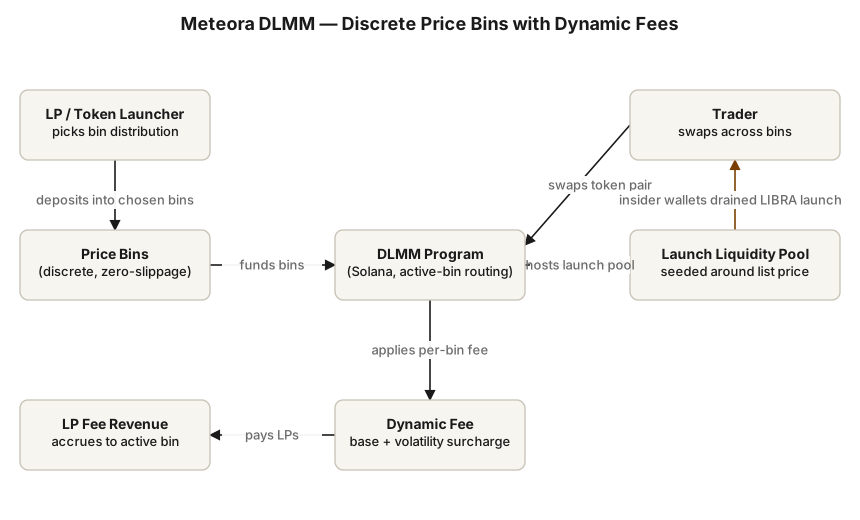 Open full-size diagram
Summary
Meteora DLMM (Dynamic Liquidity Market Maker) is a Solana automated market maker that organizes liquidity into discrete, non-overlapping price "bins" instead of a continuous curve. Within a bin, trades execute at a fixed price with zero slippage; liquidity providers choose which bins to fund and can shape their capital across bins using preset or custom distributions. Meteora launched DLMM in beta in December 2023, following its 2023 rebrand (the team's earlier product, Mercurial Finance, restructured after the FTX collapse disrupted the Solana ecosystem in late 2022). DLMM became one of the primary liquidity venues for new Solana token launches, including memecoins, and by 2025 Meteora pools carried a double-digit share of Solana DEX volume.
Design (Mechanism)
DLMM is explicitly modeled on Trader Joe's "Liquidity Book" design (Avalanche), adapted for Solana. Each pool is divided into a fixed grid of price bins, each representing a narrow price range with its own constant-sum reserve of the two pooled assets. A trade that stays inside one bin fills at a single fixed price with no slippage; a larger trade walks across multiple bins sequentially, so slippage only appears when liquidity in the active bin is exhausted and price crosses a bin boundary. LPs deposit into specific bins and can pick from several liquidity "shapes" (e.g., spot/uniform, curve, or bid-ask distributions) to concentrate capital where they expect trading activity, replacing the single min/max tick-range parameter used by conventional concentrated-liquidity AMMs (like Uniswap v3) with discrete, individually addressable bins.
Fees are dynamic rather than fixed: a base fee plus a variability-based surcharge widens automatically during high-volatility periods, compensating LPs for the higher impermanent-loss risk of active bins and discouraging pure arbitrage extraction. Because bins are discrete and independently priced, DLMM pools can also be bootstrapped with liquidity concentrated in a narrow band around a token's launch price, which made the design popular for new-token liquidity bootstrapping and "single-sided" launch pools, an early competitor use case to bonding-curve launchpads such as pump.fun.
Outcome
DLMM shipped in beta in December 2023 and became a widely used liquidity primitive on Solana, particularly for memecoin and new-token pools. Trading volume through Meteora's pools grew sharply through 2024 into 2025 as Solana's memecoin and token-launch activity surged, with Meteora capturing a meaningful share (reported in double digits) of total Solana DEX volume during peak periods and, at times, several hundred million dollars of total value locked across its pools. The protocol shipped a native MET token, with a token-generation event in October 2025.
In February 2025, Meteora co-founder Ben Chow stepped down after being implicated in the collapse of the LIBRA memecoin, a token promoted by Argentine President Javier Milei that spiked and then crashed within hours, wiping out an estimated ~$251 million from roughly 13,000 wallets amid allegations of insider dumping and paid political promotion. Chow and Meow (another Jupiter/Meteora co-founder who took over Meteora's operations) denied wrongdoing, but the episode caused significant reputational damage to Meteora and to the broader Solana launch-liquidity ecosystem, since Meteora's DLMM pools were reportedly used to seed LIBRA's liquidity. Meteora continued operating and building (DLMM v2, DAMM v2, dynamic bonding curves) after the episode.
Why it worked
- Discrete bins deliver genuinely zero-slippage execution within a price range, an improvement over continuous concentrated-liquidity curves for both traders (tighter effective spreads) and LPs (more precise capital placement).
- Dynamic, volatility-responsive fees let the protocol capture more value during the volatile price action typical of new-token and memecoin trading, which is exactly the segment where Meteora found product-market fit on Solana.
- Flexible bin-distribution "shapes" gave sophisticated LPs and token launchers fine control over liquidity concentration, making DLMM pools attractive as the default liquidity venue for new Solana token launches.
Limitations and criticisms
- The mechanism itself performed as designed, but a co-founder's public implication in the LIBRA memecoin collapse exposed how closely a DeFi protocol's trust depends on team reputation rather than code, raising fair questions about insider access to launch liquidity on Meteora's own pools.
- Bin-based liquidity management is more complex for casual LPs than simple full-range AMM deposits, requiring users to understand bin width, distribution shape, and active-bin dynamics to avoid concentrated impermanent loss.
- As a launch-liquidity venue, DLMM pools are also exposed to the broader "rug and dump" dynamics of the memecoin market, where fast token launches with thin, single-sided liquidity are structurally prone to manipulation regardless of the AMM's own mechanics.
Lessons
- Zero-slippage discrete-bin AMMs can be a genuine mechanism-design improvement over continuous concentrated-liquidity curves for volatile, thinly traded assets like new token launches.
- Protocol-level trust in DeFi is fragile and closely tied to team reputation: a mechanism can function exactly as designed while the protocol's brand is damaged by an incident involving people, not code.
- Liquidity infrastructure that is optimized for memecoin/launch use cases inherits the reputational and legal risk of that use case, even when the AMM itself has no discretionary control over which tokens are listed.
Redesign (EDITORIAL)
EDITORIAL — hypothesis, not fact. A redesign could separate "neutral infrastructure" from "curated launch surface": keep the bin-based DLMM AMM as permissionless, unopinionated market infrastructure, but require any first-party Meteora-branded launch tooling or liquidity-bootstrapping product to run through a transparent, on-chain-auditable allocation process (e.g., publicly timestamped bin deposits, vesting-locked initial liquidity, and disclosure of any team or insider wallets seeding a pool). This would not prevent bad actors from using the permissionless DLMM contracts directly, but it would reduce the specific failure mode seen with LIBRA, where a protocol's own affiliated team and pools were allegedly used to facilitate an insider-advantaged launch, by making conflicts of interest structurally visible rather than relying on after-the-fact trust in the team.
Sources
- Meteora DLMM Solana program (LBUZKhRxPF3XUpBCjp4YzTKgLccjZhTSDM9YuVaPwxo) — primary (contract)
- Meteora official site — primary (official)
- Meteora DLMM TVL, Fees, Revenue & Volume - DefiLlama — primary (data)
- Meteora Co-Founder Ben Chow Steps Down Over LIBRA Allegation (news)
- Meteora co-founder Ben Chow resigns amid LIBRA scandal - The Block (news)
- Argentina's $4.6 Billion Crypto Scandal; Largest-Ever Crypto Theft - Forbes (news)
Related experiments
Last verified: 2026-07-27 · Spot an error? Suggest a correction