Anonymice
A free-to-mint, 100% on-chain generative PFP collection whose stake-to-earn/burn-to-mint token economy throttled its own mint and permanently burned 6,450 of 10,000 possible mice.
▶ Run interactive simulation animated mechanism with editable parameters
How it works onchain
 Open full-size diagram
Summary
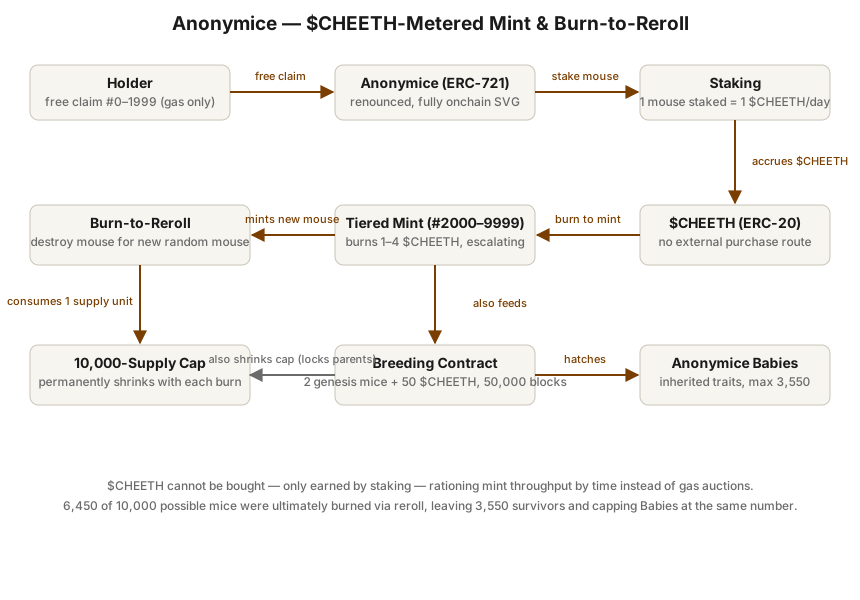
Anonymice launched on Ethereum on September 16, 2021 as a fully on-chain, randomly generated PFP collection with a maximum possible supply of 10,000 mice. Its pitch was radical minimalism and anti-cash-grab design: no IPFS, no APIs, no website dependency ("just code"), CC0, zero royalties, and a contract whose ownership was renounced (sent to the 0xdead address) so nobody could ever change it. The first 2,000 mice were free to claim (gas only); every subsequent mouse could only be minted by burning $CHEETH, an ERC-20 earned exclusively by staking existing mice at 1 $CHEETH per mouse per day, at escalating price tiers (1–4 $CHEETH). Combined with a burn-to-reroll mechanic — destroy your mouse for a fresh random one — the design produced an unusual outcome: the mint "sold out" over roughly two days with no gas war, and by the end 6,450 mice had been burned, leaving a surviving supply of 3,550. In October 2021 the team shipped what it described as the first fully on-chain breeding system: two genesis mice plus 50 $CHEETH produced an incubator NFT whose on-chain image displayed a live 50,000-block countdown, hatching into an Anonymice Baby with probabilistic trait inheritance (max 3,550 babies). A DNA-chip mint followed on May 25, 2022.
Design (Mechanism)
- Fully on-chain generation and storage. Trait data and images are generated and served from the contract itself (base64-encoded output), with no external dependencies. The contract is immutable via renounced ownership.
- Two-phase mint gated by time, not money. Mice #0–1999: free claim. Mice #2000–9999: mintable only with $CHEETH, which cannot be bought from the project — it is emitted solely by staking mice (1/day/mouse). Mint prices escalated in tiers from 1 to 4 $CHEETH, so later mints required more accumulated staking time (or buying $CHEETH/mice from other holders on secondary markets).
- Burn-to-reroll. Any holder could burn a mouse to mint a new randomly generated one, gambling for rarer traits. Every reroll permanently consumed one unit of the 10,000 cap, deflating final supply.
- On-chain breeding (Oct 15, 2021). Two genesis mice + 50 $CHEETH were locked for 50,000 blocks (~7 days) in a breeding contract that rendered a dynamic incubator image counting down blocks on-chain; the resulting baby's traits were random but weighted toward traits shared by both parents.
- No treasury extraction. Free mint, zero royalties, no premine of value to the team — the "business model" was essentially reputational.
Outcome
The mint mechanics worked as intended: demand was strong but gas costs never spiked, because emission-rate-limited $CHEETH metered mint throughput. The burn/reroll gamble was heavily used — 6,450 of 10,000 potential mice were destroyed (including some already-rare pieces, e.g. the "astro mouse" #7767), leaving 3,550 survivors, and breeding capped babies at the same 3,550. The project became a frequently cited reference implementation for fully on-chain NFTs, token-metered mints, and on-chain dynamic imagery, and spawned an ecosystem (staking, babies, DNA chips, badges, a bespoke low-fee marketplace built by ecosystem devs 0xInuarashi and saintmaxi, NFTX vaults). Commercially, like most 2021 PFPs, market activity and community size declined substantially after the 2021–2022 cycle (recent aggregator data shows minimal trading volume and a small residual community), though the collection remains fully functional and tradeable forever by construction. Peak/current floor-price figures: Unknown / not found from reliable sources. Verdict: partial_success — a landmark mechanism-design and engineering success whose market relevance faded.
Why it worked
- Emission-gated minting eliminated the gas war. Because mint capacity was rationed by $CHEETH accrual (a time-based drip) rather than a first-come-first-served ETH sale, there was no single block-height stampede — a genuine solution to 2021's gas-war problem.
- Credible neutrality. Renounced contract, free mint, CC0, zero royalties, and no team treasury removed rug-pull and extraction concerns, which was itself a differentiator in September 2021.
- Burn mechanics aligned individual gambling with collective scarcity. Every reroll was individually rational (chance at rarity) and collectively deflationary, giving surviving holders a hard-supply story the market could price.
- On-chain purity as marketing. "No IPFS, no API, just code" plus the block-countdown incubators were legible technical feats that earned durable developer mindshare.
Where the design broke
- No sustainable value engine. With zero royalties, no treasury, and a fixed $CHEETH sink structure, there was no funded roadmap; continued development depended on volunteer/reputational energy, which is hard to sustain through a bear market.
- Utility-token gravity. $CHEETH demand existed only while minting/breeding sinks remained; once mint and breeding concluded, staking emissions had no strong sink, a common death spiral for NFT utility tokens.
- PFP-cycle dependence. The core asset was still a profile-picture collectible; when the 2021–22 PFP market deflated, mechanism elegance did not translate into retained buyers.
- Deflation is a one-shot narrative. Burned supply creates scarcity once; it does not generate recurring reasons to arrive, so attention decayed after the mechanic concluded.
Lessons
- Meter mints with an earned resource, not a timestamp. Rate-limited, stake-earned mint currency converts a gas auction into a time auction and smooths demand — a pattern later reused across NFT/gaming economies.
- Burn-to-reroll is a powerful voluntary supply sink because it lets individual risk-seeking finance collective scarcity; but it destroys provable rarity history and works only once per asset.
- Maximal decentralization trades away adaptability. Renouncing ownership and forgoing royalties bought trust but removed every lever (funding, patching, repricing) for sustaining the project after launch.
- Fully on-chain storage is the strongest permanence guarantee in the NFT space — Anonymice remains completely functional with zero maintenance, unlike API/IPFS-dependent peers.
- Token utility must outlive the launch event. Sinks (mint tiers, breeding fees) must be designed as a renewable series, or the emission token collapses when the last sink closes.
Redesign (EDITORIAL — hypothesis, not fact)
The following is editorial hypothesis, not a factual account. A modern Anonymice could keep the emission-metered mint and burn-to-reroll core but fix the sustainability gap in three ways. First, replace "renounce everything" with a minimal immutable core plus a token-holder-governed extension registry: the art and supply logic stay frozen, but new $CHEETH sinks (seasonal rerolls, trait grafting, cosmetic mutations) can be added on a schedule, making the utility token's demand renewable rather than one-shot. Second, route a small protocol fee (e.g., 1–2% on the native marketplace, not creator royalties) into an on-chain endowment that pays for ongoing sink development, preserving the "no cash grab" ethos while funding maintenance. Third, make deflation continuous instead of terminal: a standing reroll pool where burned mice slowly re-enter as mintable supply at a decaying rate would keep the gambling loop — the project's most engaging mechanic — alive indefinitely. The bet is that Anonymice's failure mode was not its mechanisms but their finiteness; the redesign converts each one-shot event (mint, burn, breed) into a repeating season while keeping the fully on-chain, zero-extraction identity intact.
Sources
- Anonymice: 100% On-Chain, Randomly Generated, Free NFTs (official launch post) — primary (docs)
- ANONYMICE INFORMATION (official project overview, mint results, breeding) — primary (docs)
- Anonymice ERC-721 contract — primary (contract)
- Anonymice official Linktree — primary (docs)
- Anonymice Marketplace FAQ (ecosystem marketplace by 0xInuarashi & saintmaxi) (docs)
- Anonymice — IQ.wiki (analysis)
- Anonymice — NFT Price Floor (analysis)
Related experiments
Last verified: 2026-07-26 · Spot an error? Suggest a correction