Chicken Bonds
A principal-protected DeFi bonding primitive by Liquity that let LUSD holders bond into an auto-compounding, floor-price-backed derivative token (bLUSD) to bootstrap protocol-owned liquidity.
▶ Run interactive simulation animated mechanism with editable parameters
How it works onchain
 Open full-size diagram
Summary
Chicken Bonds (branded "LUSD Chicken Bonds") was a novel DeFi bonding primitive designed and deployed by the Liquity team on Ethereum mainnet, launching on 4 October 2022. It targeted two long-standing DeFi problems at once: how a protocol can accumulate protocol-owned liquidity (POL) cheaply and non-dilutively, and how to offer a risk-averse yield instrument. Users deposited Liquity's LUSD stablecoin into a "bond," represented by a generative-art ERC-721 NFT, which accrued a virtual balance of a derivative token, bLUSD (bonded LUSD), along a plateauing curve over time. At any point the bonder could "chicken out" (reclaim their full LUSD principal, forgoing accrued bLUSD) or "chicken in" (surrender the LUSD in exchange for the accrued bLUSD). bLUSD was an auto-compounding, fungible ERC-20 with a rising, never-decreasing floor price against LUSD, backed by a reserve that captured system yield. The design was described by its authors as effectively a "principal-protected zero-coupon perpetual convertible bond." The system was immutable and non-custodial: after deployment the Liquity team held no admin or governance control over the core logic.
Design (Mechanism)
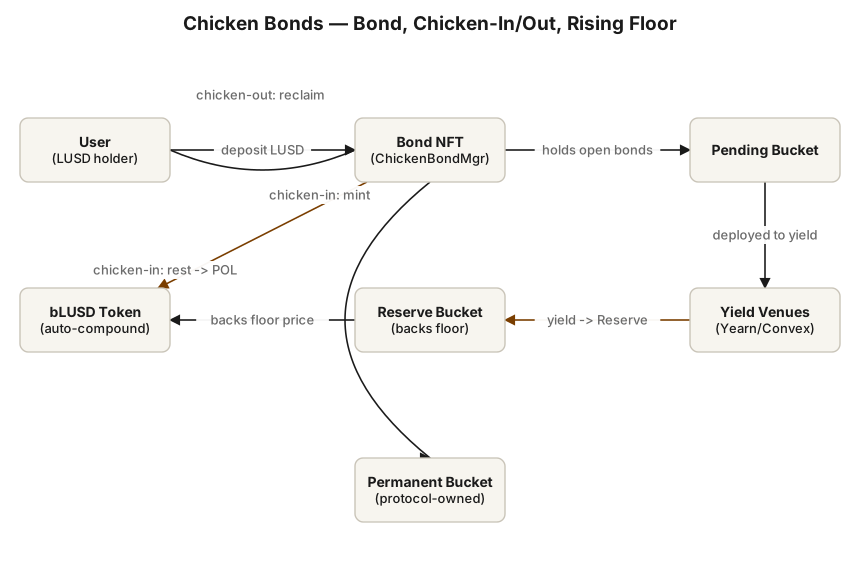
The core contract, ChickenBondManager (0x57619FE9C539f890b19c61812226F9703ce37137), routed all bonded LUSD into yield venues — principally B.Protocol's automated wrapper around the Liquity Stability Pool, and a Yearn Curve LUSD vault (auto-compounding via Convex). Accounting used three virtual "buckets":
- Pending bucket — LUSD from still-open bonds; its yield flows to the Reserve.
- Reserve bucket — backs the entire bLUSD supply; bLUSD is fully redeemable pro-rata for the LUSD held here, establishing the floor.
- Permanent bucket — protocol-owned, non-redeemable LUSD; this is the POL the system accrues.
When a user chickened in, their bonded LUSD was split: a portion proportional to bond maturity (b_r = sp_r) went to the Reserve (backing the newly minted bLUSD), and the remainder entered the Permanent bucket, becoming POL. The closer a bond was to its bLUSD accrual cap, the larger the share credited to the Reserve. Because yield continually flowed into the Reserve while permanent LUSD stayed locked, the backing ratio (LUSD per bLUSD) could only rise, giving bLUSD a monotonically increasing redemption floor. Redemption of bLUSD for Reserve LUSD acted as an arbitrage backstop keeping the market price near or above floor. Bond positions were tradeable ERC-721 NFTs (art by artist "Luchador"). The only privileged action anywhere in the system was a one-time activateMigration() graceful wind-down that Yearn's governance address could trigger if the underlying Curve/Yearn vault became obsolete, after which bonders were expected to chicken out and bLUSD holders to redeem.
Outcome
Chicken Bonds was a strong technical and conceptual success but a commercial disappointment. The mechanism worked as designed — bonding, chicken-in/out, the rising floor, and reserve redemptions all functioned, and no exploit or loss of principal was reported. However, adoption stalled. Launched into the depths of the 2022 bear market and the post-Terra "DeFi doldrums," the system attracted modest capital and never reached the scale needed to make bLUSD deeply liquid or its yield compelling relative to simpler alternatives. TVL declined over 2023 (on the order of ~$2M by September 2023, down sharply from launch-era levels), and the market price of bLUSD frequently traded near its floor with limited premium, muting the "yield amplification" thesis. The system was designed to be effectively wound down when its underlying Yearn v2 vaults were deprecated, and it was ultimately treated as legacy/no-longer-promoted (e.g., integrators such as DeFi Saver moved it to a "no longer available" status). It remains best characterized as technically successful but commercially unsuccessful; it was never re-deployed at scale on Liquity v2 / BOLD.
Why it worked
- Principal protection was real and enforced by code. The chicken-out option meant risk-averse users could always recover their exact LUSD deposit, a genuinely differentiated and honest guarantee among yield products.
- Elegant, verifiable invariant. The monotonically rising backing ratio and immutable, admin-less contracts made the value proposition auditable and hard to rug — a rare property for a "high yield" primitive.
- Non-dilutive POL bootstrapping. By diverting a maturity-weighted slice of each chicken-in into a permanent bucket, the protocol accumulated liquidity without emitting or diluting a governance token, solving the "chicken-and-egg" liquidity problem the name puns on.
- Composability and clean UX. bLUSD as a standard auto-compounding ERC-20 and bonds as tradeable NFTs made positions transferable and integrable.
Why it failed or underperformed
- Bad market timing and low demand. Launching amid a bear market and DeFi risk-aversion starved the system of the inflows needed to make its yield and bLUSD liquidity attractive.
- Yield source ceiling. All yield ultimately derived from LUSD Stability Pool / Curve returns, which in a low-activity, low-liquidation environment were unexciting; amplification of a small base yield is still a small yield.
- Reflexive bootstrapping problem. bLUSD's premium (and thus the incentive to chicken in rather than out) depended on future bonders; thin participation created a weak flywheel and prices that hugged the floor.
- Complexity vs. reward. The three-bucket model, curves, and NFT bonds imposed real cognitive and gas overhead that outweighed the modest edge over just depositing LUSD directly into the Stability Pool.
- Ecosystem gravity. Confined to Liquity's LUSD on Ethereum mainnet, it never achieved the multi-protocol "bonding standard" adoption its whitepaper envisioned.
Lessons
- A cryptographically honest guarantee is necessary but not sufficient. Principal protection and an immutable rising floor earned trust but did not, by themselves, generate demand; product-market fit and headline yield still dominate user behavior.
- Reflexive bootstrapping mechanisms are fragile at low scale. Designs whose value depends on a growing pool of future participants can stall in a stable, low-inflow equilibrium — launch conditions and initial liquidity matter enormously.
- Yield derivatives inherit their base's ceiling. "Amplified" yield is only as good as the underlying source; wrapping a modest yield in sophisticated machinery does not manufacture new returns.
- Immutability is a double-edged sword. Zero admin control maximized trust and safety but also removed levers to iterate, incentivize, or migrate the product as conditions changed, hastening its slide into legacy status.
Redesign (EDITORIAL — hypothesis, not fact)
The following is the researcher's editorial hypothesis, not established fact.
A modern redesign would keep the immutable rising-floor invariant and principal-protected bond as the trust anchor, but decouple the product from a single stablecoin, a single chain, and a single low-variance yield source. Concretely: (1) make Chicken Bonds a generalized, permissionless factory — a "bonding standard" — so any DAO could spin up a bToken over its own asset with pluggable, risk-tiered yield adapters (LSTs, RWA/T-bill vaults, incentivized LP), giving the amplification engine a higher and more diversified base yield. (2) Add a bootstrapping subsidy that decays over time (protocol matching or emissions into the Reserve during an initial epoch) to overcome the cold-start reflexivity, sunsetting once TVL crosses a self-sustaining threshold. (3) Introduce a governance-minimal but non-zero adaptivity layer — e.g., a time-locked, community-ratified ability to add new yield adapters or trigger orderly migration — preserving safety while avoiding the "immutable but stranded" endgame. (4) Deploy natively as bBOLD on Liquity v2 across L2s to lower gas and widen reach, and replace bespoke NFT bond UX with a fungible-plus-optional-NFT wrapper to reduce friction. The bet: the mechanism's failure was distribution and demand, not design, so the highest-leverage changes are broadening the surface area and jump-starting the flywheel — not altering the elegant core math.
Sources
- Chicken Bonds — Official site — primary (docs)
- LUSD Chicken Bonds — Official Documentation (Technical Design) — primary (docs)
- liquity/ChickenBond — Source repository — primary (contract)
- Chicken Bonds Whitepaper & Bounty (GitBook) — primary (docs)
- ChickenBondManager on Etherscan — primary (contract)
- bLUSD Token Tracker on Etherscan — primary (contract)
- Potential future system migration / wind-down (Docs) — primary (docs)
- Liquity Breaks DeFi Doldrums With 'Chicken Bonds' Offering (The Defiant) (news)
- Chicken Bonds By Liquity [Initial Review Dec 2022] (Serenity Research) (analysis)
- Liquity Deep Dive: What is LQTY and What Are Chicken Bonds? (CoinGecko) (analysis)
Related experiments
Last verified: 2026-07-26 · Spot an error? Suggest a correction