Aavegotchi
DeFi-collateralized NFT ghosts on Polygon that combined yield-bearing aToken 'Spirit Force,' a DAI bonding curve for GHST, and play-to-earn 'rarity farming' governed by one of gaming's most active DAOs.
▶ Run interactive simulation animated mechanism with editable parameters
How it works onchain
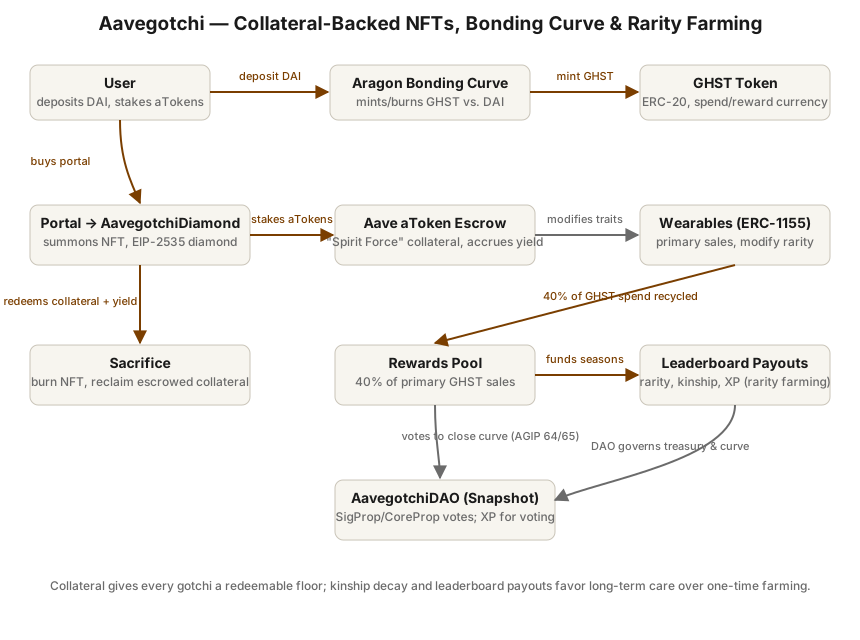 Open full-size diagram
Summary
Aavegotchi is a crypto-pet game built by Pixelcraft Studios (co-founded by pseudonymous CEO "Coder Dan" and Jesse Johnson) that fused DeFi and NFTs: each ghost-shaped ERC-721 avatar holds an escrow of yield-bearing Aave aTokens ("Spirit Force"), so the NFT has an intrinsic, growing floor value and can be "sacrificed" to reclaim collateral. Its GHST token launched 2020-09-14 on Ethereum via an Aragon Fundraising bonding curve backed by DAI; the game itself launched on Polygon on 2021-03-02, where the first 10,000 portals sold out in under a minute. Aavegotchi pioneered leaderboard-based play-to-earn ("rarity farming"), an emotional-attachment score ("kinship"), the EIP-2535 Diamond standard in production (co-founder-adjacent engineer Nick Mudge authored the standard), and an unusually active DAO. The bonding curve was closed by DAO vote in March 2023 after absorbing roughly 30.3M DAI; the project migrated fully from Polygon to Base on 2025-07-25 and continues operating.
Design (Mechanism)
- Value-staked NFTs. Summoning an Aavegotchi from a portal requires staking Aave interest-bearing aTokens into an escrow contract owned by the NFT. The collateral accrues Aave lending yield over time, giving every NFT a redeemable floor ("sacrifice" burns the NFT and returns collateral). This made the NFT a container for productive capital, not just art.
- Trait-based scarcity + dynamic scores. Each gotchi has randomized traits determining a Base Rarity Score, plus mutable stats: XP (from governance participation and games) and kinship (rises with regular "petting" interactions, decays with neglect). Wearables (ERC-1155) modify rarity.
- Rarity farming. Seasonal GHST prize pools (typically ~1.5M GHST per season) are paid down descending leaderboards for rarity, kinship, and XP — a P2E design that rewards ongoing curation rather than one-time grinding. 40% of GHST spent in primary sales (wearables, consumables, portals) is recycled into the rewards pool.
- Bonding-curve token issuance. GHST was minted/burned against DAI on an Aragon Fundraising curve (opened at 0.2 DAI), giving continuous liquidity, algorithmic price discovery, and a hard DAI backing while the curve was live.
- Governance. AavegotchiDAO evolved through staged "leveling" (SigProp → CoreProp process on Snapshot); XP rewards for voting tied game progression to governance turnout.
- Architecture. All core logic lives in a single upgradeable EIP-2535 Diamond (AavegotchiDiamond), one of the first large production deployments of the standard, enabling modular facet upgrades under DAO oversight.
Outcome
Partial success, still ongoing. The September 2020 token sale and March 2021 Polygon launch were emphatic product-market hits: Haunt 1's 10,000 portals sold out in under a minute, and Aavegotchi became Polygon's flagship early game, later expanding to Gotchiverse land gameplay, a Baazaar marketplace, and GBM auctions. The bonding curve took in ~30.3M DAI over its lifetime; the DAO voted (AGIP 64/65) to close it in March 2023 — coincidentally on the day of the USDC/DAI depeg — and split the DAI 25/25/25/25 between liquidity, the DAO treasury, Pixelcraft, and protocol rewards. Rarity farming distributed millions of GHST across many seasons. However, like the whole P2E cohort, activity and GHST price fell far from 2021 peaks; the project's own Geist L3 chain was wound down by DAO vote in 2025, and the ecosystem consolidated with a full migration to Base on 2025-07-25 (Polygon contracts frozen as view-only). The game persists with a loyal niche community and a 2026 roadmap, but never achieved mainstream gaming scale.
Why it worked
- Intrinsic value floor changed NFT psychology. Collateral-backed NFTs with a sacrifice/redeem path meaningfully reduced downside fear during minting manias and gave a principled valuation anchor.
- Emissions rewarded stewardship, not extraction. Kinship's interaction-decay loop and leaderboard payouts favored long-term, attached owners over mercenary farmers — a rare P2E design that partially resisted the death spiral that killed Axie-style earn loops.
- The bonding curve was a slow, credible sale. Continuous issuance against DAI avoided a single manipulable TGE, funded the team and DAO transparently over years, and could be shut off gracefully by governance.
- Serious engineering. The Diamond-standard architecture allowed years of feature upgrades on one address; being an early Polygon anchor tenant gave cheap transactions when Ethereum gas made the original mainnet plan untenable.
- Governance as gameplay. XP for voting produced unusually high DAO participation and legitimized big decisions (curve closure, chain migrations).
Where the design broke
- Yield collateral was a marketing hook more than an economic engine. Aave yields on stablecoin Spirit Force were low; the "growing" collateral was negligible relative to speculative trait premiums, so the DeFi leg mattered less than advertised once hype faded.
- P2E gravity. Rarity-farming emissions still depended on new primary-sale inflows (40% recycling); when the 2021–22 GameFi cycle ended, demand for wearables and portals shrank and reward pools became less compelling.
- Complexity tax. Portals, haunts, traits, kinship, wearables, FRENS, land, and DAO levels formed a steep onboarding curve that limited the audience to crypto-natives.
- Infrastructure churn. Ethereum → Polygon → (Geist L3, wound down) → Base migrations consumed years of community energy and fragmented liquidity and tooling.
Lessons
- Backing NFTs with redeemable, yield-bearing collateral is a powerful trust primitive, but the yield must be material to the asset's price or it becomes narrative decoration.
- Emissions tied to ongoing care (kinship decay, leaderboards) age far better than pay-once/earn-forever P2E loops; recycling a fixed percentage of primary revenue into rewards creates a bounded, self-limiting subsidy.
- A long-running bonding curve is an underrated fundraising design: continuous price discovery, multi-year runway, transparent treasury accrual — and, crucially, a governance path to retire it cleanly (AGIP 64/65).
- Making governance participation part of game progression (XP for voting) measurably increases DAO engagement.
- Chain migrations are survivable for a strong community but each one costs momentum; teams should budget for them as full product launches, not maintenance.
Redesign (EDITORIAL — hypothesis, not fact)
This section is editorial hypothesis, not fact. A modern redesign would keep the collateral-escrow NFT but make the yield leg real: point Spirit Force at higher-yield, risk-tiered sources (e.g., staked-ETH or tokenized T-bill vaults) so a gotchi's floor grows at a rate players can feel, and let trait rarity act as a multiplier on the owner's share of a protocol-level yield pool rather than on pure emissions. Rarity-farming payouts could be funded entirely from secondary-market fees plus collateral yield skim — eliminating dependence on primary-sale inflows and making the reward budget genuinely sustainable at steady state. Kinship could be extended into an underwriting signal (long-kinship gotchis unlock fee discounts or governance weight), deepening the identity/reputation angle that was Aavegotchi's most original idea. Finally, deploy once on a single durable L2 with account-abstraction onboarding, and treat cross-chain presence as mirrored read-only state rather than serial migrations.
Sources
- Aavegotchi Wiki — Introduction — primary (docs)
- Aavegotchi Wiki — Bonding Curve — primary (docs)
- Aavegotchi Wiki — Contract Addresses — primary (docs)
- Aavegotchi Wiki — Team — primary (docs)
- Aavegotchi Wiki — Rarity Farming — primary (docs)
- aavegotchi/aavegotchi-contracts (EIP-2535 diamond implementation) — primary (contract)
- AavegotchiDiamond on PolygonScan — primary (contract)
- Aavegotchi Has Migrated to Base (official blog) — primary (docs)
- Play-to-Earn Guide: Aavegotchi's Rarity Farming Explained (official blog) — primary (docs)
- Aavegotchi Confirms March 2 Launch Date (official Medium) — primary (docs)
- CoinFi: Aavegotchi bonding curve closes on exact day of DAI depeg (news)
- DappRadar: Aavegotchi Launches NFT Play-to-Earn Rarity Farming (news)
Related experiments
Last verified: 2026-07-26 · Spot an error? Suggest a correction