Ten Thousand Tokens
A fixed-supply collection of 10,000 NFTs where each NFT is a one-time 'launch key' that can be burned to deploy a unique ERC20 on a shared Uniswap V4 hook, splitting perpetual swap fees between the launcher, remaining NFT holders, the platform, and a buyback wallet.
▶ Run interactive simulation animated mechanism with editable parameters
How it works onchain
 Open full-size diagram
Summary
Ten Thousand Tokens is a token-launch primitive from TokenWorks ("a playground for onchain financialized ideas"). It inverts the usual "one scarce collection" NFT model: instead of concentrating value in a flagship token, it distributes it across a constellation of up to 10,000 individual ERC20 tokens, each keyed to one NFT in a fixed-supply ERC721 collection on Ethereum. Each NFT is effectively a single-use option: hold it to earn a share of protocol-wide trading fees, or burn it to permanently deploy your own token and become that token's fee beneficiary. The token universe is capped "by immutable constant, at 10,000 — one per NFT." The NFT collection is deployed at 0x26d7ad0e930b54b84c00daad077ee31ba9e2fb2e on Ethereum mainnet, with launched tokens trading through a shared Uniswap V4 hook. The project's official X account is @token_works (linked directly from token.works and carrying the matching bio).
Design (Mechanism)
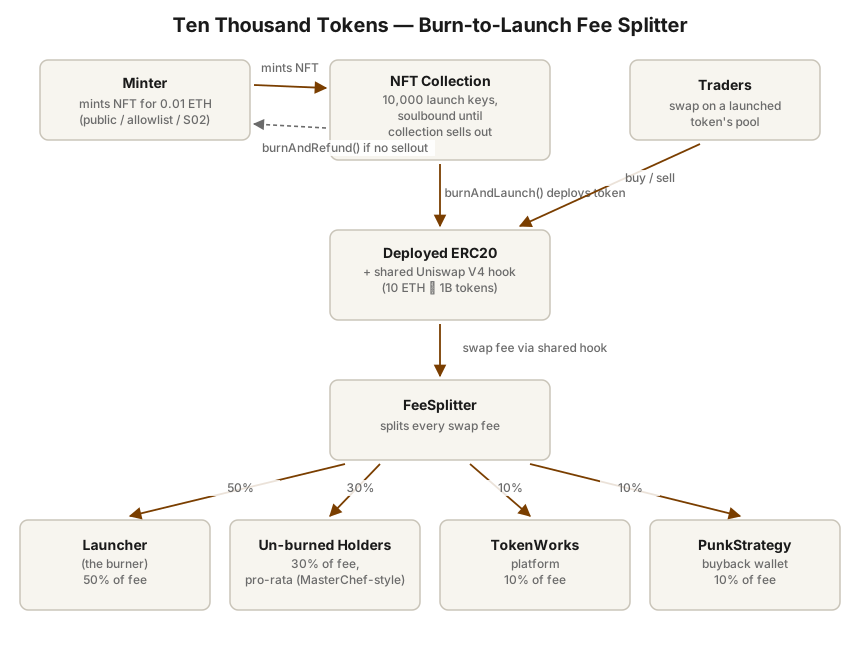
Mint (7-day window). Three concurrent paths: a public mint at 0.01 ETH per NFT (3 per wallet, with a 24-hour delay), a Merkle/allowlist-gated mint at 0.01 ETH with address-dependent caps, and a free claim for holders of a prior "S02 Soulbound" NFT (non-refundable). NFTs are soulbound (non-transferable) until full sellout, then become transferable. Per the announcement, the first 24 hours were allowlist-only.
Two sale outcomes. If the collection sells out, every NFT becomes a live "launch key." If it does not, paid minters can call burnAndRefund() after the window closes to reclaim their 0.01 ETH.
Burn-to-launch. Calling burnAndLaunch() destroys the NFT and deploys a unique ERC20 on Uniswap V4 with hardcoded initial pricing (documented as 10 ETH ≡ 1 billion tokens). The burner becomes that token's permanent "launcher."
Fee split (per swap, via a shared hook → FeeSplitter). A single hook across all pools is the only path by which ETH enters the fee economy. Each swap's fee is split:
- 50% → the token's launcher/burner
- 30% → un-burned NFT holders, pro-rata
- 10% → TokenWorks (platform)
- 10% → PunkStrategy (an on-chain buyback wallet)
Launch taxes. A decaying buy tax starts at 99% at block 0 and decays 1% per block down to a permanent 1% baseline by ~block 98; the sell tax is a flat 1% at all times. Excess decay-phase fees are converted to ETH and used to buy tokens back on-chain, removing supply.
Holder accrual. The 30% holder pool uses a MasterChef-style cumulative-accrual design with a dynamic divisor: as NFTs are burned out of the holder set, each remaining holder's per-token share grows (documented from ~0.003% at 10,000 held to 30% at a single remaining NFT). This creates a game-theoretic tension the whitepaper acknowledges: burning captures a launch's upside but shrinks the shared holder pool, and "no individual launcher can refrain unilaterally without losing the option value of their own launch."
Outcome
Status: too_early_to_judge. Launched 2026-05-14 (per Tekedia; on-chain/social activity clusters in mid-2026). As of last verification the project was live and functioning: the tenthousandtokens.net dashboard reported 133 tokens deployed and an aggregate market cap of roughly $6.34M, but only ~$312 of 24-hour trading volume across the deployed tokens. NFT marketplaces showed roughly 2,100–2,900 holder wallets, a floor around 0.0588 ETH (well above the 0.01 ETH mint), and cumulative secondary volume near 1.85K ETH (OKX). So the primitive works mechanically and the mint was a commercial success relative to mint price, but the launched-token economy that is supposed to feed the 30% holder pool is thin — most of the 10,000 potential tokens remain unlaunched and traded volume is low.
Why it worked
- Clean, legible primitive. "Hold to earn fees, or burn to launch your own token" is a one-sentence pitch that early crypto-native observers repeated verbatim, driving organic attention (the floor traded at multiples of mint within days).
- Real optionality with a floor. The refund path (
burnAndRefund) and the soulbound-until-sellout rule reduced downside for minters, while burn-to-launch offered genuine upside — a favorable risk shape for a 0.01 ETH entry. - Immutable, hard-capped scope. The 10,000-cap and hardcoded launch parameters make the system credibly non-dilutive and hard to rug at the protocol layer, which is attractive to a fee-sharing audience.
Where the design broke
- Thin launched-token demand. With ~133 of 10,000 tokens launched and negligible daily volume, the 30% holder fee pool — the core reason to not burn — currently distributes very little, undermining the "rewards the patient" thesis.
- Reflexive game theory cuts against fee flow. Because burning captures private launch value while diluting the shared pool, the dominant individual strategy pressures holders to burn, but each new low-liquidity token adds little aggregate fee volume — a coordination problem the whitepaper openly flags.
- Fragmentation of liquidity. Spreading value across thousands of micro-tokens spreads liquidity thin; most launched tokens likely have shallow markets, so the 50% launcher reward and 30% holder pool are both starved.
Lessons
- Fee-sharing primitives are only as strong as the underlying trading volume. A mechanically elegant split (50/30/10/10) means nothing if the launched assets don't trade; the design monetizes activity it cannot itself create.
- Burn-to-launch creates an anti-coordination trap. When the private reward for defecting (burning) dilutes the collective reward for cooperating (holding), you should expect over-launching of low-quality tokens unless launch is gated by cost or curation.
- Scarcity-inversion is a marketing hook but a liquidity liability. "10,000 tokens instead of one" differentiates the pitch but fragments the very liquidity the fee economy depends on — abundance and deep markets are in tension.
- Refundable, soulbound-until-sellout mints are a strong minter-protection pattern worth reusing independently of the rest of the mechanism.
Redesign (EDITORIAL — hypothesis, not fact)
The following is the researcher's analysis, not established fact.
The central flaw is that Ten Thousand Tokens rewards the act of launching more than the quality of what is launched, so the fee economy that funds the 30% holder pool is chronically under-fed. A redesign could:
- Gate launches on demonstrated demand. Require a burn to be accompanied by a minimum seeded liquidity or a small refundable bond that is slashed if the token's pool stays below a volume threshold for N days — filtering out dead-on-arrival launches that only dilute the holder pool.
- Make the holder/launcher split dynamic on realized volume. Instead of a fixed 50/30, tilt more of each token's fee toward the holder pool when only a few tokens have launched (bootstrapping the "patient" reward), and toward launchers as aggregate volume grows — aligning incentives with the network's maturity.
- Concentrate liquidity via optional token-merging or shared-vault routing. Allow launched tokens to opt into a shared liquidity or index vault so micro-tokens aren't stranded in shallow pools; deeper markets raise fee throughput for everyone.
- Add a lightweight curation/reputation layer (e.g., allowlisting launchers or letting holders signal which launches receive boosted fee weighting) so the 10,000-token universe trends toward fewer, deeper, higher-signal assets rather than a long tail of illiquid deployments.
Net: keep the burn-to-launch primitive and the immutable cap, but couple launching to real liquidity/demand and make the fee split adaptive, so the system stops rewarding volume it cannot generate.
Verification notes. Founders/team are not disclosed on the official site, docs, or whitepaper (treated as Pseudonymous / Unknown — not fabricated). The X handle @token_works is verified via the official website (token.works links to it and the account bio matches the site descriptor); beware same-name impostors including @tokenworks, "TokenWorks Inc. (@TokenWorks)", and @tokenworks1, which are unrelated. Launch date is per Tekedia (2026-05-14); on-chain contract creation date could not be independently confirmed (Etherscan direct fetch was blocked). Metrics (holders, floor, volume, tokens deployed) are point-in-time from OKX/OpenSea/the project dashboard and will drift.
Sources
- Ten Thousand Tokens — Whitepaper v1.0 (token.works) — primary (docs)
- TokenWorks™ official site — primary (docs)
- Ten Thousand Tokens — Docs — primary (docs)
- Ten Thousand Tokens — dashboard (tokens deployed / market cap) — primary (docs)
- Ten Thousand Tokens NFT collection (Ethereum) — OKX (analysis)
- Ten Thousand Tokens NFT collection — OpenSea (analysis)
- TokenWorks™ on X — launch announcement — primary (news)
- Tokenworks Launches 'Ten Thousand Tokens' — Tekedia (news)
Related experiments
Last verified: 2026-07-26 · Spot an error? Suggest a correction