Autoglyphs
The first generative art project both generated and stored entirely on the Ethereum blockchain, whose artwork is produced in real time by an algorithm embedded in the smart contract itself.
▶ Run interactive simulation animated mechanism with editable parameters
How it works onchain
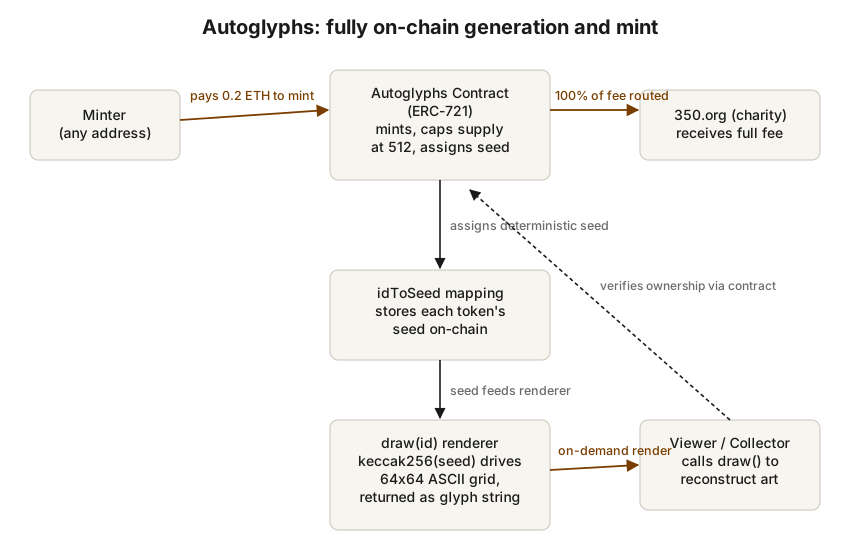 Open full-size diagram
Summary
Autoglyphs is a 512-piece generative art collection released by Larva Labs — the studio of Matt Hall and John Watkinson, the same duo behind CryptoPunks — on April 8, 2019. Its historical significance is that it was, by the creators' own framing, "the first art project that was both generated and stored entirely on-chain." Where CryptoPunks stored a hash of its images and hosted the actual pixel art off-chain, Autoglyphs embeds the drawing algorithm directly in the Ethereum smart contract. When a glyph was minted, the Ethereum Virtual Machine itself executed the generative code and permanently recorded the resulting artwork's parameters on-chain. Each piece is a monochrome ASCII-style composition rendered on a 64×64 character grid.
Minting was open to anyone willing to donate a creation fee of 0.2 ETH (roughly $35–$40 at the time) to Larva Labs' chosen charity, 350.org, a climate-change nonprofit. All 512 pieces were claimed within hours of launch, and the proceeds (reported as $13,670) went to charity rather than to the creators. Autoglyphs became a foundational reference point for the "fully on-chain" and generative-art-on-blockchain movements that later flourished through platforms like Art Blocks, and pieces now sit in institutional collections including the Centre Pompidou and the Whitney Museum of American Art.
Design (Mechanism)
Autoglyphs is an ERC-721 contract (address 0xd4e4078ca3495de5b1d4db434bebc5a986197782, verified source on Etherscan, compiled with Solidity 0.4.24). Its defining mechanic is that the artwork is not a stored image but a deterministic function of on-chain state:
- Seeded generation. At mint, the contract derived a seed for each token. Rendering is deterministic:
keccak256(abi.encodePacked(idToSeed[id]))drives the algorithm, so a glyph can be regenerated from the contract at any time and will always produce the identical composition. Nothing is stored off-chain to define the image. - On-chain renderer. A
draw(id)function walks a 64×64 grid (USIZE), computing each character position with fixed-point arithmetic and selecting from a small set of ASCII "symbol schemes" (e.g.X/\.,+-|,\|-/). The output is a text glyph — the art is literally the string the contract emits. - Fixed supply and charitable mint. Supply was capped at 512. The mint fee (0.2 ETH) was routed to 350.org rather than retained by Larva Labs, an unusual "no rake for the artist" posture that reinforced the project's framing as a conceptual/instruction-based artwork rather than a revenue vehicle.
- Relinquished control. Larva Labs deliberately gave up curatorial control after deployment: they could not predict, choose, or repeat which glyphs would appear, describing the mint as "a live performance for which we can rehearse, but cannot predict nor repeat." The algorithm — not any hand-picked output — is positioned as the artwork.
The result is an artifact that is fully self-contained on Ethereum: as long as the chain persists and the contract is callable, every Autoglyph can be reconstructed from first principles with no dependence on IPFS, Arweave, a website, or any external renderer.
Outcome
By most measures Autoglyphs is a major success. The full 512 minted out within hours on launch day (April 8, 2019), and it has since become a blue-chip generative collection. Secondary trading has reportedly exceeded ~$50 million cumulatively. In February 2024, a complete set of ten Autoglyphs sold for 5,000 ETH (approximately $14.6 million) via the brokerage Fountain.xyz — described at the time as the largest NFT art sale since 2022. Floor prices have fluctuated dramatically with market cycles (reported around 230 ETH near that sale, and lower — on the order of ~87 ETH — in softer conditions).
Institutionally, Autoglyphs has been validated as a canonical work: pieces are held by the Centre Pompidou and the Whitney Museum of American Art, and the project is regularly cited as the conceptual bridge between CryptoPunks and the later on-chain generative-art boom. Notably, when Larva Labs sold CryptoPunks and Meebits to Yuga Labs on March 11, 2022, they explicitly retained Autoglyphs, underscoring its standing within their own portfolio.
Why it worked
- A genuine technical first. Being the first project to both generate and store art entirely on-chain gave Autoglyphs a durable, defensible historical claim that later collections could not retroactively take.
- Provenance of the creators. Coming from the CryptoPunks team gave the launch instant credibility and collector attention in a still-tiny 2019 NFT market.
- Conceptual coherence. Scarcity (512), the charitable mint, relinquished curatorial control, and the "algorithm is the art" thesis formed a tight, art-historically literate narrative that aged well and appealed to serious collectors and museums.
- True permanence. Full on-chain storage removed the link-rot and off-chain-dependency risks that plague most NFTs, which became a major selling point as collectors grew sophisticated.
Limitations and criticisms
Where Autoglyphs left value or reach on the table:
- No creator revenue and no royalties. The mint fee went entirely to charity and the collection carries no enforced royalties, so Larva Labs captured essentially none of the tens of millions in later secondary value — a deliberate choice, but one that limited any ongoing project treasury or ecosystem-building.
- Minimal ongoing stewardship. Autoglyphs has largely been left as a static historical artifact with little active community, tooling, or narrative development, so its cultural mindshare has at times trailed more actively marketed generative platforms (e.g. Art Blocks).
- Aesthetic austerity. The stark monochrome ASCII output is conceptually powerful but visually narrow, giving it a smaller mainstream collector base than more colorful generative projects.
Lessons
- On-chain permanence is a design decision with long-term payoff. Embedding the generator and storing everything on-chain future-proofed the work against off-chain dependency failures; projects that want durability should treat on-chain storage as a first-class constraint, not an afterthought.
- Constraint and relinquished control can be features. A hard 512 cap plus giving up the ability to curate outputs created scarcity and conceptual integrity that markets and museums rewarded — restraint compounded value.
- Founder provenance and a coherent thesis accelerate legitimacy. A tight, art-literate narrative from credible creators mattered as much as the code in establishing Autoglyphs as canonical.
- Foregoing capture is a values choice with real cost. Zero creator take and no royalties strengthened the artistic statement but meant the creators built almost none of the durable economic upside their innovation generated — a tradeoff worth making consciously.
Redesign (EDITORIAL — hypothesis, not fact)
The following is the researcher's speculative analysis, not established fact. If one were designing an "Autoglyphs 2.0" today while preserving its core virtue — art that lives entirely on-chain — several updates seem worth testing. First, adopt an explicit, machine-readable public-domain/CC0 dedication for the generator and outputs; Autoglyphs predated the CC0 norm, and a clear license would remove ambiguity for derivative and educational use while matching the "the algorithm is public" ethos. Second, reconsider the value-capture model: rather than a binary of "all to charity / nothing to creators," a small transparent split (e.g. charity + a modest creator/maintenance endowment governed on-chain) could fund ongoing stewardship — an on-chain renderer library, museum-grade documentation, and an SVG/HTML tokenURI so the art self-displays in any wallet without an external site. Third, richer but still fully deterministic on-chain rendering (color palettes, layered schemes, or an on-chain SVG output) could widen aesthetic range without sacrificing permanence, using modern Solidity's cheaper storage and string tooling that were unavailable in 2019. Finally, a lightweight on-chain provenance/attestation layer could let museums and collectors verify institutional custody natively. The guiding hypothesis: Autoglyphs' scarcity-plus-permanence formula was correct, and the largest untapped opportunity was durable stewardship and self-rendering, not more supply.
Sources
- Larva Labs / Autoglyphs (official project page) — primary (docs)
- Autoglyphs generator / technical index (official) — primary (docs)
- Autoglyphs ERC-721 contract (Etherscan token tracker) — primary (contract)
- Larva Labs / About (founders) — primary (docs)
- Yuga Labs Acquires CryptoPunks and Meebits (Larva Labs blog) — primary (retrospective)
- Autoglyphs Set Fetches Record-Breaking $14.6 Million in Historic NFT Sale (news)
- Collecting the Algorithm: Autoglyphs (Curated) (analysis)
Related experiments
Last verified: 2026-07-26 · Spot an error? Suggest a correction