Deafbeef
Pseudonymous Canadian artist-engineer who stored self-contained C code on Ethereum to generate audiovisual works, pioneering fully on-chain generative audio and token mechanics like transfer-triggered degradation and owner-tunable parameters.
▶ Run interactive simulation animated mechanism with editable parameters
How it works onchain
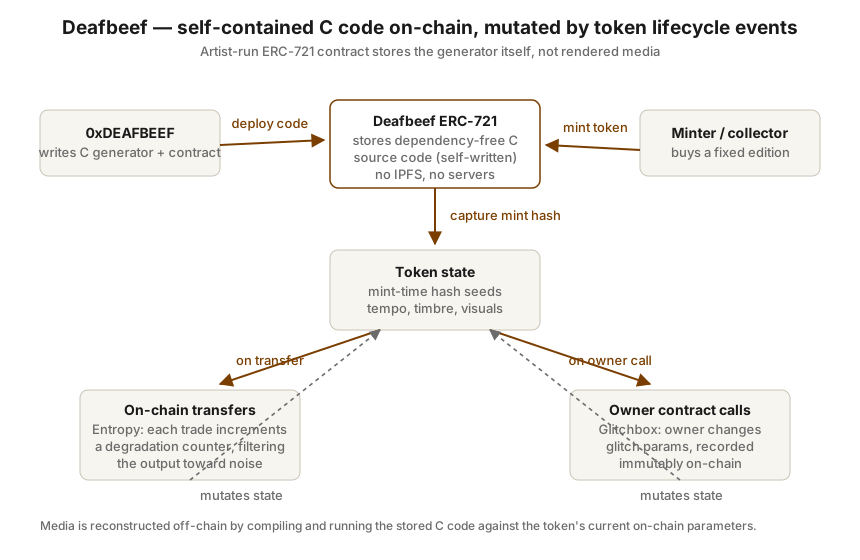 Open full-size diagram
Summary
Deafbeef (styled 0xDEAFBEEF) is a pseudonymous Toronto-based artist and electrical engineer — also a classically trained musician, recording engineer, and blacksmith — who began publishing fully on-chain generative audiovisual art on Ethereum in March 2021. His genesis series, Synth Poems (128 editions), stored self-contained C code on the Ethereum blockchain; the code, seeded by a hash captured at mint, deterministically generates each token's audio and video output. No IPFS, no servers, no external libraries: anyone with the chain data and a C compiler can reconstruct every artwork forever. Over 2021 he released Volume 1 — six series totaling 223 pieces (Synth Poems, Angular, Transmission, Entropy, Glitchbox, Advection) — under a single self-written contract (0xd754937672300ae6708a51229112de4017810934), each exploring a different blockchain-native mechanic. Deafbeef became one of the canonical figures of on-chain art: his work has sold at Sotheby's and Phillips, entered LACMA's permanent collection (Noumenon), and he contributed the proof-of-concept that helped bring CryptoPunks fully on-chain in 2021.
Design (Mechanism)
- On-chain code as the artwork. Rather than storing rendered media, Deafbeef stores compact, dependency-free C source on Ethereum. The contract holds the generative model plus per-token parameters; output media (WAV/video) is reconstructed off-chain by compiling and running the code. This trades rendering convenience for maximal permanence and verifiability.
- Mint-hash seeding. Each token's parameters derive from a random hash at mint time, driving musical variables (tempo, timbre, pitch, time signature) and visual ones. Simple rules yield wide variation within a recognizable series aesthetic.
- Token state as artistic input. Volume 1 escalates the coupling between token mechanics and output:
- Entropy (Series 3, 8 editions): every on-chain transfer increments a degradation counter; the generated media becomes progressively more filtered and distorted, until — after enough trades — it is indistinguishable from noise. Inspired by Alvin Lucier's I Am Sitting in a Room; notably, no information is truly lost, since the pristine state remains reconstructable from the immutable code by varying the input parameter.
- Glitchbox (Series 4, 64 editions): owners can call the contract to change glitch parameters, with each interaction recorded immutably on-chain — the collector becomes a performer.
- Advection (Series 5, 8 editions): a fluid-dynamics model with collaborative interaction mechanics.
- Artist-run distribution. Deafbeef wrote his own ERC-721 contract and sale mechanics rather than using a platform (contrast Art Blocks), keeping the full pipeline — synthesis code, contract, distribution — as a single-author craft practice.
- Scarcity structure. Deliberately small fixed editions (four series of only 8; 128 and 64 for the larger two) mean at most eight complete Volume 1 sets can ever exist.
Outcome
Major success by the standards of on-chain art. All Volume 1 series minted out in 2021, and Deafbeef was quickly recognized alongside Art Blocks and Autoglyphs as a canonical demonstration that the blockchain could be a native artistic medium rather than a receipt-pointer system. Secondary recognition includes sales at Sotheby's (Natively Digital, the 3AC "Grails" auctions) and Phillips; collectors include Dylan Field, Alan Howard, and Fingerprints DAO. Noumenon (Volume 2) entered LACMA's permanent collection, and the artist has spoken/exhibited at institutions including the Toledo Museum of Art. He continued releasing work (Volume 2: Caves, Noumenon, which embeds blockchain timestamps into the artwork) and remained active and respected through subsequent market cycles. Exact per-series mint prices and aggregate sales figures: Unknown / not found in primary sources consulted.
Why it worked
- Genuine technical scarcity of skill. Hand-written FM synthesis and rendering in bare C, small enough to store on-chain, was something almost no one else could produce in 2021; the constraint itself was the aesthetic.
- Mechanics with meaning. Entropy's transfer-degradation is mechanism design as art criticism: it makes speculative flipping visibly costly to the artwork, forcing holders to weigh liquidity against preservation — a rare case where a token mechanic embodies the work's thesis (permanence vs. decay) instead of decorating it.
- Permanence claims that were actually true. In a period when most "NFT art" pointed at centralized URLs, code-on-chain gave collectors a credible forever-artifact, which institutions and blue-chip collectors could underwrite.
- Credible single-author provenance. One artist, one contract, self-distribution — clean provenance and a coherent body of work, well-suited to museum and auction-house framing.
Limitations and criticisms
- Reconstruction friction. The art requires off-chain compilation/execution to experience; most viewers rely on pre-rendered copies, so day-to-day the permanence guarantee is latent rather than lived.
- Interactive mechanics vs. market caution. Entropy's degradation arguably suppresses trading of exactly the tokens it made famous — holders are reluctant to transfer, so the mechanic is mostly experienced counterfactually.
- Not a scalable model. The approach depends on a rare skill set and tiny editions; it inspired imitators but produced no reusable platform or protocol, so its influence is exemplary rather than infrastructural.
Lessons
- Store the generator, not the output. Compact deterministic code plus on-chain parameters achieves permanence that media files (even on IPFS) cannot; the artwork survives as long as the chain and a compiler exist.
- Token lifecycle events are an expressive palette. Transfers, ownership, timestamps, and owner calls can be first-class artistic inputs (Entropy, Glitchbox, Noumenon) — mechanism design can carry the concept, not just the distribution.
- A mechanic that penalizes trading changes holder behavior. Transfer-triggered mutation creates an endowment/preservation effect; designers can use state mutation to encourage long-term holding without lockups.
- Constraints are a moat. Self-imposed minimalism (no libraries, on-chain size limits) produced both a distinctive aesthetic and a defensible reputation that platforms could not commoditize.
- Reversibility defuses destructive mechanics. Entropy's degradation is parameterized, not information-destroying — a design that makes a provocative point while keeping the canonical work recoverable.
Redesign (EDITORIAL — hypothesis, not fact)
This section is editorial hypothesis, not fact. A modern redesign could keep the code-on-chain core but close the "latent permanence" gap: compile the C generators to a small WASM/EVM-verifiable runtime so any client can reconstruct the media trustlessly in-browser, making the permanence guarantee experiential rather than theoretical. Entropy-style mechanics could be generalized into a standard interface (e.g., an ERC-721 extension exposing stateOf(tokenId) driven by transfer count, holding duration, or owner calls) so wallets and marketplaces render mutable works correctly. One could also experiment with asymmetric degradation — decay on sale-transfers but slow "healing" during long holds — to sharpen the hold-vs-flip incentive, and with pricing the restoration of a degraded state as a burn-based action, converting the artistic mechanic into a sustainable royalty substitute. The main risk is over-engineering: Deafbeef's value came from restraint, and a protocolized version might trade away exactly the single-author craftsmanship that made it canonical.
Sources
- DEAFBEEF official site (series list, contract, technical notes) — primary (docs)
- Deafbeef Volume 1 contract on OpenSea (0xd754...0934) — primary (contract)
- Fingerprints DAO — 'Constraints Lead to Creativity': an interview with DEAFBEEF — primary (retrospective)
- LACMA Unframed — Remembrance of Things Future: A Conversation with 0xDEAFBEEF — primary (retrospective)
- Curated — Collecting the Artist: 0xDEAFBEEF (analysis)
- Sotheby's — DEAFBEEF Series 0: Synth Poems, Token 5 (Grails Part IV) (archive)
- Le Random — DEAFBEEF artist profile (analysis)
Related experiments
Last verified: 2026-07-26 · Spot an error? Suggest a correction