Iron Finance
A Frax-style partially collateralized stablecoin (IRON) on BSC and Polygon whose share token TITAN hyperinflated to near-zero in June 2021 in what the team called crypto's first large-scale bank run.
▶ Run interactive simulation animated mechanism with editable parameters
How it works onchain
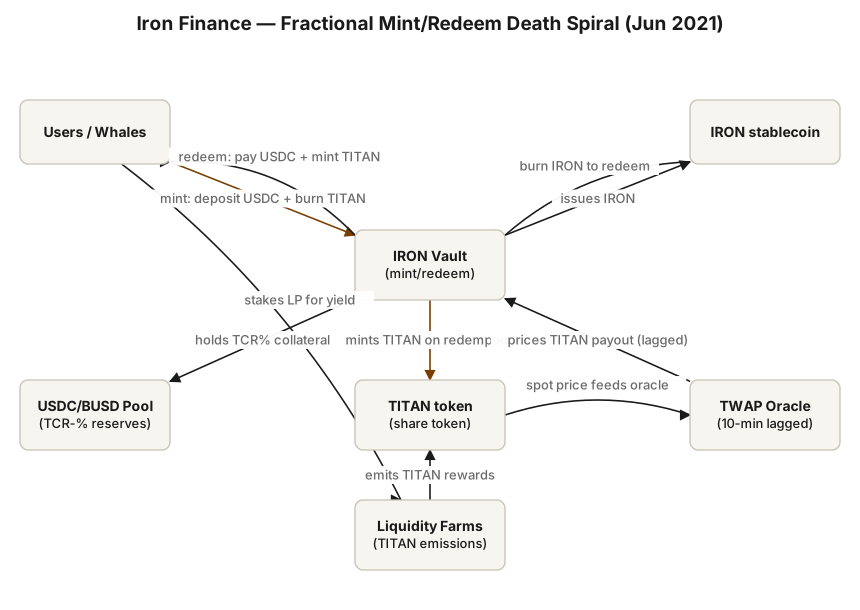 Open full-size diagram
Summary
Iron Finance was a fork of Frax's fractional-algorithmic stablecoin model, launched by an anonymous team on Binance Smart Chain on 6 March 2021 and expanded to Polygon in May 2021. Its stablecoin IRON was partially backed by a hard-collateral stablecoin (BUSD on BSC, USDC on Polygon) and partially by a volatile "share" token (STEEL on BSC, TITAN on Polygon) that absorbed seigniorage. Riding Polygon's yield-farming boom — and a widely publicized blog post by Mark Cuban, who was providing TITAN liquidity — the protocol reached roughly $2 billion in TVL, with TITAN peaking around $65. On 16 June 2021 large holders pulled liquidity and sold, IRON slipped off peg, and the redemption mechanism entered a death spiral: every IRON redeemed minted new TITAN, whose supply exploded from about 1 billion to tens of trillions of tokens in hours, driving its price to effectively zero. The team's postmortem called it "the world's first large-scale crypto bank run" and stated there was no rug pull or exploit; the failure was a designed-in reflexivity, not a hack.
Design (Mechanism)
- Two-token fractional model (Frax fork). IRON targeted $1. Minting one IRON required depositing TCR × $1 of USDC and (1 − TCR) × $1 worth of TITAN (which was burned), where TCR is the Target Collateral Ratio. Redeeming one IRON returned USDC plus freshly minted TITAN in proportion to the Effective Collateral Ratio (USDC reserves ÷ IRON supply).
- Dynamic collateral ratio. If IRON's hourly TWAP traded above $1, the TCR stepped down 0.25%/hour (more algorithmic); below $1, it stepped up 0.25%/hour (more collateralized), capped at ±6%/day. At the time of collapse the ratio was around 75%.
- TWAP-priced redemptions. The dollar value of TITAN paid out on redemption was computed from a 10-minute time-weighted average price, not spot — a deliberate anti-manipulation choice that became a critical flaw when spot moved faster than the oracle.
- Aggressive liquidity mining. High-APR farms (initially via Value DeFi's vFarm on BSC, later QuickSwap/SushiSwap pools on Polygon) paid emissions in the share token, recruiting mercenary capital that made the peg's "algorithmic" portion depend on continuous demand for TITAN.
- No circuit breakers. There was no redemption throttle, minting pause, or backstop fund; the only mint/redeem safeguard was the TWAP lag itself.
Outcome
Around 10:00 UTC on 16 June 2021, whales withdrew IRON/USDC liquidity and sold TITAN and IRON directly into pools rather than redeeming, pushing IRON off peg. TITAN fell from ~$65 to ~$30, briefly recovered, then a second wave of selling triggered mass panic redemptions. Because each redemption minted TITAN priced at a lagging TWAP above spot, redeemers instantly dumped their TITAN, crashing spot further and enlarging the next redemption's mint — a positive-feedback loop. TITAN's supply inflated from ~1 billion to roughly 35 trillion tokens and its price went to effectively zero; a contract condition also caused redemptions to revert when TITAN's oracle price hit zero, temporarily trapping holders until the team enabled a fixed-rate USDC withdrawal (roughly the ~75% collateralized portion). Approximately $2 billion in TVL evaporated. Mark Cuban publicly acknowledged losses and called for stablecoin regulation. The team later shipped an over-collateralization-oriented "v2" ecosystem (IronSwap, lending, the ICE token), but it never regained meaningful traction and the project wound down; the iron.finance domain has since lapsed to an unrelated site. Outcome: failed — a design-level collapse without an exploit.
Why it worked
- For ~3 months, mint/redeem arbitrage held IRON's peg well in normal conditions, and the fractional model was more capital-efficient than fully collateralized stablecoins.
- Enormous farming yields plus Polygon's low fees generated rapid liquidity bootstrapping — TVL scaled to ~$2B, briefly making it one of Polygon's largest protocols.
- The Frax template it copied had (and has) a working track record on Ethereum, lending the design surface credibility.
Where the design broke
- Reflexive collateral. ~25% of the "backing" was TITAN, whose value derived mostly from demand to mint IRON and farm emissions. Confidence was the collateral; when confidence broke, backing and peg failed simultaneously — a classic fractional-reserve run with no lender of last resort.
- TWAP lag weaponized the redemption path. Redemptions paid TITAN valued above its crashing spot price, so redeeming-and-dumping was always profitable on the way down, making the death spiral self-financing.
- Unlike Frax, no slow-growth discipline. Frax lowered its collateral ratio gradually against organic demand; Iron scaled the algorithmic share against mercenary farm capital that had no reason to stay.
- Zero-price edge case. Redemption logic reverted when the TITAN oracle price reached zero, freezing exits at peak panic and deepening losses and distrust.
- Anonymous team, no backstop, concentrated whale liquidity — every trust amplifier pointed the wrong way once the run began.
Lessons
- A stablecoin partially backed by its own endogenous share token converts market panic directly into supply hyperinflation; the mechanism that defends the peg in calm markets finances the run in a crisis.
- Oracle lag (TWAP) is not neutral: in fast crashes it systematically overpays redeemers in the collapsing asset, turning an anti-manipulation feature into a death-spiral accelerator. Stress-test mechanisms under the assumption spot and oracle diverge maximally.
- TVL recruited by emissions is a liability measure, not a success measure — capital that arrives for APR leaves at the first sign of stress, and fractional models are precisely the designs that cannot tolerate that exit.
- Handle boundary conditions (price = 0, oracle staleness) explicitly; a revert in the exit path during a panic traps funds and undermines trust in the protocol.
- Celebrity capital (Mark Cuban) amplifies inflows and, symmetrically, the speed and publicity of the collapse.
Redesign (EDITORIAL — hypothesis, not fact)
This section is editorial hypothesis, not a factual account. A survivable variant would likely need: (1) a hard floor on the collateral ratio (e.g., never below 85–90%) with the algorithmic tranche capped in absolute size rather than percentage; (2) redemption pricing at min(spot, TWAP) for the share token, plus a dynamic redemption fee that rises with redemption velocity, so exiting during a run pays into the remaining collateral instead of draining it; (3) a protocol-owned USDC backstop funded by seigniorage during expansion (Frax later moved this direction with AMOs and eventually full collateralization — suggesting the fractional-algorithmic end state converges back to full backing); (4) emissions vested or locked so farm capital cannot mass-exit atomically; and (5) an explicit, pre-announced "wind-down at floor value" mode instead of a reverting redemption path. Even so, the deeper hypothesis from Iron's failure is that partial backing by an endogenous token is not parameter-tunable into safety — the run equilibrium always exists, and the design only controls how expensive it is to trigger.
Sources
- Iron Finance Post-Mortem 17 June 2021 (official) — primary (retrospective)
- $IRON: The first Partial-Collateralized stablecoin on Binance Smart Chain (official launch post) — primary (docs)
- IRON Stablecoin token contract (PolygonScan) — primary (contract)
- TITAN token contract (PolygonScan) — primary (contract)
- Iron Finance Titan Post-Mortem Analysis (Omniscia) (analysis)
- Runs on Algorithmic Stablecoins: Evidence from Iron, Titan, and Steel (Federal Reserve FEDS Notes) (analysis)
- In Token Crash Postmortem, Iron Finance Says It Suffered Crypto's 'First Large-Scale Bank Run' (CoinDesk) (news)
- Bank Run in DeFi – Iron Finance Fiasco Explained (Finematics) (analysis)
- Iron Finance Implodes After 'Bank Run' (The Defiant) (news)
Related experiments
Last verified: 2026-07-26 · Spot an error? Suggest a correction