Aragon
The pioneering Ethereum DAO framework whose modular aragonOS powered thousands of onchain organizations (including Lido and Curve governance) but whose own network token ended in a treasury-raid standoff, dissolution of its Swiss association, and an ETH redemption that burned ANT entirely.
▶ Run interactive simulation animated mechanism with editable parameters
How it works onchain
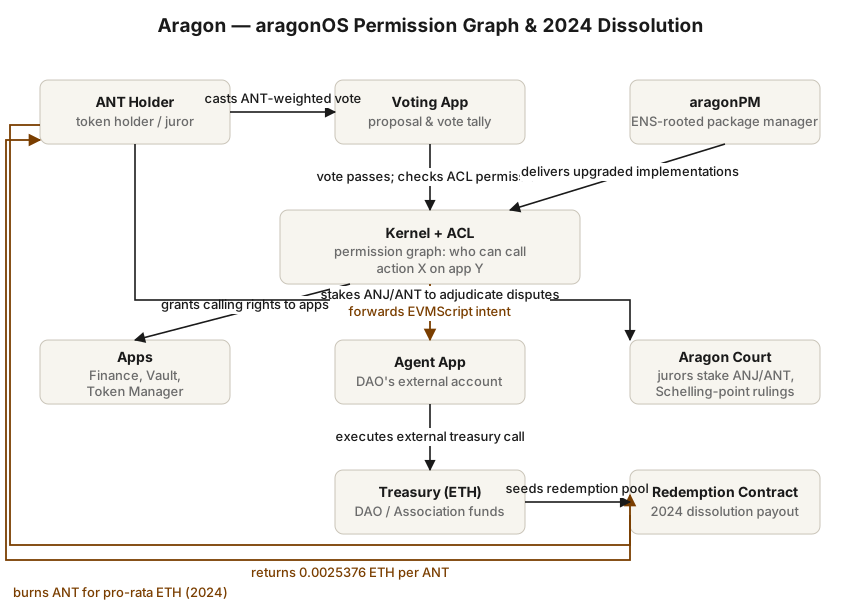 Open full-size diagram
Summary
Aragon is the archetypal DAO-infrastructure experiment: a project founded in November 2016 by two Spanish programmers, Luis Cuende and Jorge Izquierdo, to let anyone create "unstoppable organizations" on Ethereum. Its May 17, 2017 ANT token sale raised 275,000 ETH ($25M at the time) in under 15 minutes — one of the fastest sales of the ICO era. The aragonOS framework it shipped became foundational plumbing for onchain governance: Aragon's current site claims roughly 10,000 projects launched and $35B+ in assets governed with its stack, and major protocols including Lido and Curve built governance on Aragon contracts. Yet the meta-experiment — governing Aragon itself with the ANT token and a network treasury — failed dramatically. After activist funds accumulated ANT trading below treasury value and a governance standoff turned hostile in 2023, the Aragon Association dissolved itself, made its 86,343 ETH ($155M) treasury redeemable at 0.0025376 ETH per ANT, and burned the token. The tooling survived under a new product company (Aragon X) and foundation; the token network did not.
Design (Mechanism)
aragonOS (the v1-era framework) was a modular DAO operating system:
- Kernel + ACL: each DAO is a minimal Kernel proxy holding an Access Control List that maps granular permissions ("who can call action X on app Y, and who can re-grant that permission") between apps and entities. This permission graph, rather than a monolithic voting contract, was Aragon's core architectural idea.
- Upgradeable apps via aragonPM: DAO functionality (Voting, Token Manager, Finance, Agent, Vault) shipped as proxy apps whose implementations were versioned in an onchain package manager (APM) rooted in ENS, making DAOs upgradeable through their own governance.
- EVMScripts / forwarders: chained intent execution, e.g. a token vote forwarding an arbitrary script to the Agent app, which acts as the DAO's external account.
- Aragon Court (2020): a subjective-dispute layer where jurors staked ANJ, were drawn proportionally to stake, and voted on disputes with Schelling-point incentives (majority-coherent jurors earn fees; incoherent jurors are slashed) plus multi-round appeals. ANJ was later merged back into ANT.
- ANT: the network token, sold in 2017, migrated 1:1 to a leaner ANTv2 (ERC-2612/ERC-3009 support) in 2020, intended to govern the Aragon Network and its treasury via Aragon Network Votes.
- Later stack (Aragon OSx, 2023–present): a rewritten, leaner protocol built around plugin-based DAOs with a permission manager, powering the current Aragon App across multiple EVM chains.
The terminal mechanism, ironically, was the cleanest: a fixed-rate redemption contract letting any ANT holder burn tokens for a pro-rata share of the association's ETH treasury (deadline November 2, 2024).
Outcome
Two verdicts in one experiment. As infrastructure, Aragon was a major success: aragonOS became one of the most-forked and most-relied-upon governance codebases in crypto, with Lido's LDO governance among the highest-value deployments, and the OSx/Aragon App stack still ships today under Aragon X and a new Aragon Foundation. As a token network, it failed. The Aragon Association repeatedly delayed transferring the treasury to ANT-holder control (a promise dating to 2022); "risk-free value" (RFV) activist funds bought ANT below treasury backing to force a distribution; the conflict escalated (including the association repurposing the newly launched Aragon DAO into a grants-only vehicle and banning critics from community channels), and in November 2023 the association chose dissolution over continued token governance: 86,343 ETH redeemable, ~$11M retained for wind-down costs and the new product entity, ANT burned. outcome_status: partial_success — with the token-governance layer specifically a failure.
Why it worked
- Right abstraction, early: the Kernel/ACL permission-graph model was genuinely novel and general; it let one codebase serve grant DAOs, protocol governance, and treasuries, which is why serious protocols adopted it.
- Credible engineering culture: audited, open-source, versioned contracts (aragonPM) at a time when most "DAO tooling" was vaporware; the 2017 raise funded years of real development.
- Distribution via infrastructure: Aragon won by being embedded in other protocols' governance rather than by attracting users to its own network — infrastructure adoption outlived every strategic pivot.
Where the design broke
- Token without a business model: ANT never captured value from aragonOS usage (deployments were free and forkable), so the token's only "fundamental" was claim-in-theory on the treasury — which made it a pure RFV target once price fell below backing.
- Governance promises deferred: the association held the treasury offchain for six years while its stated roadmap called for onchain governance; the gap between stated design and deployed control invited the raid and undercut the defensive moves that followed.
- Strategy churn: Aragon Chain, Vocdoni/Aragon Voice, Aragon Govern, Court ran as parallel initiatives that drew on the same treasury runway rather than a single focused roadmap; co-founder Jorge Izquierdo resigned as Aragon One CEO in 2021, citing governance disagreements.
- Adversarial endgame: when token holders and stewards became opponents, the only mutually trusted mechanism left was liquidation.
Lessons
- A governance token whose only backing is a treasury larger than its market cap is an open invitation to risk-free-value raiders; either give the token real cash-flow claims or don't hold a large discretionary treasury against it.
- "Progressive decentralization" promises are load-bearing: delaying treasury handover for years destroyed more value than any technical failure in Aragon's history.
- Infrastructure adoption and token success are separable outcomes; free, forkable public-goods code can win enormously while its native token fails — plan the funding model for that reality.
- A treasury-backed redemption-and-burn is a legitimate, orderly failure mode; Aragon's wind-down returned ~$155M to holders rather than bleeding out through governance warfare.
Redesign (EDITORIAL — hypothesis, not fact)
This section is editorial hypothesis, not historical fact. A redesigned Aragon would (1) put the treasury in an onchain vault with ANT-holder-ratified budgets from day one, with a standing rage-quit-style redemption right so the token can never trade far below backing and raiders have nothing to raid; (2) charge a small protocol fee on high-value deployments (e.g., basis points on treasury actions through the Agent app, waivable for public goods) so ANT accrues value from the stack's actual success instead of speculation; (3) keep the org as a lean protocol-guild funded by streamed, milestone-gated budgets rather than a Swiss association with discretionary control; and (4) resist product pivots by constitutionally scoping the DAO to the core framework, pushing Court-like adjacencies to independently tokened spin-outs from the start. The bet: Aragon's architecture was right, and only its treasury-governance and value-capture layers needed to exist onchain as early as its rhetoric claimed.
Sources
- Aragon official site (current products, 10K projects / $35B governed claims) — primary (docs)
- Historical token sale information (Aragon legacy docs) — primary (docs)
- aragon-network-token repository (ANTv1/ANTv2 contracts and upgrade docs) — primary (contract)
- ANTv2 token on Etherscan — primary (contract)
- A New Chapter for the Aragon Project (dissolution & redemption announcement) — primary (governance)
- Aragon Association to dissolve itself, provide liquidity for ANT redemption (The Block) (news)
- Aragon Association to dissolve, make 86K ETH redeemable (Blockworks) (news)
- ANT Token Sale Raises $25 Million in 15 Minutes (Crypto Insider, 2017) (news)
- Aragon 2024: Looking Forward (post-dissolution restructuring) — primary (docs)
Related experiments
Last verified: 2026-07-26 · Spot an error? Suggest a correction