Kleros
A decentralized arbitration protocol on Ethereum that uses token-staked, cryptoeconomically incentivized crowdsourced jurors to resolve disputes for smart-contract applications.
▶ Run interactive simulation animated mechanism with editable parameters
How it works onchain
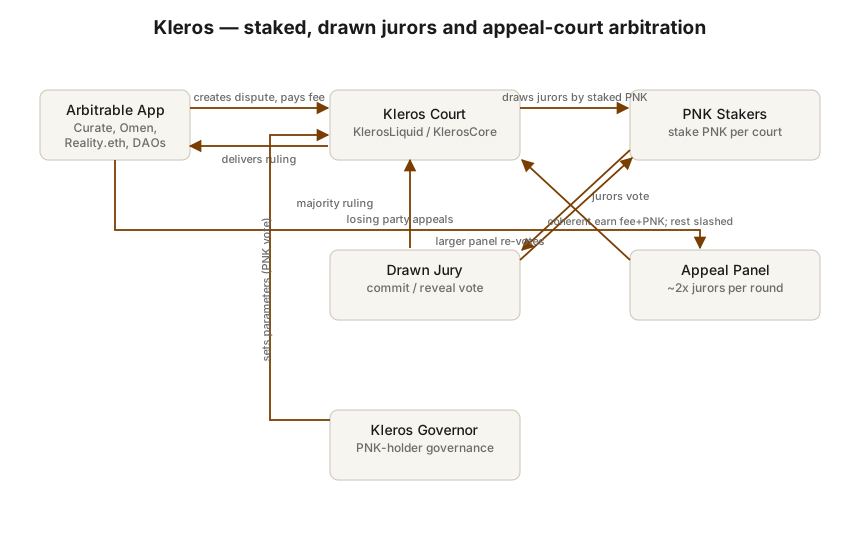 Open full-size diagram
Summary
Kleros is a decentralized arbitration protocol built on Ethereum, launched by Coopérative Kleros (a French cooperative, SCIC). Founded by Federico Ast (CEO), Clément Lesaege (CTO), and Nicolas Wagner, the project describes itself as "the arbitration protocol for the internet economy." Its core idea, drawn from Schelling-point game theory, is that a crowd of self-selected, token-staked jurors can adjudicate disputes about which no central authority is trusted — e.g., "did the freelancer deliver the work?", "is this token entry legitimate?", or "which outcome did a prediction market resolve to?" Jurors are drawn pseudo-randomly in proportion to their stake of the native PNK token, vote privately, and are rewarded or penalized based on whether they voted coherently with the majority. The PNK token was distributed in July 2018 via the first-ever Interactive Coin Offering (IICO), a fair-launch auction mechanism advocated by Vitalik Buterin and Jason Teutsch. The court software (KlerosLiquid / "Court" and later Kleros V2 / KlerosCore) has been live on Ethereum mainnet and Gnosis Chain, and serves as arbitration/oracle infrastructure for a family of Kleros products including Curate (Token/Address curated lists), Proof of Humanity, and integrations with Reality.eth, Omen, and Snapshot (SafeSnap).
Design (Mechanism)
Kleros operates as a set of "courts" arranged in a tree, each specialized in a subject area (e.g., general court, curation, oracle, technical). To become eligible as a juror in a court, a user stakes PNK in that court. When a dispute arises, the protocol draws jurors pseudo-randomly, weighted by the amount of PNK staked — the more PNK staked, the higher the probability of being drawn per dispute (each unit of staked PNK is effectively a lottery ticket). Drawn jurors review evidence submitted by parties, then commit and reveal a vote among the possible rulings.
The incentive core is a Schelling-point / coherence game: jurors who vote with the eventual majority earn arbitration fees (paid in ETH) plus PNK redistributed from incoherent jurors, while jurors who vote against the majority lose ("are penalized on") a portion of their locked PNK. The theory is that, absent a way to coordinate on a lie, rational jurors converge on the honest answer they expect other honest jurors to also choose. Losing parties pay arbitration fees, and a dispute can be appealed to a larger, more expensive panel; the number of jurors roughly doubles (plus one) each appeal round, making it progressively costlier for an attacker to bribe or overwhelm a majority. Appeal fees also fund the crowd-sourced defense of correct rulings, mitigating the classic p+epsilon bribery attack. Governance and parameters (court creation, fee levels) are controlled by PNK holders via the Kleros Governor. The PNK token contract on mainnet is 0x93ED3FBe21207Ec2E8f2d3c3de6e058Cb73Bc04d and the KlerosLiquid court is 0x988b3A538b618C7A603e1c11Ab82Cd16dbE28069; Kleros V2 (KlerosCore) is deployed on Arbitrum One.
Outcome
Status: partial_success. Kleros is technically live and has operated continuously for years, but adoption has remained modest relative to the ambition of "an internet court system." As of late 2021, independent analyses reported roughly ~1,000 disputes resolved and ~14,000 registered participants. The protocol found durable product-market fit as infrastructure rather than as a mass consumer court: Curate/Tokens lists became widely used registries (e.g., integrations referenced with Ledger and MetaMask), Proof of Humanity used Kleros for challenge arbitration, and Kleros arbitration secured prediction markets (Omen) and Reality.eth oracle escalations, including a governance-protection role that reportedly blocked a >$100,000 attempted theft from Proof of Humanity governance in December 2023. The team increasingly pivoted toward enterprise/consumer dispute resolution, e.g., a partnership with Argentine exchange Lemon (50+ cases resolved, reportedly high satisfaction) and a 2024 pilot in General Lavalle, Argentina. In January 2024, Mexico passed legislation described by Kleros as the first national law to recognize decentralized justice as a legally valid dispute-resolution mechanism. Kleros V2 was in testnet/testing through 2023–2024.
Why it worked
- Sound cryptoeconomic core. The Schelling-point-plus-appeals design is one of the most rigorously specified subjective-oracle mechanisms in the space, with academic backing and a clear theory for why honest voting is an equilibrium and why bribery gets expensive under appeal.
- Composable infrastructure niche. Rather than only chasing end-user disputes, Kleros exposed a generic
Arbitratorinterface that other protocols could plug into, making it the default "subjective oracle" for curation lists, prediction markets, and DAO tooling. - Credible fair launch and legitimacy work. The IICO token sale, an active cooperative structure, and sustained academic/legal engagement gave Kleros unusual credibility and even legislative recognition.
Where the design broke
- Weak mass demand for onchain courts. Volume stayed low (hundreds-to-thousands of cases) because most real-world disputes are off-chain, and users/businesses are reluctant to submit to a novel, pseudonymous, crypto-native tribunal.
- UX, cost, and speed friction. Ethereum gas costs, the need to acquire and stake PNK, evidence handling, and multi-day appeal timelines made the juror and litigant experience heavy compared to traditional dispute channels.
- Juror-participation and quality concerns. Small juror pools and low per-case pay create risks of apathy, low-effort voting, and concentration by large PNK stakers; critics questioned whether coherence incentives reliably produce correct (vs. merely convergent) rulings on ambiguous cases.
- Token performance and attention. PNK never achieved the market prominence of comparable DeFi tokens, limiting the security budget and mindshare relative to the mechanism's ambitions.
Lessons
- A well-designed mechanism is necessary but not sufficient. Kleros arguably won the theory but under-delivered on distribution: onchain justice needs demand-side integration (partners who must use it) more than it needs a better voting rule.
- Subjective oracles thrive as embedded infrastructure, not standalone destinations. Kleros's most durable value came from being a plug-in arbitrator for curation, prediction markets, and DAOs — a lesson for any "human-in-the-loop" oracle project.
- Appeal-based security trades UX for robustness. Escalating panels defend against bribery but impose latency and cost, which materially cap the addressable dispute market; designers must weigh security depth against usability.
- Legitimacy compounds. Sustained academic, legal, and legislative engagement (e.g., Mexico recognition) is a slow but real moat for a "justice" protocol, distinct from purely technical competition.
Redesign (EDITORIAL — hypothesis, not fact)
The following is the researcher's editorial hypothesis, not established fact.
If rebuilt today, a Kleros-style protocol would likely lean much harder into being an invisible, low-cost oracle layer rather than a consumer-facing "court." Concretely: (1) Move settlement fully to an L2 / app-chain (Kleros V2 already targets Arbitrum) so juror actions cost cents and appeals can resolve in hours, removing the biggest UX tax. (2) Abstract away the token. Let integrating apps sponsor arbitration fees and let jurors stake via delegated/pooled PNK with slashing, so ordinary participants never touch the token flow directly — reserving PNK exposure for professional "juror-stakers." (3) Layer identity-weighted or reputation-weighted juries on top of pure stake-weighting (leveraging Proof of Humanity), to blunt plutocratic capture and low-effort voting while preserving sybil resistance. (4) Add an AI-assisted triage tier: an LLM drafts an evidence summary and a proposed ruling that jurors ratify or override, cutting per-case cognitive load and raising throughput, with human jurors as the final Schelling anchor. (5) Package vertical products (e-commerce escrow, freelance milestones, insurance claims) with SLAs and off-chain legal wrappers, since the demonstrated demand is in embedded B2B/consumer flows, not a general internet tribunal. The core Schelling-point-plus-appeals engine would remain — its problem was never the math, but the cost, latency, and go-to-market surrounding it.
Sources
- Kleros official site — primary (docs)
- Kleros Documentation — Deployment Addresses — primary (contract)
- Kleros Short Paper (v1.0.7) — Lesaege, Ast, George — primary (docs)
- Kleros' Token Sale is Over: the Next Chapter Begins (Federico Ast) — primary (retrospective)
- Kleros, a Protocol for a Decentralized Justice System (Federico Ast) — primary (retrospective)
- Kleros Project Update 2024 — primary (governance)
- Kleros: A Socio-Legal Case Study Of Decentralized Justice & Blockchain Arbitration (Bergolla, Seif, Eken) (analysis)
- Applying blockchain to the modern legal system: Kleros (Springer) (analysis)
Related experiments
Last verified: 2026-07-26 · Spot an error? Suggest a correction