Aragon Court
A Schelling-game 'subjective oracle' on Ethereum in which staked jurors were randomly drafted to rule on disputes smart contracts couldn't decide, with slashing for minority voters and escalating appeal rounds.
▶ Run interactive simulation animated mechanism with editable parameters
How it works onchain
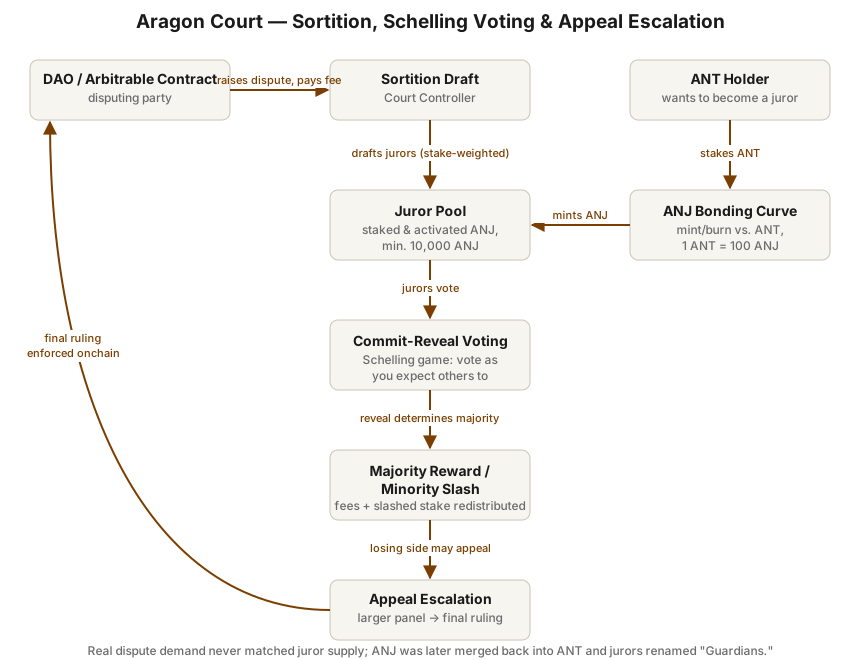 Open full-size diagram
Summary
Aragon Court was Aragon's dispute-resolution protocol on Ethereum — a "subjective oracle secured by cryptoeconomics" meant to be the judicial branch of Aragon's envisioned "digital jurisdiction" for DAOs. Built by Aragon One (the Swiss company founded around Aragon co-founders Luis Cuende and Jorge Izquierdo), its contracts were deployed to mainnet in late 2019, a juror pre-activation period ran January 7 – February 10, 2020, and the court's first term began February 10, 2020. Jurors staked a dedicated work token, ANJ (minted from ANT via a bonding curve, 1 ANT = 100 ANJ during pre-activation; 10,000 ANJ minimum to be draftable), and were randomly drafted in proportion to stake to rule on disputes via a Schelling game. The system functioned as engineered, but real dispute demand never materialized; the ANJ work token was judged a failure and merged back into ANT (governance proposal October 2020, migration completed 2021, jurors rebranded "Guardians" in a redeployed ANT-staked version). Aragon sunset the Court, Govern, and Voice frontends effective December 1, 2024, and archived the repository in May 2025.
Design (Mechanism)
- Two-sided market. Supply side: users stake and activate ANJ to become jurors and earn dispute/subscription fees. Demand side: DAOs and arbitrable contracts (e.g., Aragon Agreements, later Aragon Govern's optimistic execution) pay fees to have subjective disputes adjudicated.
- Sortition. Each dispute drafts a small initial panel (three jurors at launch) selected pseudo-randomly with probability proportional to activated stake.
- Schelling-game voting. Jurors commit and then reveal votes, aiming to vote how they believe other honest jurors will vote. Jurors in the winning majority earn ruling fees plus a share of tokens slashed from minority voters; minority voters lose a portion of their activated stake.
- Appeal escalation. Any ruling could be appealed (with appeal collateral) through successive rounds with larger juror sets, terminating in a final round in which all active jurors could vote — making outright bribery or 51% capture progressively more expensive.
- Work-token economics. ANJ was minted/burned against ANT on a bonding curve, intending to isolate the court's cryptoeconomic security in its own asset. Court parameters and upgrades were governed with the intent of progressive decentralization to ANT holders.
- Security posture. V1 was audited (audit published in the repo; the mainnet-launch post credits Georgios Konstantopoulos), backed by a 2,300+ test suite and a bug bounty of up to $50,000 per critical bug from a $250,000 pool. Mainnet contracts sat publicly deployed from November 2019 for review before activation. Core mainnet controller:
0xee4650cBe7a2B23701D416f58b41D8B76b617797.
Outcome
Pre-activation drew over 1,000,000 ANT staked and ~247 registered jurors before term #1. From February 13, 2020, Aragon ran a "Precedence Campaign" of paid mock disputes to build case-law norms; the very first mock dispute (a hypothetical Gitcoin blacklisting case) ended controversially and Aragon One voided it and reimbursed participants — an early demonstration that the "subjective oracle" could produce outcomes its own creators found unacceptable. Real, organic dispute volume remained minimal. In October 2020 Aragon One proposed merging ANJ back into ANT, citing a ~20x security gap (ANJ ~$6M market value vs ANT $125M+), market confusion about bonding curves and work tokens, and drawbacks outweighing the single theoretical benefit of incentive isolation; after a withdrawal and community revision, ANJ holders converted at 0.044 ANT/ANJ (one-year lock, auto-staked in the court) or 0.015 unlocked, and the court was redeployed with ANT staking and jurors renamed Guardians, serving as the judicial check on Aragon Govern's optimistic governance. Usage stayed low; Aragon pivoted to the OSx stack, sunset the legacy frontends on December 1, 2024, and archived the code in May 2025. The design lives on in forks such as 1Hive's Celeste. Outcome: technically successful, commercially unsuccessful.
Why it worked
- The core machinery — stake-weighted sortition, commit-reveal Schelling voting, slashing, and appeal escalation — deployed on mainnet and adjudicated disputes end-to-end without exploit or notable security failure.
- Careful rollout (months of public contract deployment, audit, large bug bounty, pre-activation period, mock-dispute precedence campaign) built a functioning juror community of a few hundred participants before real stakes arrived.
- Appeal-round escalation to the full juror set gave a credible, well-reasoned answer to bribery/capture attacks on small panels.
Where the design broke
- No demand. Almost no DAOs had subjective disputes flowing to the court; the supply side (jurors chasing yield) vastly outweighed the demand side (fee-paying disputes), so juror rewards depended on subsidy rather than organic fees.
- Work-token drag. ANJ fragmented liquidity and value from ANT, left the court secured by only ~$6M of stake, and confused users; Aragon itself concluded the drawbacks outnumbered the benefits and reversed the design within nine months of launch.
- Legitimacy paradox. The voided Gitcoin mock dispute showed the design retained an operator override for "wrong" verdicts, undercutting the claim that Schelling-point consensus equals justice; conversely, verdicts jurors reach by guessing what others will vote need not track the merits.
- Strategy churn. The product cycled through incompatible architectures (Court → ANJ merge → Aragon Protocol/Govern "Guardians" → OSx) without settling into a stable niche, while competitor Kleros already occupied the small decentralized-justice market.
Lessons
- A cryptoeconomic court is a two-sided marketplace; engineering the supply side (staked jurors) is far easier than generating the demand side (parties who actually want onchain arbitration), and without demand the mechanism is a subsidy machine.
- Separate "work tokens" for a single protocol service tend to fragment security and liquidity; the security of a slashing-based oracle is bounded by the market cap of what is staked, so a small dedicated token can make the court cheaper to attack than the value it arbitrates.
- Schelling-game voting rewards predicting the crowd, not judging the merits; absent strong norms/case law, verdicts can diverge from community values — and if operators void bad verdicts, the mechanism's credibility as a neutral oracle collapses.
- Mock disputes and precedence campaigns are valuable stress tests: Aragon's first mock case surfaced legitimacy problems at near-zero cost before real value was at risk.
Redesign (EDITORIAL — hypothesis, not fact)
This section is editorial hypothesis, not fact. A modern redesign would start demand-first: embed arbitration as an escrowed default inside high-volume primitives (grant streams, optimistic governance, prediction-market resolution, marketplace escrow) so disputes arrive automatically rather than being sold as a standalone product. Secure it with the ecosystem's main asset (or restaked ETH) instead of a bespoke work token, sized so attack cost visibly exceeds value-at-risk per dispute. Replace pure Schelling voting with merit-anchored adjudication: jurors stake on rulings justified against a published constitution/case-law corpus, with appeals judged partly on reasoning quality (possibly with LLM-assisted evidence summarization), reducing the gap between "what the crowd will vote" and "what the rules say." Finally, make the override path explicit — a constitutional supermajority process for voiding verdicts — so exceptional interventions strengthen rather than erode legitimacy.
Sources
- aragon/aragon-court — 'A subjective oracle secured by cryptoeconomics' (official repo, archived May 2025) — primary (contract)
- Launching Aragon Court (official blog) — primary (docs)
- Aragon Court pre-activation begins January 7th (official blog) — primary (docs)
- Aragon Court is live on mainnet (official blog) — primary (docs)
- Precedence Campaign Primer (official blog) — primary (docs)
- Update on Aragon Court's first mock dispute (Aragon One blog — Gitcoin mock dispute voided) — primary (retrospective)
- Governance proposal: Merge ANJ into ANT (official blog) — primary (governance)
- The $ANJ → $ANT Migration is Here! (official blog) — primary (governance)
- Legacy Product Update — sunsetting Court/Govern/Voice frontends Dec 1, 2024 (official blog) — primary (docs)
- What is Aragon Court (legacy official docs) — primary (docs)
- DAO platform Aragon launches digital jurisdiction dispute resolution protocol (CryptoNinjas, Feb 11 2020) (news)
- ANT and Aragon Court — Luke Duncan (Aragon researcher) economic analysis (analysis)
Related experiments
Last verified: 2026-07-26 · Spot an error? Suggest a correction