Celeste (1Hive)
1Hive's BrightID-gated fork of Aragon Court: a subjective oracle where HNY-staking 'keepers' are drafted to resolve disputes over whether optimistic governance actions violate a community covenant.
▶ Run interactive simulation animated mechanism with editable parameters
How it works onchain
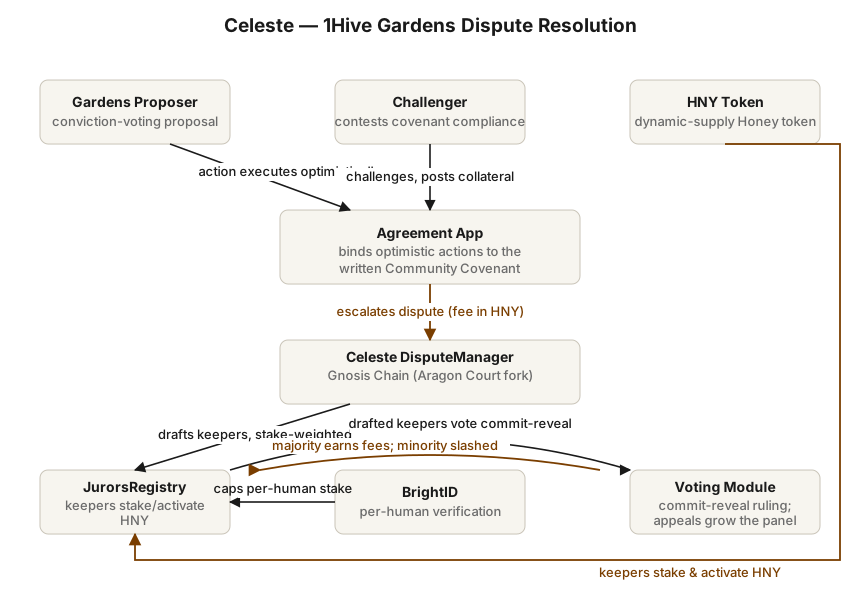 Open full-size diagram
Summary
Celeste is a decentralized dispute-resolution protocol ("subjective oracle") built by the 1Hive community as a fork of Aragon Court, deployed to Gnosis Chain (then xDai) in April 2021. Its job is to make optimistic, covenant-based governance enforceable: 1Hive's Gardens DAOs let anyone submit funding proposals under conviction voting, and any proposal that arguably violates the DAO's plain-language Community Covenant can be challenged and escalated to Celeste. A drafted panel of "keepers" — HNY stakers who must also be BrightID-verified humans — then rules on whether the action is compatible with the covenant. Celeste's two signature departures from its Aragon Court parent are Sybil-resistant, per-person stake caps (so wealth cannot simply buy adjudication power) and deep integration with 1Hive's Honey (HNY) token economy. It launched alongside an upgrade of the Honey contracts that introduced a dynamic supply policy (yearly issuance capped at ~10%, with automatic burns when the common pool exceeds 30% of supply).
Design (Mechanism)
- Optimistic actions + challenge. Gardens proposals (conviction-voting funding requests, disputable votes, Quests bounty claims) execute optimistically under an Agreement app that binds them to a written covenant. Anyone can challenge an action by posting collateral; if the parties don't settle, the challenge escalates to Celeste as a dispute, with fees paid in HNY.
- Keepers and drafting. To adjudicate, a user stakes and activates HNY in the JurorsRegistry and must hold a BrightID verification. Draft probability is proportional to activated stake, but BrightID enables a cap on how much effective stake any one human can activate — the anti-plutocracy twist on Aragon Court/Kleros.
- Schelling-point voting. Drafted keepers have a portion of activated tokens locked, then vote commit-reveal on the dispute. They are instructed to vote the way they expect the plurality to vote (a Schelling game anchored on the covenant text), not their personal preference. Keepers in the minority of the final ruling are slashed; majority voters earn dispute fees plus the slashed HNY.
- Appeals. A ruling can be appealed by posting appeal collateral, triggering a new round with a larger drafted panel; successive appeals grow the panel until a final round. Appeal economics reward successful appellants.
- Precedent by culture, not code. Past rulings inform community debate about covenant interpretation but are not binding in-protocol.
- Deployment. Modular Aragon-Court-derived contracts on Gnosis Chain: court AragonCourt/Celeste at 0x44E4fCFed14E1285c9e0F6eae77D5fDd0F196f85, plus DisputeManager, JurorsRegistry, Voting, Treasury and Subscriptions modules; governed initially by a Celeste swarm DAO with a stated path to 1Hive DAO control.
Outcome
Celeste deployed smoothly in April 2021 and became the backstop for the whole 1Hive governance stack: Gardens' disputable conviction voting and disputable voting, and later the Quests bounty system, all name Celeste as arbitrator. It is one of very few Kleros-style courts to ship person-capped (rather than purely capital-weighted) adjudication in production. However, its footprint stayed small: dispute volume was low (a byproduct of both healthy deterrence and modest ecosystem size), keeper participation was limited to the HNY community, and adoption outside the 1Hive/Gardens ecosystem on Gnosis Chain never materially developed. HNY's small market cap also bounded the economic security of rulings. The protocol still exists at celeste.1hive.org, but activity tracks the (now quiet) HNY ecosystem. Precise cumulative dispute counts: Unknown / not found. No exploit or catastrophic failure is on record.
Why it worked
- Deterrence is the product. Like courts generally, Celeste's main value was ex ante: the credible threat of challenge + slashing kept covenant-violating proposals rare, letting conviction voting stay permissionless without a gatekeeping committee.
- Sybil-resistant stake caps addressed the sharpest critique of token courts (whale capture of verdicts) with an existing identity primitive (BrightID) rather than a bespoke one.
- Tight vertical integration. Celeste wasn't a court looking for customers; it shipped with captive demand from Gardens and Quests, and its fee/stake token (HNY) aligned keepers with the ecosystem they were policing.
- Forking a battle-tested codebase (Aragon Court) reduced novel-contract risk for a small volunteer swarm.
Why it failed or underperformed
- Ecosystem-bounded demand. Binding the court to HNY on xDai made it coherent internally but unattractive externally; third-party protocols mostly integrated Kleros or UMA instead, and Celeste never became a general-purpose oracle.
- Security budget tied to a micro-cap token. The cost of corrupting a final-round ruling scales with HNY's value, which declined with the 2021→2022 cycle, shrinking the disputes the court could safely secure.
- Low case flow means an untested jurisprudence. With few disputes, keeper skill, precedent culture, and appeal economics were never stress-tested at scale.
- Dependency risk: BrightID verification added onboarding friction for keepers, and the Aragon Court lineage was itself abandoned upstream (Aragon wound down the Court), leaving a small swarm to maintain a complex codebase.
Lessons
- Subjective oracles are primarily deterrence machines; measuring them by dispute throughput misses the point, but zero external demand still means no sustainable fee model.
- Per-person stake caps via proof-of-personhood are a practical, shippable answer to plutocratic jury capture — the pattern deserves reuse beyond 1Hive.
- Denominating court security in a small community token couples the justice system's integrity to that token's market cycle; courts guarding meaningful value need a deeper or more stable security budget.
- Forking sophisticated infrastructure is cheap; maintaining it after the upstream project exits is not. Plan for the maintenance tail, not just the deploy.
- Optimistic governance (covenant + challenge + court) lets small DAOs stay permissionless without moderators, but it only works if the covenant is written clearly enough to anchor Schelling-point rulings.
Redesign (EDITORIAL — hypothesis, not fact)
This section is editorial hypothesis, not historical fact. A modern Celeste would decouple the security budget from the community token: keepers stake a hard asset (e.g., restaked ETH or a stable asset) for economic security, while HNY-style tokens retain fee-routing and governance roles, so verdict integrity no longer rides a micro-cap's price. Person-caps would migrate from BrightID to aggregated proof-of-personhood (Passport-style scoring across attestations) to cut onboarding friction. Rather than one court per ecosystem, Celeste's real innovation — capped, human-weighted juries — could be packaged as a neutral "arbitrator module" implementing a standard arbitration interface (ERC-792-like), letting any optimistic-governance framework plug it in and share one cross-DAO keeper pool, solving the case-flow problem. Finally, publishing structured, hash-committed rationales for each ruling would turn cultural precedent into a queryable corpus, making Schelling coordination easier as juries scale.
Sources
- Celeste documentation (Key Concepts, Dispute Lifecycle, Introduction) — primary (docs)
- 1Hive/celeste-contracts (GitHub) — primary (contract)
- 1Hive Protocol contract addresses (1Hive wiki) — primary (docs)
- Celeste swarm page (1Hive wiki) — primary (docs)
- Celeste Launch and Next Steps (1Hive forum, April 2021) — primary (governance)
- Celeste — a brief primer (1Hive forum) — primary (governance)
- 1Hive: Introduction to Celeste (Publish0x community article) (analysis)
- Celeste Dispute Resolution Protocol (P2P Foundation wiki) (analysis)
- Quests integration with Celeste (1Hive wiki) — primary (docs)
Related experiments
Last verified: 2026-07-26 · Spot an error? Suggest a correction