Gamma Strategies
Automated concentrated-liquidity management protocol (formerly Visor Finance) whose 'Hypervisor' vaults actively rebalance Uniswap v3-style LP positions — twice rebuilt after major exploits.
▶ Run interactive simulation animated mechanism with editable parameters
How it works onchain
 Open full-size diagram
Summary
Gamma Strategies is an active liquidity-management protocol built on top of concentrated-liquidity AMMs (Uniswap v3 and Algebra-based forks such as QuickSwap, Camelot, and Thena). Its core primitive, the Hypervisor, is a non-custodial vault that holds a Uniswap v3-style position on behalf of many depositors, chooses price ranges, rebalances, and compounds fees — converting v3's non-fungible, high-maintenance LP NFTs back into a fungible, passive ERC-20 share.
The project began in 2021 as Visor Finance (VISR), which pitched "NFT smart vaults" for Uniswap v3 liquidity shortly after v3 launched in May 2021. Gamma was originally a research/strategy organization seeded by a Visor grant in May 2021. After Visor suffered multiple 2021 security incidents — culminating in an $8.2M infinite-mint exploit in December 2021 — the projects merged under the Gamma name, migrated VISR holders to a new GAMMA token (snapshot December 21, 2021), and reorganized around security and strategy performance. Gamma then expanded to dozens of EVM chains as the default liquidity manager for many DEX forks, peaking near ~$128M TVL (DefiLlama) on January 3, 2024 — the day before a second major exploit ($3.4–6M, Arbitrum vaults) knocked it back. As of mid-2026 the protocol is still operating (limit orders on Uniswap v4, vaults, Hyperliquid trading vaults) but with TVL around ~$2.8M, roughly 98% below peak, and GAMMA token trading has largely dried up on tracked exchanges.
Design (Mechanism)
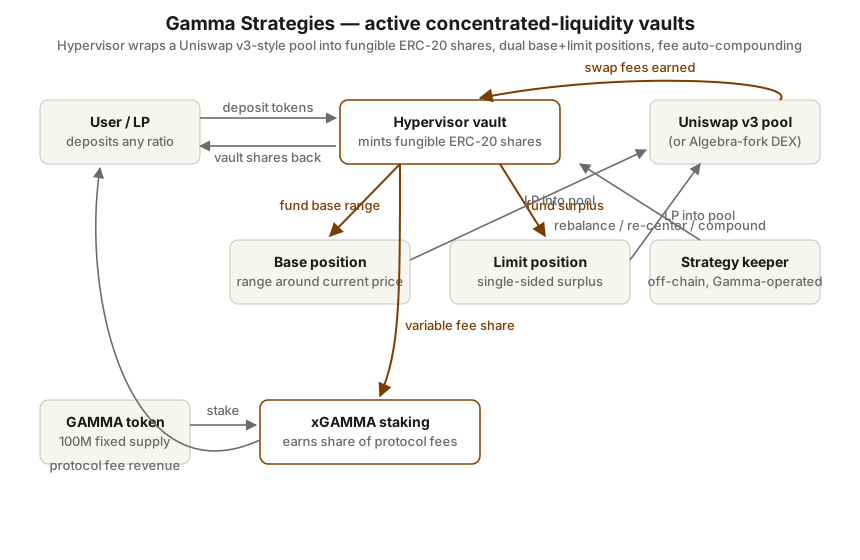
- Hypervisor vaults. Each vault wraps one AMM pool. Depositors add one or both tokens in flexible ratios and receive fungible ERC-20 shares priced against the vault's holdings. The vault manages two positions: a base position spanning a range around the current price (holding both assets in pool ratio) and a limit position holding the single-sided surplus just outside the range — an elegant way to accept arbitrary deposit ratios without forced swaps.
- Active management. An off-chain strategy engine (operated by Gamma) calls rebalance functions: re-centering ranges, harvesting and re-compounding swap fees, and adjusting range widths per volatility. Users hold a passive token; strategy discretion is centralized with Gamma's keeper roles.
- Fee model. Vaults take a share of earned swap fees; a variable portion flows to xGAMMA stakers (stake GAMMA at 0x26805...7d8c, earn protocol fees). GAMMA has a fixed 100M supply, migrated 1:1-style from VISR after the 2021 exploit.
- Deposit safety checks. Because share price is computed from pool price at deposit time, vaults rely on TWAP/price-change thresholds to block manipulation. This parameterization — not the core math — was the weak point in January 2024: thresholds on some LST/stable vaults allowed 50–200% price moves, letting an attacker inflate the gDAI/DAI pool price via flash-loaned swaps, mint mispriced shares (270k gDAI + 1 wei DAI), and withdraw at corrected prices.
- B2B distribution. Gamma became infrastructure for DEXes themselves: Algebra-based DEXes on Polygon, Arbitrum, BNB, and many L2s shipped "automated LP" via white-labeled Hypervisors, giving Gamma very wide multichain distribution (30+ chains).
Outcome
Partial success. Gamma proved the product category: it was among the first movers (with Arrakis/G-UNI and Charm) in converting Uniswap v3 positions into fungible managed vaults, achieved real multichain adoption, and survived two catastrophic exploits without abandoning users (post-2021 token migration; post-2024 remediation plan and reconfiguration, with deposits halted protocol-wide during response). But the January 4, 2024 exploit (~$3.4M converted to 1,535 ETH by the attacker, ~$6.2M total per some analyses; funds sent to Tornado Cash after failed negotiation) broke growth momentum permanently: TVL fell from ~$128M to low single-digit millions by 2026, and the GAMMA token — ATH $2.74 — has collapsed with trading halted on tracked venues (CoinGecko, July 2026). Separately, published research through the period questioned whether active v3 management reliably beats passive ranges after impermanent loss, muting the category's value proposition.
Why it worked
- Real pain point. Uniswap v3 made LPing an active, expert task; Gamma re-packaged it as a passive ERC-20 deposit — the correct abstraction for retail LPs, treasuries, and integrating protocols.
- Dual-position (base + limit) design allowed single-sided or arbitrary-ratio deposits without swap slippage, a genuinely clever mechanism.
- B2B pivot compounded distribution: becoming the default ALM for Algebra-fork DEXes put Gamma on dozens of chains without needing its own user acquisition.
- Credible crisis response (token migration in 2021, transparent post-mortem in 2024) preserved enough trust to keep operating where many exploited protocols simply die.
Where the design broke
- Security debt was fatal twice. The Visor-era codebase carried weak security guarantees (three 2021 incidents, incl. an $8.2M infinite mint); the rebrand fixed that code, but the 2024 exploit came from misconfigured risk parameters — the same class of failure (deposit-time pricing manipulation) that plagues share-based vaults.
- Trust is the whole product for a discretionary asset manager; two exploits made "give Gamma your LP" a hard sell, and TVL never recovered.
- Active-management underperformance: active range management often underperformed passive LPing net of costs and IL, so the fee-generating engine lacked a durable performance edge.
- Value-capture mismatch: GAMMA staking captured a slice of a shrinking fee pool; token collapsed ~100% from ATH.
Lessons
- Vaults that mint shares against spot-priced deposits are price-oracle systems, whether or not they call themselves that; deposit protections (TWAP checks, price-change bounds) are consensus-critical parameters, not tuning knobs — Gamma's 2024 loss came entirely from a threshold set 50–200% too loose.
- A rebrand plus token migration can restore operations but not compounding trust; the second incident is priced far more harshly than the first.
- B2B/white-label distribution scales TVL fast but concentrates correlated risk: one shared Hypervisor bug or misconfiguration exposes every partner DEX on every chain simultaneously.
- Automation must beat the passive baseline after all costs; "active management" as a product only endures if the strategy layer demonstrably outperforms holding or wide-range LPing.
Redesign (EDITORIAL — hypothesis, not fact)
This section is editorial hypothesis, not fact. A redesigned Gamma would (1) make deposit pricing manipulation-proof by construction — e.g., mint shares against a lagged TWAP with a hard cap on per-block share issuance, or use a deposit queue settled at the next epoch's TWAP so flash-loan price spikes can't be captured within one transaction; (2) put safety parameters (price-change thresholds, TWAP windows) on-chain under a guarded, time-locked config registry with automated invariant monitoring and circuit breakers that pause deposits when pool price diverges from an external oracle; (3) restructure incentives so the manager has skin in the game — a slashable GAMMA-staked insurance tranche that takes first loss on vault exploits, converting the token from a fee claim into an underwriting instrument; and (4) compete on verifiable performance: publish per-vault benchmark-relative returns (vs. passive full-range LP) on-chain, and charge performance fees only above that benchmark, so the protocol's revenue is aligned with actually beating the passive alternative rather than merely accumulating TVL.
Sources
- Gamma Docs — primary (docs)
- GAMMA token on Etherscan — primary (contract)
- Visor merges with Gamma, a re-org focusing on security and performance (Medium, Dec 2021) — primary (governance)
- Post-Mortem & Remediation Plan (Gamma Strategies, Jan 2024) — primary (retrospective)
- Gamma Strategies — REKT (analysis)
- Gamma Protocol Exploit Analysis (Verichains) (audit)
- Gamma tokenomics (docs) — primary (docs)
- DefiLlama — Gamma protocol TVL (analysis)
- The Block — DeFi protocol Gamma Strategies suffers an estimated $3.4 million exploit (news)
- Introducing Gamma: an organization dedicated to funding 'Active LP' strategies and research (Visor Finance, 2021) — primary (archive)
Related experiments
Last verified: 2026-07-26 · Spot an error? Suggest a correction