Glass
Video-NFT platform (Solana, later Ethereum) where creators sold token-gated video editions stored on Arweave, keeping ~90% of sales — shut down in 2023 after concluding there was no sustainable demand for video NFTs.
▶ Run interactive simulation animated mechanism with editable parameters
How it works onchain
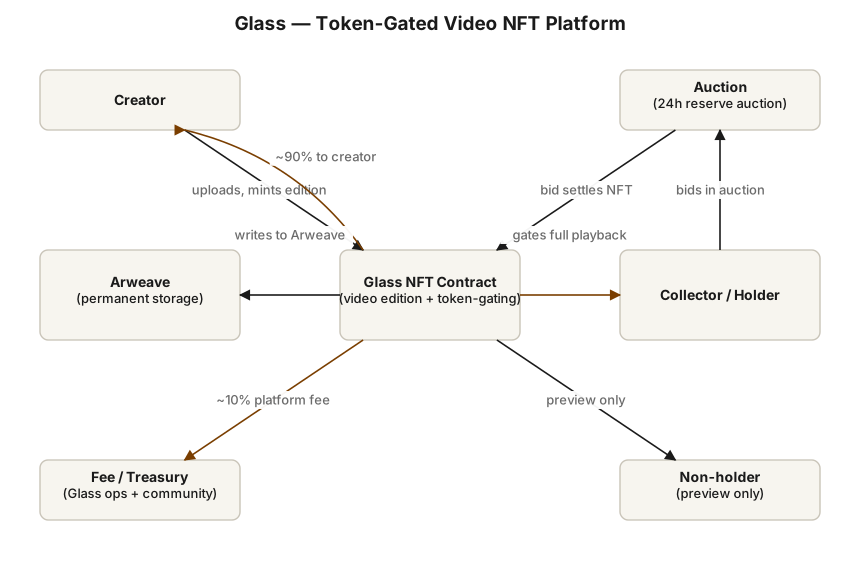 Open full-size diagram
Summary
Glass (glass.xyz) was a "web3 YouTube" experiment: a video platform where creators minted videos as NFT editions, collectors bought them to unlock full playback (non-holders saw only previews), and the underlying media was stored permanently on Arweave. Founded in 2021 by three University of Chicago alumni — Varun Iyer, Sam Sendelbach ("Sam Sends"), and Dayo Adeosun — the Los Angeles-based startup launched first on Solana, later expanded to Ethereum, and raised a $5M seed co-led by TCG Crypto and 1kx in September 2022. It generated roughly $1M for creators in its first year and worked with artists including Timbaland and Kygo, but on September 8, 2023 the founders announced the end of active development, stating flatly that "there is not sustainable demand for video NFTs." The platform and NFTs were left operational but unmaintained.
Design (Mechanism)
- Video NFT editions with token-gated playback. Creators uploaded a video, minted it as an NFT (1/1 auction or edition sale). Holders could watch the full video; everyone else got a preview. Ownership doubled as an access key and a patronage/status object.
- 24-hour reserve auctions (early Solana era). Initial drops ran as 24-hour auctions; in the earliest configuration ~80% of the final bid went to the creator and ~20% to Glass for operations and a community treasury. This later shifted to a much more creator-favorable split.
- Creator-majority revenue split. In the mature design, creators kept everything except a 10% fee on primary sales and 2% on secondary sales (contemporaneous reporting also cites 90% creator share on Ethereum and 97.5% on Solana). This was explicitly positioned against YouTube's opaque ad-revenue sharing — "transparent monetization" was the founding pitch.
- Permanent storage on Arweave. Videos were written to Arweave (small upfront fee), so content could outlive the platform — a deliberate hedge against platform death that, ironically, ended up being exercised.
- Multichain. Launched on Solana in 2021; added/pivoted to Ethereum by 2022–2023 chasing the deeper NFT collector base (2,000+ collectors on Ethereum vs. 845 on Solana as of late 2022).
- Curated supply side. Creator onboarding was application-gated (waitlist of ~70,000 reported in late 2022), reviewed on community-engagement criteria, with a plan to open fully in 2023 that never fully materialized before shutdown.
Contract addresses: Unknown / not found in surviving public sources (the official blog and docs are no longer reachable).
Outcome
Technically successful, commercially unsuccessful. The product worked: ~$1M routed to creators in year one, a record-setting sale (a Two Feet & Grandson music video NFT sold for 11 ETH, ~$44,000, reported as the highest-selling music video NFT at the time), 100+ onboarded creators, marquee names like Timbaland and Kygo, and a $5M seed at the September 2022 peak of institutional NFT interest. But demand collapsed with the 2022–2023 NFT bear market, and the chain pivot to Ethereum didn't restore traction. On September 8, 2023 — roughly one year after raising — the team announced the end of active development, closed the Telegram, and said the site, protocol, and NFTs would "remain operational and stored safely," with the team exploring unspecified pivots. Because content lived on Arweave, collector media persisted despite the company's exit.
Why it worked
- Real economic delta for creators. 90%+ of primary revenue versus YouTube's ~55% ad split was a genuinely compelling pitch, and it demonstrably moved ~$1M to creators quickly.
- Scarcity fit music video culture. High-end 1/1 music video auctions (the 11 ETH sale) worked while NFT collecting was culturally hot; music videos are natural collectible artifacts with existing fandoms.
- Storage-layer honesty. Arweave permanence meant the platform's death didn't destroy the assets — one of the few shutdowns where "your NFTs are safe" was literally true at the media layer.
Where the design broke
- Category demand was speculative, not structural. Fans consume video for free everywhere; paying to unlock a video competes with zero-cost substitutes. Once flipping profits vanished in the bear market, there was no non-speculative reason for most buyers to keep purchasing. The founders' own verdict: no sustainable demand for video NFTs.
- Patronage market too thin for a venture-scale platform. A handful of whales buying 1/1s generated headlines, not recurring platform revenue; 10%/2% fees on a small GMV couldn't sustain a seven-person funded company.
- Gated supply throttled network effects. A 70,000-person waitlist with slow application review meant the platform never tested whether long-tail creators could find long-tail demand before the market window closed.
- Chain pivot as symptom. The Solana→Ethereum move addressed liquidity access, not the underlying demand shortfall; it added migration cost without changing the value proposition.
Lessons
- Token-gating is a pricing mechanism, not a demand mechanism. Gating free-substitute content (video) creates willingness-to-pay only for superfans; size the business to the superfan base, not the audience base.
- "Better revenue split than web2" only matters if revenue exists. 90% of near-zero is near-zero; creator-economics improvements are a multiplier on demand, not a source of it.
- Bull-market GMV is not product-market fit. Glass's year-one $1M creator payouts coincided exactly with the NFT speculation peak; the durable baseline (post-2022) was the real signal.
- Permanent storage is the right default for media NFTs. Arweave meant Glass could shut down without rugging collectors' content — a design norm worth copying.
- A curated waitlist can kill you politely. If the window for a speculative category is short, slow supply-side onboarding forfeits the only period when demand exists.
Redesign (EDITORIAL — hypothesis, not fact)
This section is editorial hypothesis, not historical fact. A redesigned Glass would stop selling access to videos and start selling participation in videos' upside: mint editions as revenue-sharing tokens over the creator's future streaming/ad income (where legally structurable) or as onchain fan-club memberships with cumulative perks (early drops, credits, gated community), making the video itself free and viral rather than paywalled — the video markets the token instead of the token gating the video. Second, replace curated 1/1 auctions with cheap, large, low-priced editions (music-video "liner notes" at $5–20) to test long-tail demand fast, on a single low-fee chain (e.g., an Ethereum L2) rather than multichain. Third, keep the Arweave-permanence guarantee and make it the brand ("your catalog can't be deleted or demonetized"), targeting creators who have actually been demonetized or deplatformed — the one segment for whom censorship-resistant video hosting is a need rather than a novelty. The bear-market test: would anyone still buy at zero expected resale profit? Fan-membership + permanence plausibly clears that bar; pay-to-watch demonstrably did not.
Sources
- NFT Video Startup Glass Falls to Crypto Bear Market (CoinDesk) (news)
- Glass Protocol's Founders to Walk Away Due to Lacking Demand for Video NFTs (CryptoPotato, quotes shutdown announcement) (news)
- NFT startup Glass suspends development year after $5m funding (crypto.news) (news)
- Video NFTs That Pay Creators and the Vision of Glass Protocol (Decential, founder interview) (analysis)
- Exclusive: NFT video platform Glass raises $5M, led by TCG, 1kx (Axios) (news)
- Introducing Glass Protocol (official blog — currently unreachable, TLS broken) — primary (docs)
- What is Glass? (Music Lab Japan platform profile) (analysis)
- NFT startup Glass shuts down a year after raising $5 million (Web3 Is Going Great) (archive)
Related experiments
Last verified: 2026-07-26 · Spot an error? Suggest a correction