Loot
A free-to-mint collection of 8,000 fully on-chain, text-only 'bags' of randomized adventurer gear that pioneered the bottom-up, community-built NFT primitive.
▶ Run interactive simulation animated mechanism with editable parameters
How it works onchain
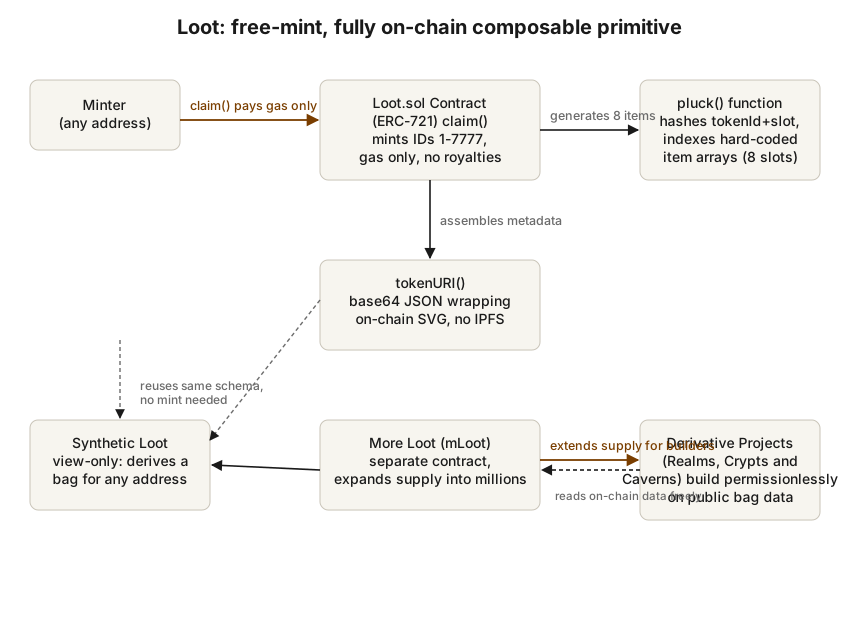 Open full-size diagram
Summary
Loot (full name "Loot (for Adventurers)") is an Ethereum NFT collection of 8,000 "bags," each of which is nothing more than a list of eight randomized fantasy items — a weapon, chest armor, head, waist, foot, and hand pieces, a necklace, and a ring — rendered as white text on a black background. It was deployed on 27 August 2021 by Dom Hofmann (co-founder of Vine and Byte) and announced simply by tweeting the contract address. There was no mint price beyond gas, no royalties, no roadmap, no team, and no imagery or stats. All 8,000 bags were claimed within roughly three to four hours.
The radical idea was to invert the usual NFT order of operations. Instead of a project shipping art, lore, and a game and selling access to it, Loot shipped only the raw, machine-readable ingredients and left every layer of interpretation — art, statistics, rarity, worldbuilding, and games — to the community. This made Loot a "bottom-up" or "composable primitive" NFT, and it briefly became one of the most influential design experiments in the NFT era, praised by Vitalik Buterin and spawning a large ecosystem of derivative projects.
Design (Mechanism)
The core Loot.sol contract is a standard ERC-721 with three defining properties:
- Fully on-chain and deterministic. Each bag's eight item strings are generated at read time by hashing the token ID together with a slot keyword (
pluck(tokenId, "WEAPON", weapons), etc.) and indexing into hard-coded Solidity string arrays. Rarer "name prefixes/suffixes" and "+1" greatness suffixes are layered in for higher hash values. Nothing is stored off-chain;tokenURIreturns a base64-encoded JSON blob wrapping an SVG that is assembled from those strings entirely within the EVM. The metadata cannot rot or be rugged by a dead server. - Free mint, no royalties.
claim()let anyone mint token IDs 1–7777 for only gas; IDs 7778–8000 were reserved for the owner. No secondary royalty was encoded, an intentional choice to keep the primitive maximally neutral and ownerless. - Minimalism as an interface. By omitting art, numbers, and rules, Loot defined a shared, public schema (eight slots, a fixed vocabulary of items) that anyone could build on top of without permission. Because the data lives on-chain and is free to read, third parties could compose new contracts and front-ends against Loot without coordinating with Hofmann.
Hofmann followed the launch with two extensions that reinforced the primitive framing. Synthetic Loot is a view-only function that deterministically derives a "bag" for every Ethereum address, so any wallet has default gear without minting — treating the address itself as the seed. More Loot (mLoot) is a separate contract expanding supply into the millions (with a further tranche released per year) to counter scarcity gatekeeping. Together these positioned Loot less as a collectible and more as a base layer.
Outcome
Commercially and culturally, the launch was a phenomenon. Within about five days Loot generated on the order of $46M in secondary sales and a floor/market cap well into the hundreds of millions of dollars, with individual bags trading for hundreds of ETH (e.g., bag #748 reportedly sold for 250 ETH in early September 2021). A wave of derivative projects appeared almost immediately — Realms (Loot), Crypts and Caverns, Genesis Project / Adventure Gold, Loot Character, Banners, Rings, and others — many linked directly from the official site.
Over the longer term, however, the "8,000 bags become the seed of an emergent game/metaverse" thesis did not durably materialize. Speculative floor prices collapsed from their 2021 peaks, coordination across independent derivative teams proved hard, and no single canonical game emerged from the base layer. The most successful downstream effort, Realms/Loot's on-chain gaming stack, evolved substantially and somewhat separately from the original bags. So Loot succeeded overwhelmingly as an idea and a cultural moment, and as a durable on-chain artifact, but only partially as the foundation of a living game economy — hence a partial_success rather than an unqualified one.
Why it worked
- Perfect timing and a credible founder. It landed at the peak of 2021 NFT mania, and Hofmann's Vine pedigree lent instant legitimacy and reach; the "just a contract address" launch became its own viral story.
- Genuine conceptual novelty. Bottom-up composability — ship the primitive, let the crowd build the value — was a real and articulate inversion of the prevailing top-down NFT model, which is why builders and thinkers (including Buterin) engaged with it seriously.
- Fair, ownerless-feeling distribution. Free mint, no royalties, and on-chain rendering signaled a "public good" ethos that attracted developers, not just flippers, and seeded a builder community fast.
Where the design broke
- A primitive is not a product. By design Loot shipped no gameplay loop, so sustained value depended entirely on others building compelling experiences; most derivatives were themselves speculative and short-lived.
- Coordination and canon problems. With no team, roadmap, or authority, dozens of independent projects competed to define "official" stats, art, and lore, fragmenting effort and diluting any single Schelling point.
- Speculation crowded out building. Four/five-figure floor prices made the bags financial instruments first and game assets second; when the broader NFT market fell, most of the derivative economy fell with it.
Lessons
- Composable primitives can bootstrap culture but rarely finish a product on their own — leaving all interpretation to "the community" maximizes optionality and virality while minimizing the odds that any one coherent experience actually ships.
- On-chain, server-independent metadata is a durable design win even when the surrounding hype fades: Loot bags still render from the EVM years later, unlike many image-NFTs whose art has decayed.
- Removing royalties and mint price can attract builders and signal neutrality, but it also removes a funding mechanism for ongoing coordination — a permissionless base layer has no treasury to steer or sustain the ecosystem it spawns.
- Founder-less-by-design is a double-edged sword: the absence of a roadmap prevented rug-pull risk and empowered permissionless building, but also meant no one was accountable for turning the primitive into a sustained product.
Redesign (EDITORIAL — hypothesis, not fact)
The following is the researcher's analysis and speculation, not established fact.
If re-running Loot today, the goal would be to preserve the ownerless, on-chain primitive while adding just enough connective tissue to convert energy into a lasting product. Concretely: (1) Ship the neutral base contract exactly as before, but pair it with an optional, opt-in canonical standard registry — a minimal on-chain interface (e.g., an ERC that maps slots to trait schemas) so derivative builders can interoperate without a central authority, reducing the "which stats are official?" fragmentation. (2) Fund coordination through a small, transparent protocol mechanism (for example, a modest optional royalty or a one-time mint donation routed to a public, on-chain grants pool governed by holders) rather than pure free mint, so the ecosystem has resources to commission reference clients and games without reintroducing a rug-able team treasury. (3) Launch a first-party reference game as a Schelling point — explicitly framed as one interpretation among many, and open-sourced — to seed a playable loop on day one instead of hoping one emerges. (4) Bias distribution toward builders (e.g., proof-of-contribution or developer allocations alongside the open claim) to raise the ratio of makers to flippers. The bet: primitives spread on virality, but they persist only when someone deliberately funds coordination and hands the crowd a working first example to fork. This remains a hypothesis; Loot's own history shows how hard each of these additions is to do without recreating the top-down model it set out to escape.
Sources
- Loot official website (lootproject.com) — primary (docs)
- Loot (LOOT) ERC-721 contract on Etherscan — primary (contract)
- Synthetic Loot page (lootproject.com/synthloot) — primary (docs)
- The Latest NFT Fad Is a Text-Based Fantasy Game Building Block (CoinDesk) (news)
- The Loot project flips the script on NFTs (TechCrunch) (news)
- Interview with Dom Hofmann on how and why he created Loot (Platformer / Casey Newton) — primary (retrospective)
- What the Loot Project Is Teaching Us About Decentralization (Moonstream / Coinmonks) (analysis)
- Loot: The First On-Chain Community-Driven NFT Platform (Xord) (analysis)
Related experiments
Last verified: 2026-07-26 · Spot an error? Suggest a correction