Botto
A 'decentralized autonomous artist': an AI art engine whose weekly output is curated by token-holder votes that retrain its taste model, with the winning piece auctioned as an NFT and proceeds recycled to the voting community.
▶ Run interactive simulation animated mechanism with editable parameters
How it works onchain
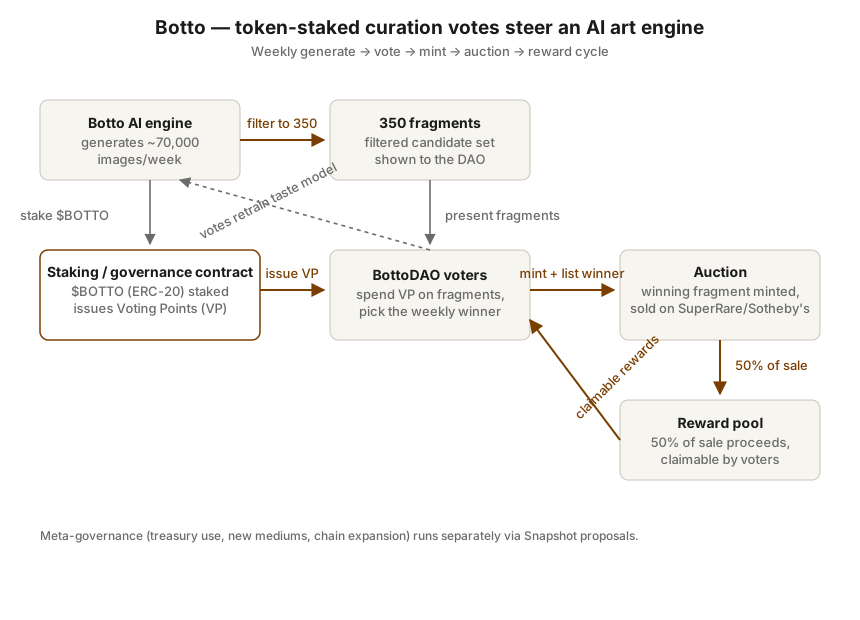 Open full-size diagram
Summary
Botto is a "decentralized autonomous artist" (DAA): a generative-AI art engine coupled to a token-governed curation market. Conceived by German generative artist Mario Klingemann (who built and then relinquished control of the art engine) together with the software collective ElevenYellow (with design studio Carbono credited in the docs), Botto minted its first artwork on SuperRare on October 22, 2021. Each week the engine produces tens of thousands of candidate images; a curated subset of 350 "fragments" is put before the BottoDAO, whose staked-token voting both selects the week's auction piece and feeds back into the model as a training signal, nudging Botto's aesthetic over time. Sale proceeds flow back to the voting community. The experiment's core claim is that taste itself can be decentralized: no single human decides what Botto makes or sells, yet the output has sold for millions at SuperRare and, since 2024, at Sotheby's.
Design (Mechanism)
- Generation: Botto's art engine (originally VQGAN+CLIP-era pipelines, later expanded to newer text-to-image models, "creative reasoning" agents, and even p5.js code art) autonomously generates prompts and images — reported at roughly 70,000 images per week, filtered down to 350 fragments shown to the DAO.
- Stake-to-vote curation: $BOTTO (ERC-20, fixed 100M supply, Ethereum mainnet at
0x9DFAD1…5BBA, later also deployed on Base) is staked in a governance contract to generate Voting Points (VP). VP are spent on fragments; this is deliberately a continuous, replenishing budget rather than one-token-one-vote, so engaged curators outweigh passive whales over time. - Feedback loop: Aggregated votes retrain Botto's taste model, so the community is not just picking winners — it is steering the artist's future output. Botto operates in 13-week "Periods," each with a DAO-selected thematic direction.
- Monetization and rewards: The top-voted fragment each week is minted and auctioned (historically on SuperRare). Per the docs, 50% of sale proceeds are returned to the community as claimable rewards (early iterations routed proceeds into $BOTTO buybacks/rewards for voters, aligning curation with revenue).
- Governance: Meta-parameters (treasury use, new mediums, collaborations, chain expansion) are decided via Snapshot votes and a documented governance process. Token distribution included an airdrop (~30M BOTTO), liquidity mining, bonding, and team vesting.
- Security: Contracts were audited by GoldmanDAO (V2 governance and NFT contracts, 2022) and Audita (full Ethereum ecosystem, April 2023; Ethereum + Base follow-up, September 2024).
Outcome
Ongoing and unusually durable for a 2021-vintage experiment. Botto's first works sold immediately and strongly on SuperRare; by October 2024 it had amassed over $4M across ~140 pieces (BusinessWire), and CNBC reported more than $5M in cumulative sales by December 2024, with a DAO of roughly 5,000 participants. Its October 2024 Sotheby's solo sale ("Exorbitant Stage") totaled $351,600 across six lots — a notable crossover into the traditional auction world. The project has kept shipping: Base deployment (2024), autonomous research/social agents, new mediums (p5.js), and a "Mirror Stages" installation at Art Basel Hong Kong 2026. Token price has been volatile and modest (sub-$1 on Etherscan snapshots), so financial upside for token holders has lagged the artistic/institutional success.
Why it worked
- A real product loop, not just a token: the weekly generate → vote → mint → auction → reward cycle produced a legible cadence and continuous reasons to participate.
- Credible artistic provenance: Klingemann's standing in generative art, and his deliberate handoff of control, made "autonomous artist" a defensible claim rather than marketing; institutions (Sotheby's, art fairs) engaged on those terms.
- Incentive-aligned curation: voters share in sale proceeds, so curation is skin-in-the-game prediction of market taste, not idle polling — an elegant fusion of curation markets and model fine-tuning.
- Narrative timing: Botto predated the 2023–24 AI wave, so when AI art became mainstream it was the canonical, already-running example of AI x DAO.
Limitations and criticisms
- $BOTTO's market value has not tracked the artist's cultural success, and governance utility depends almost entirely on staking demand rather than an independent value driver.
- Curation-as-training is slow and lossy; critics argue the DAO averages taste toward a crowd-pleasing middle, and the "autonomy" claim still depends on a core team maintaining the engine and pipeline.
- Revenue is concentrated in a thin weekly auction market that is exposed to NFT-market cycles; the 2022–23 bear sharply reduced auction proceeds relative to the 2021 debut.
Lessons
- Tokenized curation works best when votes are both a reward claim and a training signal — Botto's dual-use vote (pick the auction piece + steer the model) gives holders a reason to vote honestly and repeatedly.
- Decaying/replenishing voting points beat raw token-weight for taste aggregation: they privilege sustained engagement over one-off capital.
- An external revenue anchor (art sales) makes a DAO token partially self-justifying, but if token value depends mostly on staking-for-votes, price can decouple badly from project success.
- "Autonomy" is a spectrum: credibility came from progressively removing human override, documented publicly, rather than claiming full autonomy on day one.
- Institutional legitimacy compounds: moving from SuperRare to Sotheby's mattered more for longevity than any tokenomics tweak.
Redesign (EDITORIAL — hypothesis, not fact)
This section is editorial hypothesis, not fact. A modern redesign might: (1) route a share of auction proceeds into a protocol-owned endowment that pays voters a smoother, less NFT-cycle-exposed reward, reducing the feast/famine dynamic of weekly auctions; (2) replace pure VP-weighted averaging with quadratic or prediction-market-scored curation (reward voters whose picks outperform at auction, not merely those who voted for the winner) to fight taste-averaging toward the middle; (3) publish the taste model's training deltas onchain or via attestations each Period, making the "community steers the artist" claim verifiable rather than trusted; (4) formalize the human-operator boundary as an onchain-enumerated permission set that shrinks on a public schedule, turning "progressive autonomy" into a checkable commitment; and (5) issue per-Period curation NFTs to active voters, converting engagement history into portable reputation instead of relying solely on fungible-token staking.
Sources
- Botto Docs (mechanism, token, contracts, audits) — primary (docs)
- BOTTO Token — Etherscan (verified contract) — primary (contract)
- Botto Docs — Contract Audits (GoldmanDAO 2022, Audita 2023/2024) — primary (audit)
- Botto: A Decentralized Autonomous Artist (Klingemann et al., NeurIPS ML4CD workshop paper) — primary (retrospective)
- Meet Botto, the AI 'machine artist' making millions of dollars (CNBC, Dec 2024) (news)
- Autonomous AI Artist Botto Breaks $350K in Sales at Sotheby's Solo Exhibition (BusinessWire, Oct 2024) (news)
- Botto: Art at the Intersection of AI and Token Networks (1kx) (analysis)
Related experiments
Last verified: 2026-07-26 · Spot an error? Suggest a correction