EulerBeats
Fully on-chain generative art+music NFTs (27 'originals' per album) whose fungible 'prints' were minted and burned on an Euler's-number bonding curve that paid instant 8% royalties to original holders.
▶ Run interactive simulation animated mechanism with editable parameters
How it works onchain
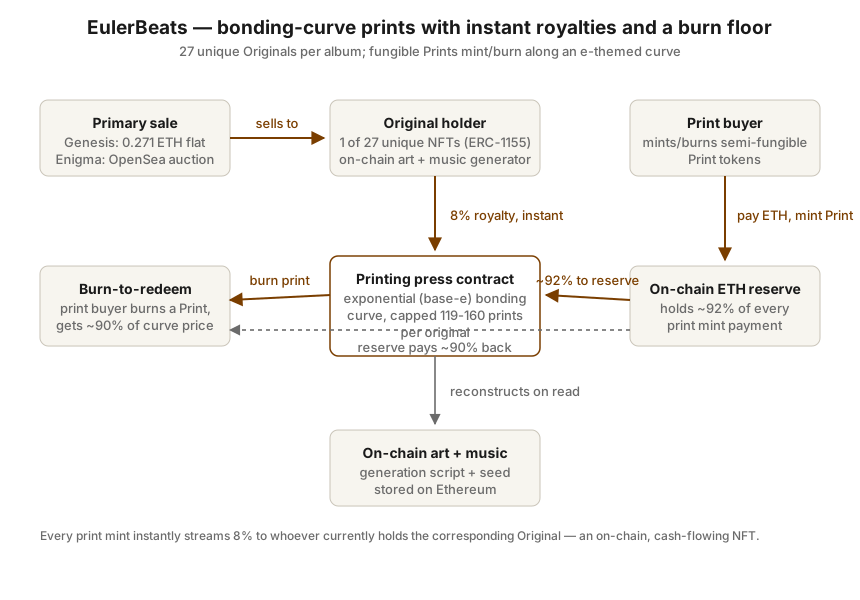 Open full-size diagram
Summary
EulerBeats, launched in February 2021 by Treum (a ConsenSys-backed studio), was one of the first projects to fuse fully on-chain generative art+music with DeFi-style token economics. Each "album" — Genesis (Feb 2021) and Enigma (Mar 2021) — consisted of 27 unique "original" NFTs whose art and audio are deterministically generated from an on-chain seed by a script also stored on Ethereum. Anyone could mint semi-fungible "prints" of an original along an exponential bonding curve themed on Euler's number (e ≈ 2.71828); each print mint instantly paid the original's holder an 8% royalty, and prints could be burned back into the curve's ETH reserve for roughly 90% of the current curve price. Genesis originals sold for 0.271 ETH each and sold out almost immediately, with reported activity exceeding $10M in the first days; the Enigma originals were auctioned on OpenSea for 1,665 ETH ($3.1M). Mark Cuban was a prominent early collector and promoter. Treum and EulerBeats were acquired by ConsenSys in October 2021; after later experiments (staking, wearables, the Polygon-based "Futura" releases), activity wound down.
Design (Mechanism)
- Dual-token ERC-1155 structure. Each album is a single ERC-1155 contract holding 27 unique originals ("LPs") plus fungible print tokens tied to each original. Genesis token:
0x8754f54074400ce745a7ceddc928fb1b7e985ed6; a separate "printing press" contract (0x8cac485c...4830f27) handled curve mint/burn logic. - On-chain art and music. The generation script and each track's seed live on Ethereum; art and audio can be regenerated without any off-chain server — a stronger permanence claim than IPFS-pinned NFT projects of the era.
- Bonding-curve prints. Print price rises exponentially with outstanding supply (curve constants themed on e). Genesis capped prints at 119 per original; Enigma at 160. Mint proceeds (minus royalty) accumulate in an on-chain reserve.
- Burn-to-redeem. A print holder can burn a print at any time and withdraw ~90% of the current curve (burn) price from the reserve, creating a hard price floor and two-way market entirely on-chain.
- Automatic royalties. 8% of every print mint is paid instantly and trustlessly to the current holder of the corresponding original — an on-chain cash-flowing NFT, pre-dating royalty standards like EIP-2981.
- Primary distribution. Genesis originals sold at a flat 0.271 ETH (a nod to e); Enigma originals were distributed via OpenSea auction in March 2021.
Outcome
Genesis sold out its 27 originals instantly in February 2021 and triggered a frenzy of print minting; DappRadar reported more than $10M of activity in the first days, and originals resold on secondary markets at large multiples (Mark Cuban publicly praised and collected the project). The March 2021 Enigma auction raised 1,665 ETH ($3.1M), with every original clearing at least 45 ETH and the top lot at ~131 ETH ($243k). Treum (and with it EulerBeats) was acquired by ConsenSys in October 2021. Follow-on products — staking, wearables, and the Futura mix releases on Polygon (contracts listed in official docs) — did not recapture the original momentum, and the project became largely inactive, though the on-chain art, music, and curves persist by design. Net assessment: a genuine mechanism-design landmark and commercial success at launch that did not sustain an ongoing ecosystem — partial_success.
Why it worked
- Royalties as native cash flow made originals productive assets with a legible valuation story (discounted print royalties), not just collectibles — a key reason sophisticated buyers (including Cuban) engaged.
- The burn floor de-risked speculation. A ~90% redeemable reserve meant print buyers' downside was bounded and visible on-chain, which encouraged participation on the way up.
- Credible permanence. Fully on-chain generation was rare in early 2021 and gave the project real technical differentiation and press attention.
- Tight thematic coherence (Euler's number in the curve, the 0.271 ETH price, math-generated audio) made the mechanism itself part of the art, which marketed itself.
- Timing: it launched at the exact peak of the Feb–Mar 2021 NFT mania with ConsenSys-adjacent distribution.
Where the design broke
- Reflexive bonding-curve demand. Prints were bought predominantly as trades on the curve, not for the music; once inflows slowed, burning for the reserve became the dominant strategy, mechanically unwinding supply and price. The curve that amplified the boom amplified the bust.
- Sequel decay. Enigma's auction format captured more value upfront for the team/sellers but gave later entrants worse asymmetry, and each subsequent release (Enigma, Futura) drew less attention — the scarcity story weakened with every new album.
- Hype dependence. Cultural attention (celebrity collectors, novelty press) was the real demand driver; when the 2021 NFT cycle rotated to PFPs, the mechanism alone could not retain users.
- Team absorption. The ConsenSys acquisition of Treum redirected the builders toward broader NFT infrastructure, leaving EulerBeats without a dedicated roadmap.
Lessons
- A redemption floor changes speculator behavior in both directions: it recruits capital early but institutionalizes the exit, so expect curve unwinding, not diamond hands, when momentum stalls.
- On-chain royalty cash flows to NFT holders are a powerful primitive — EulerBeats demonstrated enforceable, instant royalties years before marketplaces made royalties optional — but cash flows must ultimately be backed by non-speculative demand for the underlying media.
- Scarcity narratives don't survive sequels well. If the pitch is "ultra-scarce," each additional album dilutes the thesis; plan the full emission schedule before season one.
- Fully on-chain permanence is a real, durable differentiator: the artifacts still work with no team, which is why the project remains canonical even though it is dormant.
- Mechanism-as-art can be self-marketing, but complexity (originals vs. prints vs. curves) narrows the audience to mechanism connoisseurs.
Redesign (EDITORIAL — hypothesis, not fact)
This section is editorial hypothesis, not fact. A redesign would keep the strongest elements — on-chain generation, ERC-1155 originals/prints, and automatic royalty streaming — while blunting the reflexivity. First, replace the pure exponential curve with a flatter sigmoid and a mint/burn spread that decays with holding time, so quick-flip burning is penalized and long-term holders capture the reserve; alternately, route part of burn slippage to remaining print holders to reward patience. Second, tie print utility to consumption rather than pure position: print holders could receive stem/remix rights, gated listening, or curation weight, giving prints a demand source uncorrelated with curve momentum. Third, commit on-chain to the total number of albums at genesis (e.g., an immutable release schedule) to protect the scarcity thesis. Fourth, direct a slice of print royalties into a per-original endowment that funds ongoing derivative works or artist collaborations, converting speculative inflows into durable catalog value. The hypothesis: EulerBeats' economics were sound as a market microstructure experiment but lacked a non-financial demand sink; anchoring prints to actual music utility would have converted a one-cycle phenomenon into a persistent catalog.
Sources
- EulerBeats official docs (About) — primary (docs)
- EulerBeats docs — Contracts — primary (docs)
- EulerBeats Genesis token contract (Etherscan) — primary (contract)
- EulerBeats official site — primary (docs)
- EulerBeats Enigma NFT Auction Raises $3.1 Million (Crypto Briefing) (news)
- NFT music and arts project EulerBeats sells second collection for $3M (The Block) (news)
- EulerBeats 'Enigma' NFTs All Sell for $85,000 and Higher (Decrypt) (news)
- EulerBeats On-Chain Audio NFTs Attract More Collectors (DappRadar) (analysis)
- Consensys Acquires Treum (official blog) — primary (news)
- EulerBeats 101 (Tyler D Warner, Medium) (analysis)
Related experiments
Last verified: 2026-07-26 · Spot an error? Suggest a correction