JPEG'd
Peer-to-protocol NFT lending on Ethereum that let blue-chip NFT holders mint synthetic stablecoin PUSd and synthetic ether pETH against their JPEGs, collateral-damaged in the 2023 Curve/Vyper exploit and voluntarily wound down in 2024-25.
▶ Run interactive simulation animated mechanism with editable parameters
How it works onchain
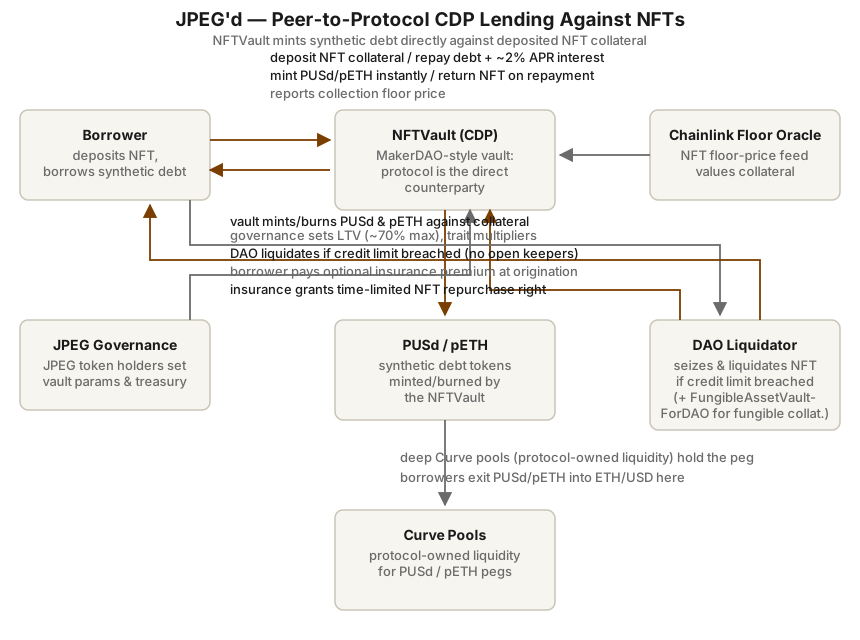 Open full-size diagram
Summary
JPEG'd was one of the canonical "NFT-fi" experiments of the 2021-22 cycle: a peer-to-protocol lending market on Ethereum that ported MakerDAO's CDP model to non-fungible collateral. Holders of blue-chip NFTs (starting with CryptoPunks, later Bored Apes, Doodles, EtherRocks and others) deposited them into protocol vaults and minted synthetic assets against them — PUSd, a USD-pegged stablecoin, and later pETH, a synthetic ether. Announced in late 2021, the project distributed its 69.42B-supply JPEG governance token partly through a public "donation event," and the protocol went live on mainnet on April 27, 2022, attracting 50 CryptoPunks as collateral within 12 hours. It pioneered Chainlink NFT floor-price feeds as oracle infrastructure. In July 2023 its pETH/ETH Curve pool was drained of 6,106 WETH ($11M) in the Curve/Vyper compiler reentrancy incident; unusually, the funds were returned within days minus a 10% bounty. The protocol never regained momentum as NFT valuations collapsed, and in December 2024 governance proposal PIP-96 wound down lending and distributed the treasury to staked token holders in early 2025.
Design (Mechanism)
- Peer-to-protocol CDP lending. Unlike peer-to-peer NFT lending (NFTfi) or peer-to-pool (BendDAO), JPEG'd was the borrower's direct counterparty, MakerDAO-style: deposit an NFT into an NFTVault, mint PUSd or pETH instantly against it, repay debt plus interest (starting around 2% APR) to reclaim the NFT. PUSd was minted/burned by the vault contracts; a FungibleAssetVaultForDAO also allowed the DAO to mint against fungible collateral.
- Oracles. Collateral valuation used Chainlink NFT floor-price feeds (JPEG'd was an early flagship integration), insulating pricing from single-marketplace manipulation.
- LTV, boosts and traits. Base credit limits were conservative (max ~70% LTV including boosts, per docs). Locking JPEG tokens could boost a position's credit limit, and rare-trait NFTs (e.g., Alien or Ape Punks) could receive valuations above floor via governance-set trait multipliers.
- Liquidation with insurance. Because NFTs are illiquid, liquidations were executed by the DAO rather than open keepers. Borrowers could pay an optional insurance premium at loan origination that granted a time-limited right to repurchase a liquidated NFT from the DAO after repaying the debt plus a penalty.
- Synthetic-asset liquidity via Curve. PUSd and pETH depended on deep Curve pools (heavily seeded with protocol-owned liquidity) for their pegs and for borrowers' exit into "real" assets — a design choice that concentrated systemic risk in Curve pool code.
- Governance. The JPEG token (35%/30%/30%/5% DAO/donation/team/advisors) governed vault parameters, trait boosts, and treasury; the token later migrated to JPGD.
Outcome
The core lending machine worked as designed for roughly three years: no known exploit of JPEG'd's own vault contracts, and the protocol underwent a Code4rena public audit contest (April 2022) before launch. But it launched into the top of the NFT bubble; as floor prices fell 80-95%, borrowing demand, TVL and JPEG token value collapsed with them. The July 30, 2023 Curve/Vyper reentrancy exploit drained 6,106.65 WETH ($11M) from the pETH/ETH pool — a bug in Vyper compiler versions 0.2.15-0.3.0, not in JPEG'd's code — depegging pETH; the attacker (or the MEV frontrunner who beat them to it) returned the funds by August 4, 2023, keeping a 610.6 ETH (~$1.1M) bounty. Despite this rare full recovery, confidence and usage never returned. In December 2024, PIP-96 ("Wind down pUSD/pETH lending operations and uncustody treasury") passed; vault interest rates were raised to 180% in January 2025 to force loan repayment, DAO liquidity was withdrawn by February 8, 2025, and treasury assets were disbursed pro rata to staked JPGD holders. The main website is now offline. Outcome: technically successful, commercially unsuccessful — ending in an orderly, solvent wind-down rather than insolvency.
Why it worked
- Instant liquidity for illiquid assets. The CDP model removed loan-matching friction; borrowing against a Punk took one transaction, which drove genuine early adoption (50 Punks in 12 hours).
- Conservative risk plumbing. Manipulation-resistant Chainlink floor oracles, low base LTVs, DAO-managed liquidation, and optional repurchase insurance meant the protocol itself stayed solvent through a brutal NFT bear market.
- Credible security process and crisis response. A pre-launch public audit contest, and a swift bounty negotiation that recovered ~$11M within five days of the Curve exploit — one of DeFi's cleanest post-exploit recoveries.
Why it failed or underperformed
- Procyclical collateral. NFT floor prices are a leveraged bet on the same crypto cycle that drives borrowing demand; when floors collapsed, both collateral values and the protocol's addressable market evaporated simultaneously.
- Externalized systemic risk. The synthetics' pegs and exit liquidity lived in Curve pools, so a compiler bug entirely outside JPEG'd's codebase drained $11M and permanently damaged trust in pETH.
- Reflexive token design. JPEG lock-ups boosting LTVs tied credit capacity to the governance token's price, amplifying the downturn.
- Small durable market. Peer-to-protocol NFT lending needs a large, stable base of blue-chip holders wanting leverage; that population shrank to a niche after 2022, leaving revenue (~2% APR on shrinking debt) unable to justify the risk surface.
Lessons
- Collateral and demand correlation is the killer. An NFT-backed credit line sees its collateral, its users, and its token all crash together; countercyclical collateral or fee models are needed for durability.
- Your risk surface includes every dependency. JPEG'd's own contracts were never hacked, yet it lost $11M through a Curve pool compiled with a buggy Vyper version — synthetic-asset protocols inherit the full stack risk of wherever their liquidity lives.
- Bounty-for-return negotiation works often enough to institutionalize. The 10% whitehat bounty produced near-full recovery; protocols should pre-commit to such frameworks before crises.
- Orderly wind-downs are an underrated success mode. Raising rates to force repayment, uncustodying collateral, and distributing the treasury to staked holders (PIP-96) returned value instead of leaving a zombie protocol — a template other sunsetting DAOs have since followed.
- DAO-as-liquidator only scales if the DAO can warehouse risk. Manual liquidation of illiquid collateral works at boutique scale but caps growth; it is a design admission that NFTs lack a real liquidation market.
Redesign (EDITORIAL — hypothesis, not fact)
This section is editorial hypothesis, not fact. A revived JPEG'd would decouple its synthetic assets from a single external AMM: peg maintenance via a protocol-native PSM against canonical assets (USDC/ETH) with strict per-pool exposure caps, so a third-party pool exploit cannot depeg the synthetic. Replace floor-price-only oracles with a dual oracle (floor feed plus TWAP of realized vault liquidation prices) and make LTV a function of collection liquidity depth rather than governance-set constants. Drop token-locking LTV boosts (reflexive) in favor of boosts earned by repayment history — onchain credit scoring per wallet. Finally, replace DAO-managed liquidation with pre-committed Dutch-auction liquidation into a permissionless bidder set, with the insurance/repurchase right preserved as a borrower-paid call option; this makes the liquidation market legible and removes the DAO balance-sheet bottleneck that capped the original design.
Sources
- JPEG'd DAO documentation — Introduction, Lending Mechanics, pETH — primary (docs)
- Code4rena audit contest repo: 2022-04-jpegd (protocol source) — primary (audit)
- PUSd token contract on Etherscan — primary (contract)
- JPEG governance token contract on Etherscan (labeled 'Old JPEG Token') — primary (contract)
- LlamaRisk — Curve Pool Reentrancy Exploit Postmortem, July 30th 2023 (analysis)
- Rekt News — Curve, Vyper (analysis)
- Blockworks — Curve suffers $70M exploit, but damage contained (news)
- Decrypt — NFT Service JPEG'd Launches CryptoPunks Lending and Chainlink Integration (news)
- IQ.wiki — JPEG'd (history, Chad Council, exploit-return timeline) (analysis)
- MEXC News — JPEG'd wind-down updates (PIP-96 and treasury disbursement) (news)
- DefiLlama — JPEG'd TVL (analysis)
Related experiments
Last verified: 2026-07-26 · Spot an error? Suggest a correction