Element Finance
Fixed-rate yield protocol that split yield-bearing positions into zero-coupon Principal Tokens and variable Yield Tokens, traded on a custom YieldSpace-style AMM atop Balancer V2.
▶ Run interactive simulation animated mechanism with editable parameters
How it works onchain
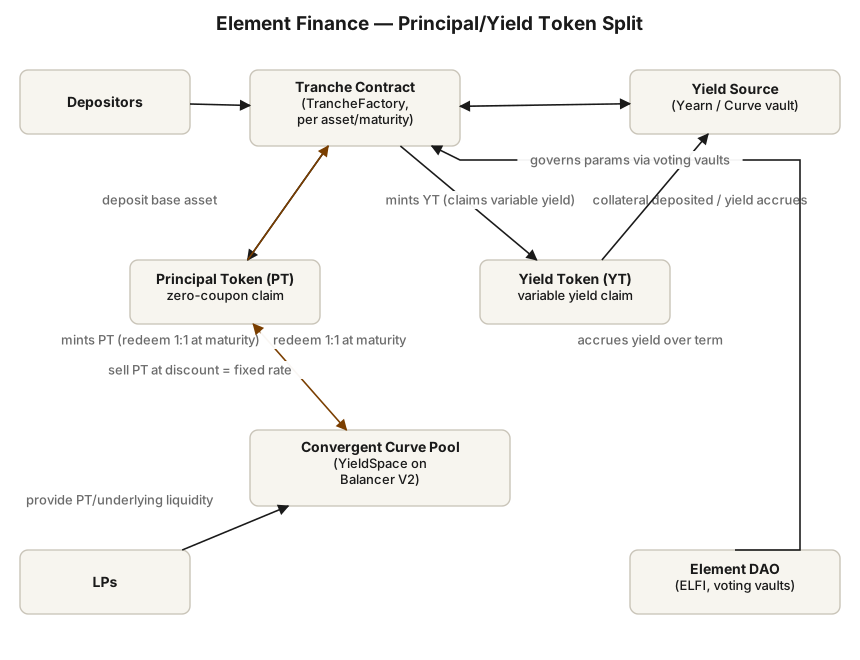 Open full-size diagram
Summary
Element Finance was an Ethereum fixed-rate yield protocol founded by Will Villanueva (CEO) and Jonny Rhea (CTO), former Ethereum researchers. It closed a $4.4M seed in December 2020 led by Andreessen Horowitz and Placeholder, launched to mainnet on June 30, 2021 (first asset: Curve's crvLUSD), and raised a $32M Series A led by Polychain at a $320M valuation in October 2021. Element's core primitive split a tokenized yield-bearing position (e.g., a Yearn vault or Curve LP position) into a Principal Token (PT), redeemable 1:1 for the underlying at maturity, and a Yield Token (YT), which accrued the variable yield over the term. Buying PTs at a discount produced a fixed rate; YTs offered leveraged variable-yield exposure with no liquidation risk. TVL passed $180M by October 2021 and roughly $218M by December 2021. In 2022 it launched the Element DAO with the ELFI token and the influential "voting vaults" governance framework (later open-sourced as Council). The company rebranded to DELV, pivoted to a successor protocol (Hyperdrive), and wound down operations in 2025 after a Hyperdrive vulnerability (pools paused March 24, 2025) and dwindling commercial traction; user funds in Element and Hyperdrive remained withdrawable.
Design (Mechanism)
- Yield stripping. Users deposited a base asset (or yield-bearing position) via a Tranche contract minted by the TrancheFactory. The position was split into two ERC-20s: a Principal Token (a zero-coupon-bond-like claim, redeemable 1:1 for the underlying at a fixed maturity date, e.g. "ePyvcrvSTETH-28JAN22") and a Yield Token (a claim on the variable yield generated over the term).
- Fixed rate as a market price. There was no rate oracle or lender-matching. A fixed rate emerged from PTs trading below par before maturity: buy a PT at a discount, hold to maturity, redeem at par — the discount is the fixed yield.
- Custom AMM. PTs traded against the underlying in a Convergent Curve Pool, a YieldSpace-derived AMM built on Balancer V2 whose curve incorporates time-to-maturity, so the PT price converges to par as maturity approaches and LPs suffer less arbitrage drag than on constant-product curves. YTs traded on ordinary pools.
- Capital efficiency loops. Because minters kept both tokens, they could sell the PT at a small discount to recover most principal while retaining YT exposure — and recursively repeat this ("yield token compounding") for leveraged exposure to variable yield with zero liquidation risk. LPs earned fees on comparatively low-impermanent-loss pairs (PT vs. its own underlying).
- Governance. The Element DAO launched in 2022 with ELFI (100M supply; ~10% airdropped to users and ecosystem contributors). Its architecture was notable: modular voting vaults (e.g., a Locking Vault and a Vesting Vault that down-weighted unvested investor/team tokens), delegation, and an elected Governance Steering Council — a hybrid of direct and representative democracy later released as the open-source Council framework.
Outcome
Technically, the protocol worked as designed: terms matured, PTs redeemed at par, and no exploit of the Element Protocol itself was reported; even at wind-down DELV stated Element funds remained safe and withdrawable. Commercially, it did not sustain. TVL peaked around $218M in late 2021 and receded through the 2022 bear market as the fixed-term model showed structural friction: liquidity fragmented across many asset/maturity pairs, terms expired and had to be re-seeded, and fixed rates on top of already-modest vault yields were unattractive versus simply holding the underlying. The company rebranded to DELV and rebuilt the idea as Hyperdrive, an "everlasting" fixed-rate AMM without discrete terms. On March 24, 2025, a vulnerability in Hyperdrive (a large LP could, under specific conditions, withdraw more value than entitled) led to all pools being paused; later in 2025 DELV announced it was winding down entirely ("Farewell to DELV"), publishing withdrawal interfaces for each protocol. The ELFI token/DAO never gained broad traction, though the Council governance framework was adopted and studied elsewhere.
Why it worked
- The PT/YT split was a genuinely sound primitive: fixed rates priced by an open market rather than an oracle, with clean composability (PTs were used as collateral by third parties such as FIAT DAO, and third-party tools like Component built on YT compounding).
- The time-decaying Convergent Curve AMM materially reduced LP losses versus naive constant-product pools for bond-like assets, a real mechanism-design contribution (alongside Yield Protocol's YieldSpace, which it built on).
- Strong team credibility (Ethereum core-dev backgrounds) and top-tier backing (a16z, Placeholder, Polychain) produced fast early growth: $180M+ TVL within four months of launch.
- The voting-vault/GSC governance design was thoughtful and reusable — arguably Element's most durable legacy via the Council framework.
Where the design broke
- Liquidity fragmentation by design. Every asset × maturity pair needed its own tranche and pool; expiring terms forced continual liquidity migration and re-bootstrapping, taxing LPs and integrators.
- Thin economic spread. Fixed rates were bounded by underlying vault yields minus AMM discount dynamics; in a bear market the product's yield advantage over just holding stablecoins or the underlying largely vanished, and demand for paying for rate certainty proved small.
- Governance without a business. ELFI launched into a declining market with no fee accrual story; the DAO could not sustain momentum, and the operating company ultimately pivoted (Hyperdrive) and then wound down when the pivot was hit by a vulnerability and funding/traction ran out.
- Category headwind. Fixed-rate DeFi as a whole (Yield Protocol, Notional v2-era, Element) underperformed; the model only later found product-market fit when Pendle attached it to points/airdrop speculation — a demand driver Element predated.
Lessons
- A correct financial primitive is not a product: fixed rates need a large, recurring buyer of rate certainty; absent institutional demand or speculative yield markets (cf. Pendle's points era), the spread is too thin to sustain liquidity incentives.
- Discrete maturities fragment liquidity and impose migration costs every term; designs that amortize or eliminate terms (Pendle's rolling markets, DELV's own Hyperdrive) are a direct response to this failure mode.
- AMM curves should encode the asset's structure — Element's time-decaying curve for par-converging bonds remains the template for pricing maturing claims onchain.
- Launching a governance token without protocol revenue or a clear mandate produces a DAO that decays with TVL; conversely, governance infrastructure (voting vaults, delegation, elected councils) can outlive the protocol that built it.
- Winding down transparently — pausing on a discovered vulnerability before loss, then shipping withdrawal interfaces — preserved user funds and reputation even in failure.
Redesign (EDITORIAL — hypothesis, not fact)
This section is editorial hypothesis, not historical fact. A redesigned Element would (1) replace discrete per-asset maturities with a small number of rolling or perpetual terms so liquidity compounds instead of expiring — essentially what Hyperdrive attempted, but launched into the 2021 demand environment rather than after it; (2) aim the YT leg at a concrete speculative demand source (restaking points, airdrop farming, RWA coupon variance) since YT buyers, not PT holders, are what actually subsidize attractive fixed rates; (3) accrue a protocol fee from term creation/AMM spread to ELFI from day one, giving the DAO a reason to exist and a treasury tied to usage; and (4) issue PTs as a standardized, oracle-friendly collateral asset (fixed-maturity, par-converging) marketed to lending protocols and treasuries — the "DeFi zero-coupon bond" institutional wedge Element described but never operationalized. The counterfactual test: Pendle's later success suggests the mechanism was right and the demand engine was the missing piece, so timing and YT-side demand, more than mechanism changes, are the load-bearing hypotheses here.
Sources
- elf-contracts — Element Protocol Smart Contracts (GitHub) — primary (contract)
- elf-deploy — deployed mainnet addresses (GitHub) — primary (contract)
- Element Protocol Developer Docs (Principal Tokens) — primary (docs)
- Element Finance Raises $4.4M (founding/seed announcement, Will Villanueva) — primary (retrospective)
- Element is Live on Ethereum Mainnet! — primary (retrospective)
- Element Finance Raises $32M Series A at a $320M Valuation — primary (retrospective)
- Element DAO, ELFI Voting Distribution (Mirror) — primary (governance)
- Farewell to DELV (wind-down announcement) — primary (retrospective)
- Element DeFi Protocol Launches to Mainnet With High Fixed-Rate Yields (CoinDesk via Yahoo) (news)
- Polychain Capital Joins $32M Investment in DeFi Protocol Element Finance (Decrypt) (news)
- Element DAO / ELFI launch coverage (TokenInsight) (news)
- Element Year in Review: 2021 (TVL milestones) — primary (retrospective)
Related experiments
Last verified: 2026-07-26 · Spot an error? Suggest a correction