Believe (Launchcoin)
Solana launchpad that let anyone create a token by replying to an X account, branded as 'Internet Capital Markets' for startups — it minted thousands of coins a day at its peak before activity fell away sharply.
▶ Run interactive simulation animated mechanism with editable parameters
How it works onchain
 Open full-size diagram
Summary
Believe was a Solana token launchpad that collapsed the distance between a social-media post and a live, tradable asset: anyone could create a token by replying to the platform's "Launch Coin" X account (@launchacoin) with a ticker and name, and Believe's backend would mint and pool the token on Solana within minutes. Founded by serial consumer-app entrepreneur Ben Pasternak (Flogg, Monkey, and the plant-based food startup Simulate, sold in October 2024), Believe launched on April 28, 2025 as a rebrand of his earlier SocialFi platform Clout. Its associated token, LAUNCHCOIN — itself a rebrand of Pasternak's January 2025 PASTERNAK memecoin — became the flagship of the "Internet Capital Markets" (ICM) narrative: the idea that real startups could bootstrap funding and community through tokens instead of venture capital. LAUNCHCOIN rose roughly 27,000% in a month to a $0.35 peak in May 2025, and the platform topped 4,000 token launches per day at its height, ultimately processing around $6 billion in trading volume. In October 2025 LAUNCHCOIN was migrated to a new BELIEVE token on a fixed conversion deadline, with supply increased by roughly a third.
Design (Mechanism)
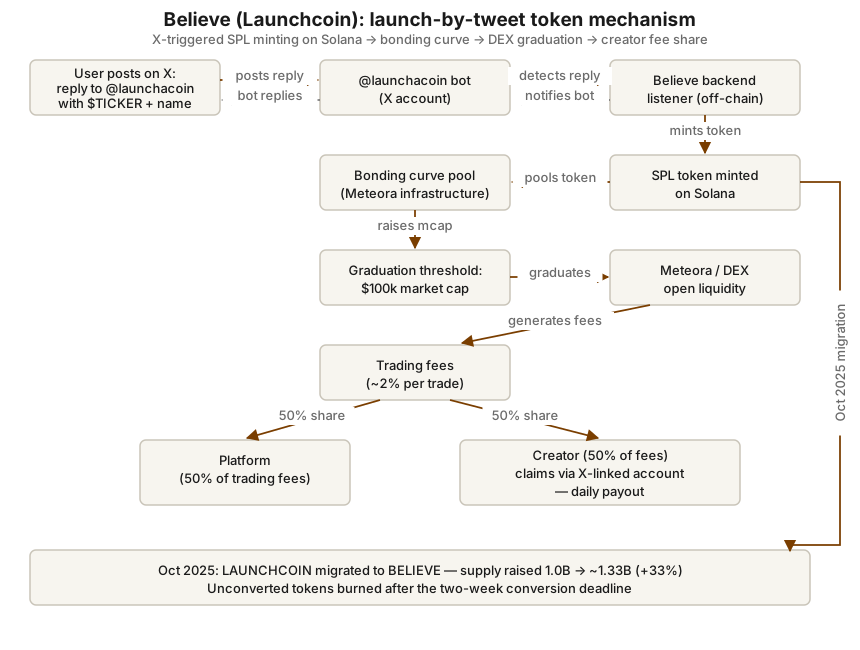
- Social-media-triggered minting. Listening infrastructure monitored X. Posting or replying with "@launchacoin + $TICKER + name" triggered automated deployment of an SPL token on Solana; the bot replied with a link to the live market. No wallet, code, or crypto knowledge was required to launch — the barrier to token creation was effectively a tweet.
- Bonding curve with graduation. New tokens traded on a bonding curve inside Believe's system (built on Meteora infrastructure); on reaching a $100,000 market cap they "graduated" to open Meteora/DEX liquidity, a pump.fun-style two-phase market structure.
- Fee-sharing flywheel. Trades incurred a fee (reported around 2% through Believe's pools), split 50/50 between the platform and the token's creator after graduation. Creators claimed daily payouts by linking their X account to the Believe app — an attempt to turn memecoin extraction into ongoing creator revenue, and the core "startups instead of VCs" pitch.
- The platform token. LAUNCHCOIN (mint
Ey59PH7Z...XRnk, first pooled January 24, 2025 as PASTERNAK) was never formally designated the platform token, but was universally traded as a proxy for Believe's success. In October 2025 it was migrated to a new BELIEVE token: a two-week conversion window (October 15–29), supply raised from 1.0B to ~1.33B (a ~33% increase), with unconverted tokens burned after the deadline.
Outcome
Explosive rise, then near-total collapse. Between May 13–15, 2025 Believe exceeded 4,000 daily token launches; LAUNCHCOIN ran from a ~$10M market cap on May 12 to over $240M on May 14. Notable "ICM" startups launched coins on the platform, and Bankless framed it as a challenge to venture capital. But activity cooled within days (under 1,000 daily launches by May 17), and Believe temporarily suspended launches on May 22, 2025 over a flood of spam coins. The October 2025 migration moved holders to a new token on a fixed conversion deadline, after which unconverted balances were burned.
Why it worked
- Zero-friction launch UX. Reducing token creation to an X reply was a genuine distribution innovation — it moved the launchpad to where attention already lived, rather than requiring users to visit a dApp.
- A narrative upgrade for memecoins. "Internet Capital Markets" reframed token launches as startup financing, attracting real founders and mainstream-adjacent attention that pure memecoin platforms couldn't.
- Aligned creator economics (on paper). The 50/50 trading-fee split gave creators recurring revenue tied to sustained volume, theoretically discouraging one-and-done rugs.
Where the design broke
- Attention-velocity economics. Launch volume was a hype curve, not a business: 4,000+ launches/day decayed to under 1,000 within a week, and fee revenue followed. Nothing in the mechanism converted speculative launches into durable projects.
- Discretionary commitments, no enforcement. The migration's dilution figures and the burn deadline for unconverted tokens were communicated by announcement rather than encoded onchain; the stated +25% supply change diverged from the actual +33%, and nothing in the mechanism reconciled the two automatically.
- No credible commitment layer. Buyback promises, fee policies, and supply were all discretionary decisions communicated via tweets, with nothing enforced onchain.
- Spam and impersonation. Near-zero launch cost invited non-project spam (forcing a service suspension) and mutable token metadata enabled impersonation, degrading trust in the long tail.
Lessons
- Distribution innovation (launch-by-tweet) can bootstrap a market in days, but a launchpad's defensibility is its trust, and trust dies with the first discretionary act against holders.
- Supply changes and migrations must be exact, onchain-verifiable, and opt-in; a "25% vs 33%" framing error cost more credibility than the dilution itself.
- Fee-sharing aligns creators with volume, not with product quality — a mechanism that rewards attention alone selects for attention farmers.
- Economic guarantees stated as promises rather than encoded onchain carry the reputational risk of whoever states them, with no fallback if the statement turns out to be wrong.
Redesign (EDITORIAL — hypothesis, not fact)
This is hypothesis, not fact. A redesigned Believe would keep the launch-by-tweet UX but move every economic promise into code: platform fee splits, buyback commitments, and token supply governed by an immutable onchain program or timelocked multisig, with the platform token formally designated and its treasury flows publicly attributable — eliminating the ownership ambiguity that undermined trust in the original launch. Migrations would be 1:1 with no supply change and no burn deadline (perpetual conversion contracts). To filter spam, launches could require a refundable stake or an X-account reputation threshold, and creator fee shares could vest against milestones (sustained holders, shipped product attestations) rather than raw volume, so the "Internet Capital Markets" pitch selects for builders instead of ticker-squatters.
Sources
- What Is Believe? Launching Memecoins via X Replies (CoinGecko Learn) (analysis)
- LAUNCHCOIN token page (Solscan) — primary (contract)
- Launch Coin bot account on X (@launchacoin) — primary (docs)
- Believe.app: New viral memecoin launchpad on Solana (Phantom) (analysis)
- Believe App's $BELIEVE Token Launch Backfires Over 'Math Error' and Supply Confusion (blocmates) (news)
- Believe: The Solana Token Launcher Coming for Venture Capital (Bankless) (analysis)
- Believe App Frenzy Sends LAUNCHCOIN Up 27,000% — But Can It Last? (Cryptohopper) (news)
Related experiments
Last verified: 2026-07-27 · Spot an error? Suggest a correction