Clanker
An AI agent on Farcaster that deploys ERC-20 memecoins on Base from a social-media reply, monetizing via permanently locked Uniswap v3 LP fees split between protocol and creators.
▶ Run interactive simulation animated mechanism with editable parameters
How it works onchain
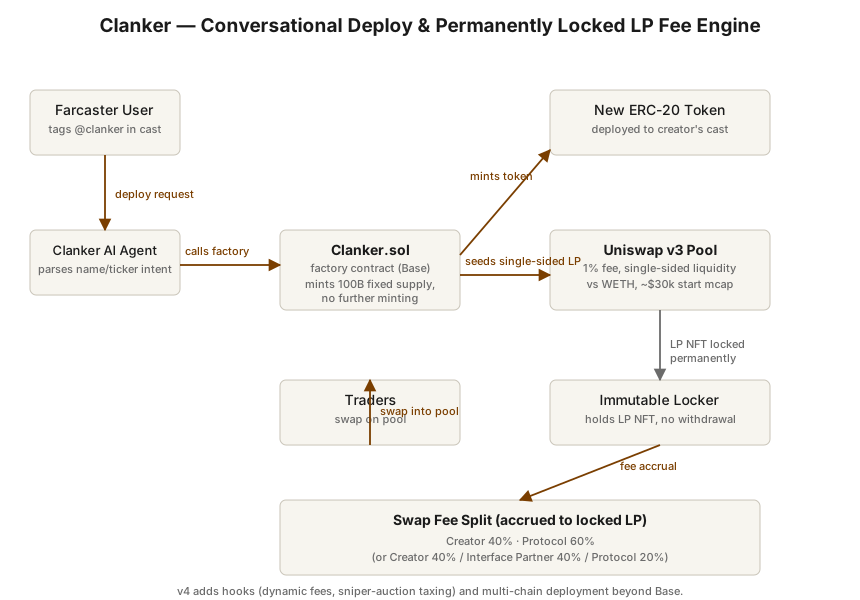 Open full-size diagram
Summary
Clanker is an AI-agent token launchpad born inside the Farcaster social network in November 2024. Built by Farcaster engineer Jack Dishman and the pseudonymous ecosystem developer proxystudio.eth, it lets anyone deploy an ERC-20 token on Base by simply tagging @clanker in a cast with a name and ticker; an LLM parses the request and the bot calls the Clanker factory contract. Every token launches with its entire supply as single-sided liquidity in a 1%-fee Uniswap v3 pool whose LP position is permanently locked, so the protocol and the creator earn swap fees forever instead of charging listing fees. Clanker catalyzed the "AI memecoin boom" on Base — 3,500 tokens and ~$4.2M in fees in its first two weeks, over 200,000 tokens and $13M in team revenue within five months, and more than $50M in cumulative fees by late 2025 — and was acquired by Farcaster (Merkle Manufactory) in October 2025, which sent the associated CLANKER (tokenbot) token up ~350%.
Design (Mechanism)
- Conversational deployment: A user tags @clanker on Farcaster (later also clanker.world, partner interfaces, or the contracts directly) with a token idea. An AI agent parses intent, then the bot deploys via
Clanker.sol, minting a fixed supply (100 billion, no further minting) to the deployer contract. - Single-sided locked liquidity: The full supply is placed as single-sided liquidity in a Uniswap v3 pool (paired against WETH or another quote token) at a starting market cap of roughly $30k. The LP position NFT is transferred to an immutable, non-upgradeable locker contract with no withdrawal method — liquidity can never be rugged by the deployer.
- Fee engine instead of listing fees: The 1% pool fee accrues to the locked position. Rewards are split 40% to the token creator and 60% to the protocol (or 40/40/20 creator/interface-partner/protocol for tokens launched through partner front-ends), giving creators a perpetual income stream proportional to trading volume — about 0.4% of all volume while the locked position is the dominant LP.
- Iterated versions: v2/v3/v3.1 added creator vaults (up to 30% of supply lockable for a minimum of 30 days), creator dev-buys at launch, and multi-pool options; v4 added modular hooks (dynamic/static fee hooks, sniper-auction modules to tax launch snipers) and expanded to Arbitrum, Unichain, Ethereum, BNB Chain, Monad, and (via Meteora) Solana.
- CLANKER token: A separate "tokenbot" CLANKER token trades on Base; after the Farcaster acquisition, protocol fees were directed to buy-and-hold CLANKER, legacy fee-vault tokens were slated for burning, and the team locked 7% of supply in a one-sided LP position.
Outcome
Explosive product-market fit: within two weeks of the November 2024 launch Clanker had deployed ~3,500 tokens and earned ~$4.2M; by April 2025 The Block reported 200,000+ tokens and ~$13M in team revenue; DefiLlama counted more than $50M in cumulative fees by October 2025, and the official site claims over $20B in total trading volume. Clanker became Base's flagship launchpad and a top revenue-generating crypto app of the cycle. In October 2025 Farcaster acquired Clanker/tokenbot (after reported interest from Rainbow), planning deeper in-app integration; the CLANKER token briefly rallied ~350% to an all-time high near $143. The protocol remains live and multi-chain as of mid-2026. Overall: a major commercial success as a protocol, though — as with all memecoin launchpads — the overwhelming majority of tokens it deployed went to near-zero.
Why it worked
- Zero-friction distribution embedded in a social graph: Launching a token became as easy as replying to a post, and Farcaster's feed provided instant discovery and social proof — the launchpad lived where the attention already was.
- Credible neutrality via immutable liquidity locks: Permanently locked single-sided LP eliminated the classic launchpad rug vector and made the "fair launch" claim checkable onchain.
- Aligned, perpetual incentives: Fee-splitting turned creators into long-term stakeholders (paid on volume forever) rather than dump-and-run issuers, and gave interface partners a reason to build distribution for Clanker.
- Right moment, right chain: It rode the late-2024 AI-agent narrative on Base, where cheap L2 gas made mass token deployment economically trivial.
Limitations and criticisms
- Nearly all deployed tokens were short-lived speculative instruments that end up near zero value, a market-structure fact of high-volume permissionless launchpads; the platform's revenue is structurally dependent on churning memecoin volume, which collapses in risk-off periods (fee revenue is highly cyclical per DefiLlama).
- The AI framing was thin — the agent mostly parsed text; value creation came from the contract/fee design, and copycats (on Base and elsewhere) competed away novelty.
- Launch sniping and creator self-dealing (dev buys, vaults) periodically shifted value to sophisticated actors, requiring successive mechanism patches (sniper auctions, vault locks) rather than being solved at inception.
- Independent ownership ended with the Farcaster acquisition — a good exit, but the protocol's fate is now tied to one social platform's strategy.
Lessons
- Distribution beats mechanism: putting token deployment inside an existing social feed did more for adoption than any tokenomics detail; the launchpad that lives where attention lives wins.
- Perpetual fee streams on permanently locked liquidity are a stronger business model than upfront listing fees — they align creators, interfaces, and protocol on volume and make rug-pulls structurally impossible for initial liquidity.
- Adversaries iterate, so launch mechanics must too: snipers and self-dealing creators forced Clanker through five major contract versions; assume your launch process is an auction and design it explicitly (e.g., sniper-auction hooks).
- A pseudonymous/two-person team can build a top-decile revenue protocol if the contracts are simple, immutable where it matters, and legible to speculators.
Redesign (EDITORIAL — hypothesis, not fact)
This section is editorial speculation. A redesigned Clanker might treat launch-time price discovery as a first-class mechanism rather than a patch: replace the fixed ~$30k initial-market-cap single-sided position with a short onchain batch auction (or gradual Dutch LBP into the v3 range) so snipers pay the market rather than extracting from it, with auction proceeds flowing to the creator vault. Creator fee streams could vest against behavior — e.g., fees escrowed and slashed if the creator dumps vaulted supply early — converting the 40% split into a bond for good conduct. Finally, the "AI" layer could do real underwriting: dedupe scam tickers, flag impersonation of real brands/people at deploy time, and publish an onchain provenance attestation (which cast, which account, what age/reputation) so downstream trading interfaces can price social authenticity instead of just volume.
Sources
- Clanker Documentation — Deployed Contracts — primary (docs)
- Clanker Documentation — Creator Rewards & Fees — primary (docs)
- clanker-devco/v3.1-contracts (GitHub) — primary (contract)
- clanker.world (official site) — primary (docs)
- Clanker deep dive pt. 1 — matthewb (Paragraph) (analysis)
- CLANKER Jumps 350% After Farcaster Acquires the AI Token Launchpad — The Defiant (news)
- Clanker Gives Rise To AI Memecoin Boom On Base — The Defiant (news)
- Clanker team earns $13 million in revenue from over 200,000 tokens on Base in five months — The Block (news)
- clanker Fees & Revenue — DefiLlama (analysis)
Related experiments
Last verified: 2026-07-26 · Spot an error? Suggest a correction