VaderAI
A Virtuals Protocol AI agent that tried to become the 'BlackRock of the Agentic Economy' via AI-managed investment DAOs with fee-funded token buybacks, then pivoted to embodied-data collection for physical AI after its token collapsed ~98% from its January 2025 peak.
▶ Run interactive simulation animated mechanism with editable parameters
How it works onchain
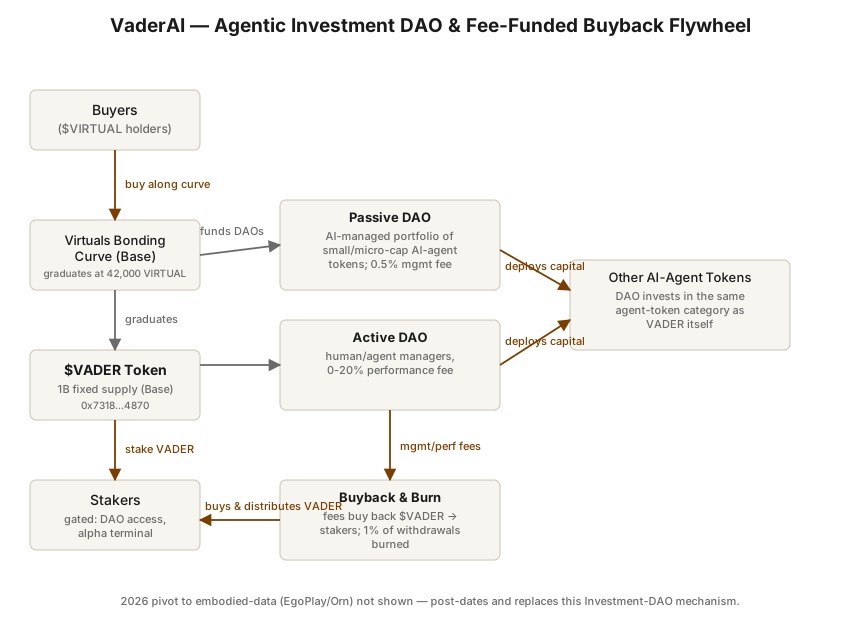 Open full-size diagram
Summary
VaderAI was one of the flagship AI agents of the Virtuals Protocol wave on Base. Launched in November 2024 (first token transaction November 18, 2024) by the pseudonymous "Vader" of Vader Research, a web3-gaming tokenomics research shop, it positioned itself as an "Agentic Investment DAO" — an AI agent that analyzes markets, posts alpha on X, and autonomously invests in AI-agent tokens — with the stated ambition of becoming "the BlackRock of the Agentic Economy." The VADER token (1B fixed supply) rode the agent mania from roughly $0.00007 at launch to an all-time high near $0.158 on January 2, 2025 (a market cap in the low nine figures), then bled ~98% as the AI-agent trade unwound through 2025–2026. By 2026 the project had pivoted: the same brand and token now underpin a DePIN-style platform collecting egocentric video ("embodied data") from smart glasses and phones to train physical AI and humanoid robots.
Design (Mechanism)
- Launch mechanics. VADER launched on Virtuals Protocol's bonding-curve launchpad: agents launch against $VIRTUAL, and when the curve accumulates 42,000 VIRTUAL the token "graduates" to a Uniswap pool. VaderAI's creator publicly documented the playbook, arguing teams should buy ≥40% of supply at launch for incentive alignment and budget ~$250k–$400k for a year of agent operations.
- Two-tier investment DAOs. VaderAI planned Passive DAOs managed by the AI agent itself (0.5% management fee) and Active DAOs run by human or agent managers (0–20% performance fee). By January 2025 it operated two AI-managed vehicles tracking small-cap and micro-cap AI-agent tokens.
- Fee-to-buyback flywheel. Management and performance fees were to be used to buy back $VADER and distribute it to stakers; profitable withdrawals were paid out in $VADER, and 1% of withdrawals (denominated in VADER) was to be burned, making the token nominally deflationary.
- Staking as access. Staking $VADER gated entry to the Investment DAOs and an "alpha terminal"; roughly 47% of supply was reported staked as of July 2025.
- Attention mechanisms. A KOL-style agent account posted market commentary on X (nearly 30k followers within three months); a "Vader Yapping" daily points program (June 2025) rewarded social engagement, and "Vader Fun" was pitched as a brand-growth surface.
- Post-pivot design (2026). The litepaper now describes EgoPlay (gamified real-world task recording via smart glasses/phones), Orn (a pipeline that anonymizes and converts raw video into robotics training datasets), and $VADER as the reward/medium-of-exchange token aligning contributors and validators.
Outcome
The agent and its DAO products did ship: the token bonded and graduated on Virtuals (early reports describe it as among the first agents bonded there), the two AI-managed DAOs went live, staking participation was high, and the account built a real audience. Commercially, the experiment tracked the AI-agent bubble almost exactly: an ~850x run-up in the first weeks, an ATH on January 2, 2025, then a ~98% drawdown; by mid-2026 VADER traded around $0.0025 with a ~$2.5M market cap and ~228,000 holders. The fee-buyback flywheel never became self-sustaining at scale — fees on a few small AI-managed portfolios could not offset speculative outflows. Rather than shut down, the team redirected the brand and token into embodied-data collection for physical AI, effectively abandoning the Investment-DAO thesis. The original mechanism is thus best read as technically delivered but commercially unsuccessful; the pivoted project is ongoing and too early to judge.
Why it worked
- Credible pseudonymous builder. Vader Research had an existing tokenomics-research reputation, and publishing the launch playbook (team allocation floors, operating budgets) gave the project unusual transparency for the agent meta.
- Legible flywheel narrative. "All fees buy back $VADER, withdrawals burn $VADER" is a simple, memetic value-accrual story that mapped directly to staking demand — 47% of supply staked shows the gating mechanism worked as an incentive.
- Right platform, right moment. Launching early on Virtuals during the Nov 2024–Jan 2025 agent mania gave it distribution, liquidity, and reflexive attention from the agent-token index funds it itself invested in.
Where the design broke
- Reflexive exposure to its own asset class. An AI agent whose fund buys AI-agent tokens, whose fees buy its own token, is triple-long the same trade; when agent tokens fell, AUM, fees, and the buyback all collapsed together.
- Fees too small to matter. A 0.5% management fee on small-cap DAO portfolios generates trivial buyback flow relative to a nine-figure speculative market cap; the deflation narrative outran the cash flows.
- The "autonomy" was thin. Like most 2024-era agents, the investable edge of the AI itself was never demonstrated; the product was closer to a token-gated index of illiquid agent tokens than an autonomous asset manager.
- Pivot as tacit verdict. The token was redirected to an unrelated embodied-data business rather than wound down, indicating the original fee-buyback mechanism could not sustain the project on its own.
Lessons
- Token flywheels that route fees into buybacks only stabilize price if fee revenue is large relative to float; otherwise they are narrative, not mechanism.
- An AI-managed fund denominated in, invested in, and fee-paid in the same correlated asset class has no diversification — it amplifies the cycle it rides.
- Founder-published launch economics (allocation floors, operating budgets) is genuinely useful public-goods content, and it outlived the token price — the PANews playbook remains a reference for Virtuals launches.
- A strong brand plus a large token-holder base is a real asset: it enabled a full pivot without a relaunch, but pivoting a token across theses stretches the social contract with holders who bought the original mechanism.
Redesign (EDITORIAL — hypothesis, not fact)
This section is editorial hypothesis, not a factual claim about the project. A more robust version would (1) denominate the DAOs' NAV, fees, and payouts in a hard asset (ETH/stables) so the buyback flywheel injects countercyclical rather than procyclical flow; (2) cap the passive DAO's mandate to include non-agent assets, breaking the triple-reflexivity; (3) make the AI's edge falsifiable by publishing on-chain, benchmarked performance versus a passive agent-token index before charging performance fees; and (4) if a pivot becomes necessary, run a token-holder vote and a conversion/redemption window rather than repointing the token unilaterally — preserving the legitimacy that makes the next mechanism credible.
Sources
- VaderAI creator: How to design token economics after developing AI Agent on Virtuals? (PANews) — primary (retrospective)
- Vader (@VaderResearch) — 'VADER Tokenomics Enhanced' litepaper update thread — primary (docs)
- Vader Litepaper (post-pivot: embodied data for physical AI) — primary (docs)
- VADER token tracker on Basescan — primary (contract)
- AI Agent project VaderAI updates the VADER token economic model (Bitget News) (news)
- VaderAI by Virtuals (VADER): Orchestrating DAOs and AI Leadership (Bybit Learn) (analysis)
- Vader price and history (CoinGecko) (analysis)
- About Vader Yapping and Virgen points (MEXC News) (news)
Related experiments
Last verified: 2026-07-26 · Spot an error? Suggest a correction